44% of B2B SaaS Companies Are Invisible to AI Buyers: What Our Research Found
We tested 100 B2B SaaS companies across 42 buyer-intent queries on ChatGPT and Perplexity. 44% received zero citations. Here's the full breakdown.
Quick Answer
The Number That Should Worry Every B2B SaaS Founder
Forty-four out of one hundred.
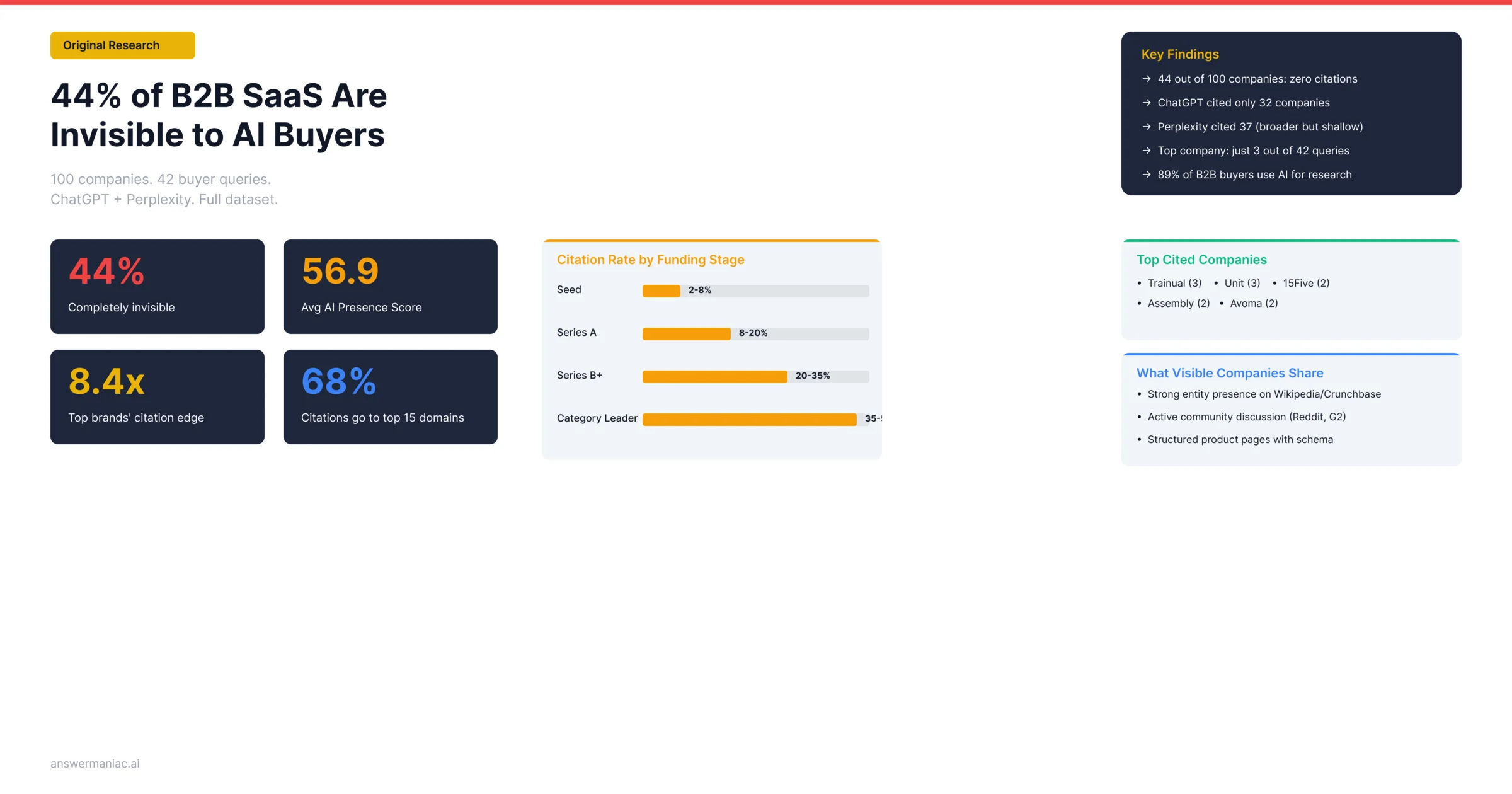
That's how many B2B SaaS companies in our study received zero citations across both ChatGPT and Perplexity when we ran 42 buyer-intent queries. Not low citations. Not a handful. Zero.
These aren't obscure startups nobody's heard of. They're funded companies with websites, content teams, and marketing budgets. They're running Google Ads. They're publishing blog posts. They're doing all the things a B2B SaaS company is supposed to do.
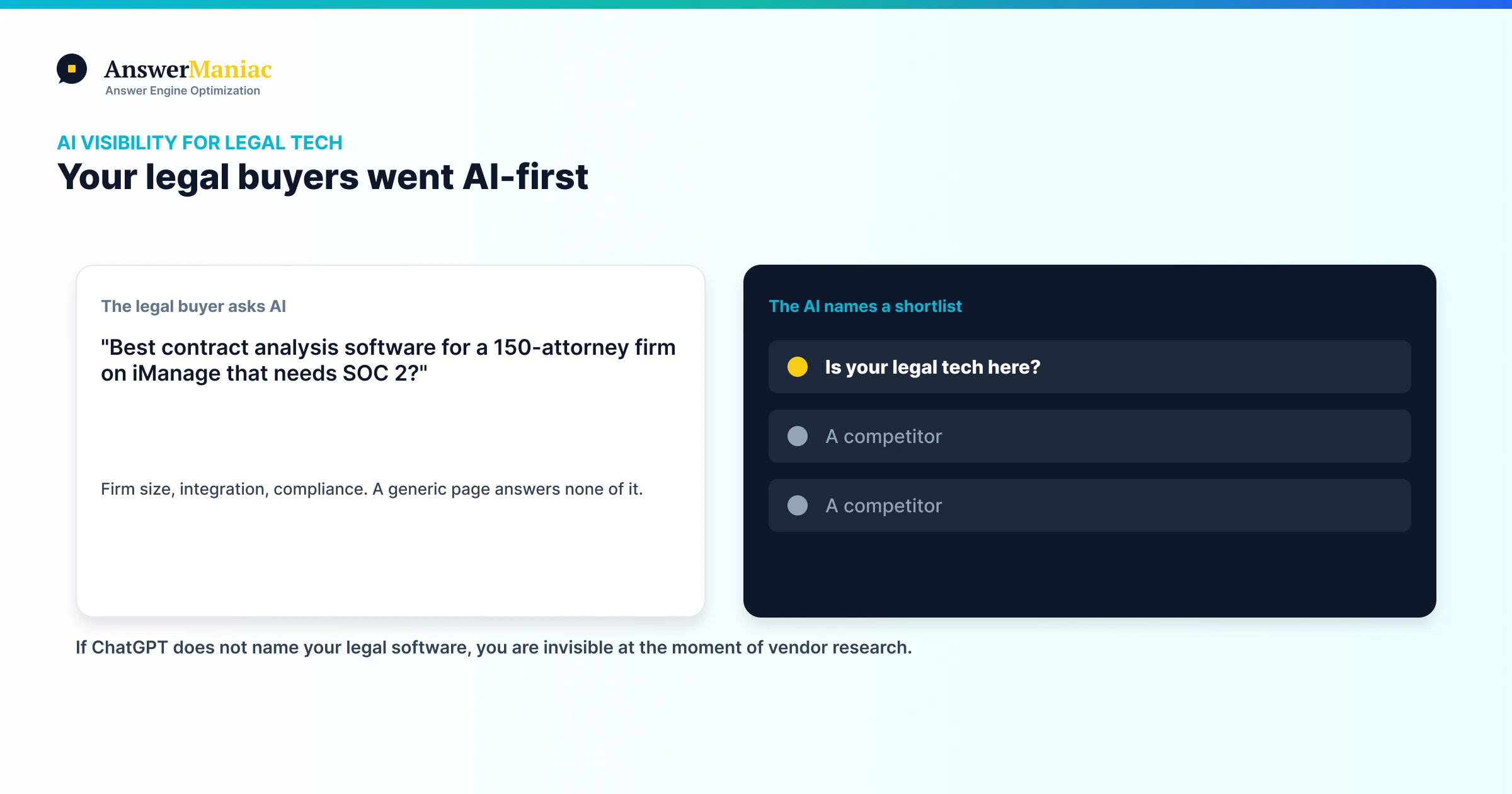
And when a buyer asks ChatGPT "what's the best HR software for mid-size companies" or tells Perplexity to "compare expense management tools for startups," those 44 companies don't show up. At all.
Meanwhile, 89% of B2B buyers now use AI tools during vendor research. And 17% of B2B SaaS discovery happens through AI-generated answers, up from roughly 4% a year ago.
The gap between companies that show up in AI answers and companies that don't is already shaping pipeline. Most companies haven't noticed yet.
What We Tested
We selected 100 B2B SaaS companies across categories like HR tech, fintech, sales enablement, project management, and expense management. Mix of Seed through Series C, plus a handful of category leaders for calibration.
For each company's category, we wrote 42 buyer-intent queries. These weren't generic. They mirrored how real buyers talk to AI: "best [category] software for [use case]," "compare [tool A] vs [tool B]," "which [category] tools integrate with Slack." The kind of prompts that show purchase intent.
We ran every query on ChatGPT and Perplexity, recorded every citation, and matched citations back to the 100 companies in our dataset.
Full methodology and the raw CSV dataset are available at /research/b2b-saas. You can download the data and run your own analysis.
Key Findings
Finding 1: The Median B2B SaaS Company Gets Zero AI Citations
This is the headline stat, and it's worth sitting with for a second. When you line up all 100 companies by total citations across both engines, the middle company has zero. More than half the dataset is invisible.
| Metric | Value |
|---|---|
| Total companies tested | 100 |
| Companies with zero citations (either engine) | 44 |
| Companies cited by ChatGPT | 32 |
| Companies cited by Perplexity | 37 |
| Total ChatGPT citations | 35 |
| Total Perplexity citations | 37 |
| Maximum citations (single company) | 3 |
| Median citations per company | 0 |
Finding 2: Even Top Companies Barely Register
The highest-cited companies in our study were Trainual and Unit, each with 3 total citations out of 42 possible queries. That's a 7.1% hit rate. For context, these are the winners.
Top 5 Companies by Combined Citations:
| Company | ChatGPT Citations | Perplexity Citations | Total |
|---|---|---|---|
| Trainual | 2 | 1 | 3 |
| Unit | 2 | 1 | 3 |
| 15Five | 1 | 1 | 2 |
| Assembly | 1 | 1 | 2 |
| Avoma | 1 | 1 | 2 |
Look at those numbers. The best-performing company in our entire dataset appeared in fewer than 1 out of every 10 relevant buyer queries. That's not a rounding error or a gap you can fill with one blog post. It's a structural problem.
Finding 3: Citation Distribution Is Extremely Concentrated
This mirrors what we see across AI search more broadly. The same 15 domains capture 68% of all citations across all AI engines. Top SaaS brands earn 8.4x more AI citations than their competitors. The distribution isn't a bell curve. It's a cliff.
ChatGPT vs. Perplexity: Two Different Citation Patterns
The two engines don't behave the same way, and that matters for how you build your AI visibility strategy.
ChatGPT cited 32 out of 100 companies with 35 total citations. It tends to concentrate citations on fewer companies but cite them more than once. Pleo, Trainual, and Unit each picked up 2 ChatGPT citations, suggesting that once ChatGPT "knows" about your company, it's more likely to mention you again.
ChatGPT Top 5:
| Company | Citations |
|---|---|
| Pleo | 2 |
| Trainual | 2 |
| Unit | 2 |
| 15Five | 1 |
| Assembly | 1 |
Perplexity cited 37 out of 100 companies with 37 total citations. It spreads citations more broadly but more thinly. No company received more than 1 Perplexity citation in our study. This is consistent with how Perplexity works: it pulls real-time search results and distributes attribution across more sources.
Perplexity Top 5:
| Company | Citations |
|---|---|
| 15Five | 1 |
| Aligned | 1 |
| Assembly | 1 |
| Avoma | 1 |
| Breezy HR | 1 |
The practical takeaway: optimizing for one engine isn't enough. ChatGPT rewards depth and repeated brand signals in training data. Perplexity rewards fresh, well-structured content that ranks in real-time search. Different mechanisms, different playbooks.
What Top-Cited Companies Have in Common
We dug into the companies that did get cited to figure out what separated them from the 44 that got nothing. Three patterns emerged.
1. Strong entity presence across multiple sources.
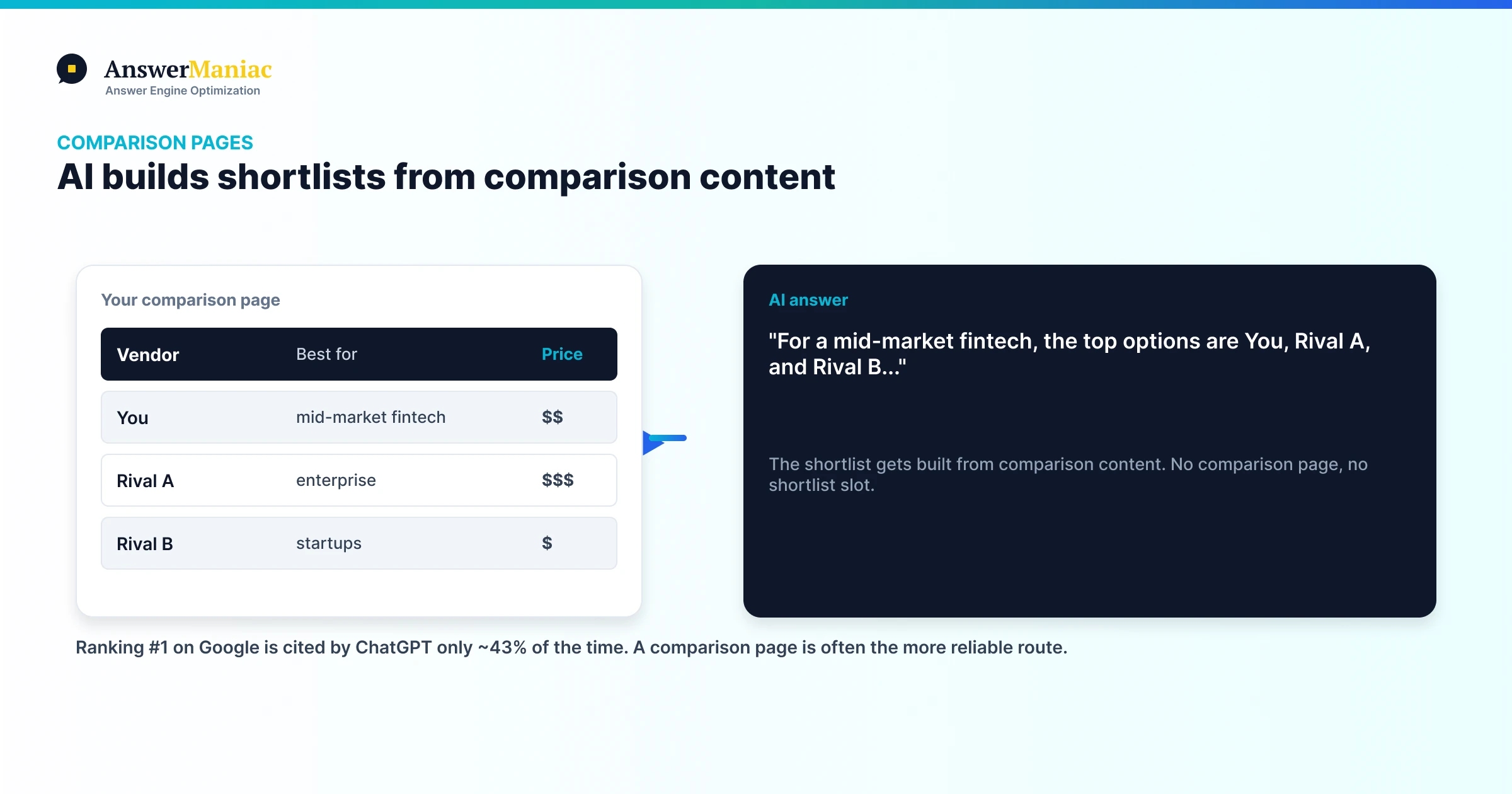
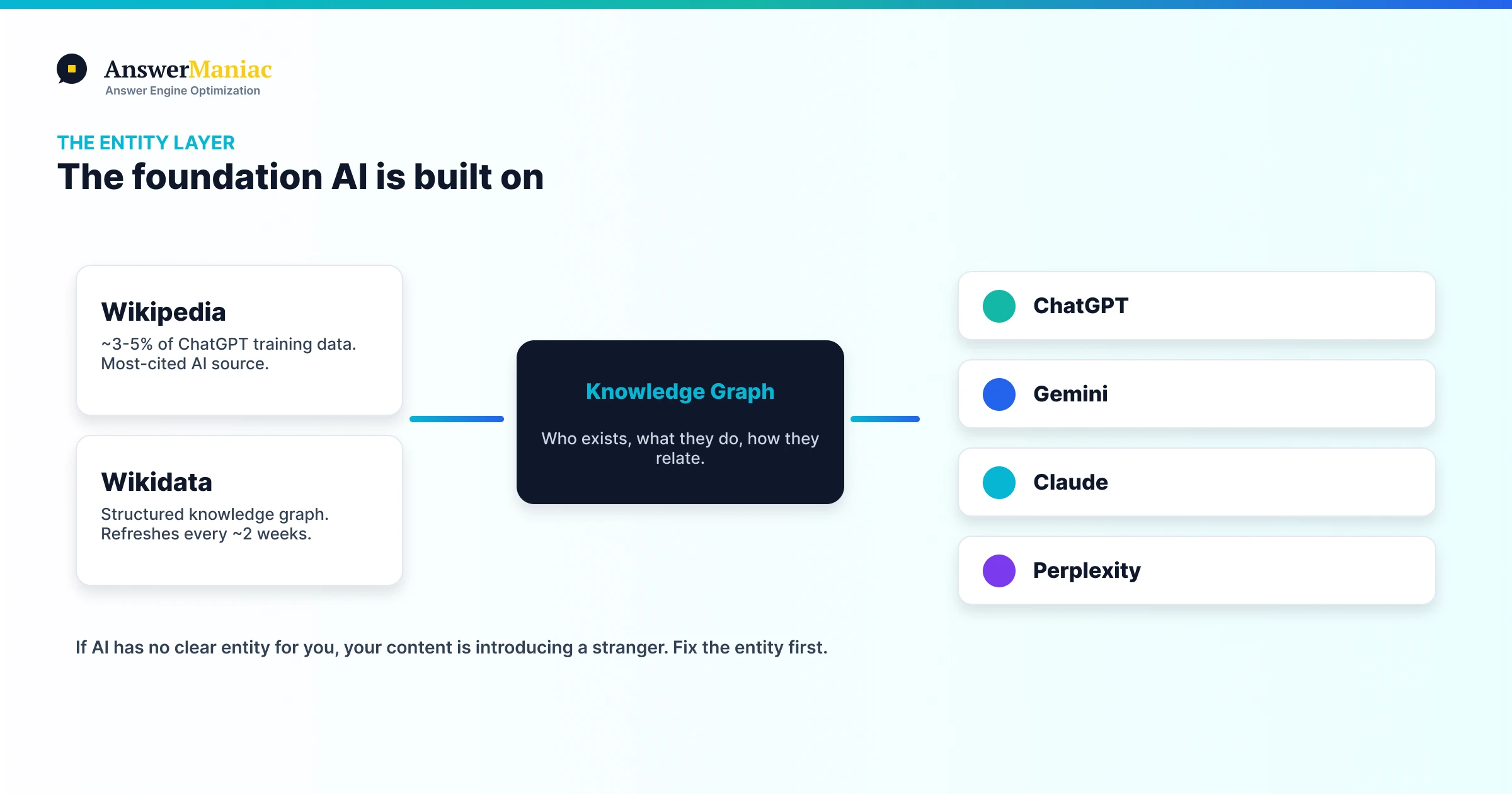
Companies like Trainual and 15Five appear consistently on review sites (G2, Capterra), comparison articles, industry publications, and their own well-structured content. They've built what we call entity coherence: AI engines find consistent information about them across enough sources to feel confident citing them.
2. Content that directly answers buyer queries.
The cited companies tend to have pages structured around specific buyer questions. Not vague thought leadership. Not keyword-stuffed landing pages. Actual answers to the questions buyers ask AI tools.
3. Third-party validation.
Almost every cited company had meaningful presence on third-party review platforms and industry roundup articles. The companies that only had their own website and blog? Rarely cited.
This tracks with our broader research on GEO vs. SEO strategies. Traditional SEO gets you ranking in Google. But AI citation requires a different kind of authority signal: one built on entity recognition and cross-source consensus.
What Invisible Companies Are Missing
The 44 companies with zero citations weren't necessarily doing anything wrong by traditional marketing standards. Many had decent websites, active blogs, and running ad campaigns.
But they shared common gaps:
No structured data. Most had minimal or no schema markup. No FAQ schema, no Organization schema, no structured product data. AI engines use structured data to understand what a company does and when to cite it.
Thin third-party footprint. Their brand mentions existed mostly on their own properties. Few reviews, minimal coverage on comparison sites, limited presence in community discussions on Reddit or industry forums.
Content built for Google, not AI. Their blog posts were optimized for keyword rankings, not for answering the specific questions that buyers ask AI tools. There's a real difference, and we break it down in our AEO vs. GEO comparison.
Weak entity signals. When we checked, many of these companies didn't have consistent NAP (name, address, product) information across the web. AI engines couldn't reliably connect mentions to a single entity.
Look, I'll be honest. When we started this research, I expected the numbers to be bad. I didn't expect the median to be zero. We've been talking to SaaS founders about AI visibility for months, and most assume they're showing up in at least some AI answers. The data says otherwise.
The Funding Stage Correlation
One pattern in the data worth calling out: citation rates correlate strongly with company stage.
| Stage | Typical AI Citation Rate |
|---|---|
| Seed | 2-8% |
| Series A | 8-20% |
| Series B+ | 20-35% |
| Category leaders | 35-50% |
This isn't surprising. More funding usually means more content, more PR, more review site presence, more third-party mentions. All the signals AI engines use to decide what to cite.
But it also means early-stage companies have a compounding disadvantage. If buyers are increasingly discovering software through AI, and AI doesn't know your company exists, you're losing pipeline to competitors who got there first.
The average AI Presence Score across B2B SaaS sits at 56.9 out of 100. For context, the DerivateX benchmark study independently found the same 44% invisibility rate across their sample. This isn't an outlier finding. It's the baseline reality.
What This Means for B2B Marketers
The shift is already happening. 17% of B2B SaaS discovery now flows through AI-generated answers, up from 4% a year ago. That number's going one direction.
Companies that build AI visibility now will have a structural advantage. Companies that wait will find the gap harder to close, because AI engines build on historical data and established entity signals. The rich get richer.
Three things you can do right now:
1. Run an AI search audit. Query ChatGPT, Perplexity, and Gemini with the buyer-intent prompts your customers actually use. See where you show up and where you don't. We publish our full research methodology if you want to replicate our approach.
2. Fix the foundation. Schema markup. Entity consistency across the web. Structured content that directly answers buyer questions. This is the technical baseline.
3. Build citation-worthy content. Not content that ranks. Content that gets cited. There's a difference. It's built on information gain, not keyword volume.
We use The ANSWER Framework (Audit, Navigate, Structure, Write, Earn, Refine) to systematically build AI visibility for B2B companies. The full breakdown of how it maps to these findings is in our B2B SaaS research hub.
Frequently Asked Questions
What is B2B SaaS AI visibility?
B2B SaaS AI visibility measures how often a software company gets cited or recommended when buyers use AI tools like ChatGPT, Perplexity, Gemini, or Copilot to research vendors. It's distinct from traditional search visibility because AI engines use different signals to decide what to cite: entity recognition, cross-source consensus, and structured data, rather than just backlinks and keyword rankings.
How do you measure an AI visibility score?
We measure AI visibility by running buyer-intent queries across multiple AI engines and tracking whether a company receives a citation. The score combines citation frequency, citation consistency across engines, and the competitiveness of the queries where citations occur. A higher score means buyers are more likely to see your company when they ask AI for vendor recommendations.
Why do so many B2B SaaS companies have zero AI citations?
Most B2B SaaS companies built their marketing for Google search, not AI engines. AI citation requires different signals: strong entity presence across third-party sources, structured data markup, content that directly answers specific buyer questions, and consistent brand information across the web. Without these signals, AI engines don't have enough confidence to cite a company.
What's the difference between AI visibility and traditional SEO?
Traditional SEO optimizes for ranking in Google search results. AI visibility optimizes for being cited in AI-generated answers. The overlap exists, but the mechanics differ. AI engines weigh entity authority, source diversity, and content structure more heavily than traditional ranking factors. A company can rank well in Google and still be invisible in ChatGPT. See our full GEO vs. SEO comparison for a deeper breakdown.
How long does it take to improve AI visibility?
Based on our work with B2B SaaS companies, measurable improvement in AI citation rates typically takes 60 to 90 days for foundational changes (schema, entity optimization, content restructuring). Sustained citation growth usually requires 4 to 6 months of consistent execution. Companies starting from zero citations generally see initial results faster than companies trying to increase from a low baseline to category-leader levels.
What AI search benchmarks should B2B SaaS companies track?
Track citation rate (what percentage of relevant queries cite your company), citation share (your citations vs. competitors), engine coverage (which AI engines cite you), and query coverage (which types of buyer queries trigger your citations). Our research hub publishes updated benchmarks quarterly.
This research was conducted by the AnswerManiac team in July 2026. The full dataset, including all 100 companies, 42 queries, and per-engine citation results, is available as a downloadable CSV at /research/b2b-saas. Methodology, query selection criteria, and limitations are documented alongside the dataset.
Get AEO Insights Weekly
Join 500+ B2B marketers getting AI visibility tactics every Tuesday.
Ready to Get Your Brand Cited by AI?
See how your competitors show up in ChatGPT, Perplexity, and Gemini — and what it would take to get recommended.