GEO vs SEO: The Complete Comparison for B2B Marketers
GEO vs SEO explained with data from 376 B2B companies. Learn how generative engine optimization differs from traditional SEO and why you need both in 2026.
Quick Answer
68% of US Google searches now end without a click (SparkToro, Jan-Apr 2026). That number isn't a trend line you can ignore. It's the baseline.
Meanwhile, ChatGPT has 883 million monthly users. Perplexity's query volume grew 370% year over year. Google AI Overviews now appear in 48% of all queries, up from 34.5% in December 2025. And Google AI Mode, with its 1 billion-plus user base, has a 93% zero-click rate.
Your B2B buyers are getting answers from AI before they ever see a search results page. The question isn't whether you need GEO. It's whether you can afford to treat SEO and GEO as separate strategies when they share most of the same foundation.
We analyzed 376 B2B companies across 14 verticals to understand where these strategies overlap and where they diverge. This is the full breakdown.
What Is the Difference Between GEO and SEO?
GEO optimizes your content to be cited inside AI-generated answers. SEO optimizes your content to rank in traditional search results.
That's the one-sentence version. The reality is more nuanced.
Traditional SEO has spent two decades refining how to rank pages on Google. Keyword research, backlink acquisition, technical optimization, content quality. The goal: get your page to position one and earn the click.
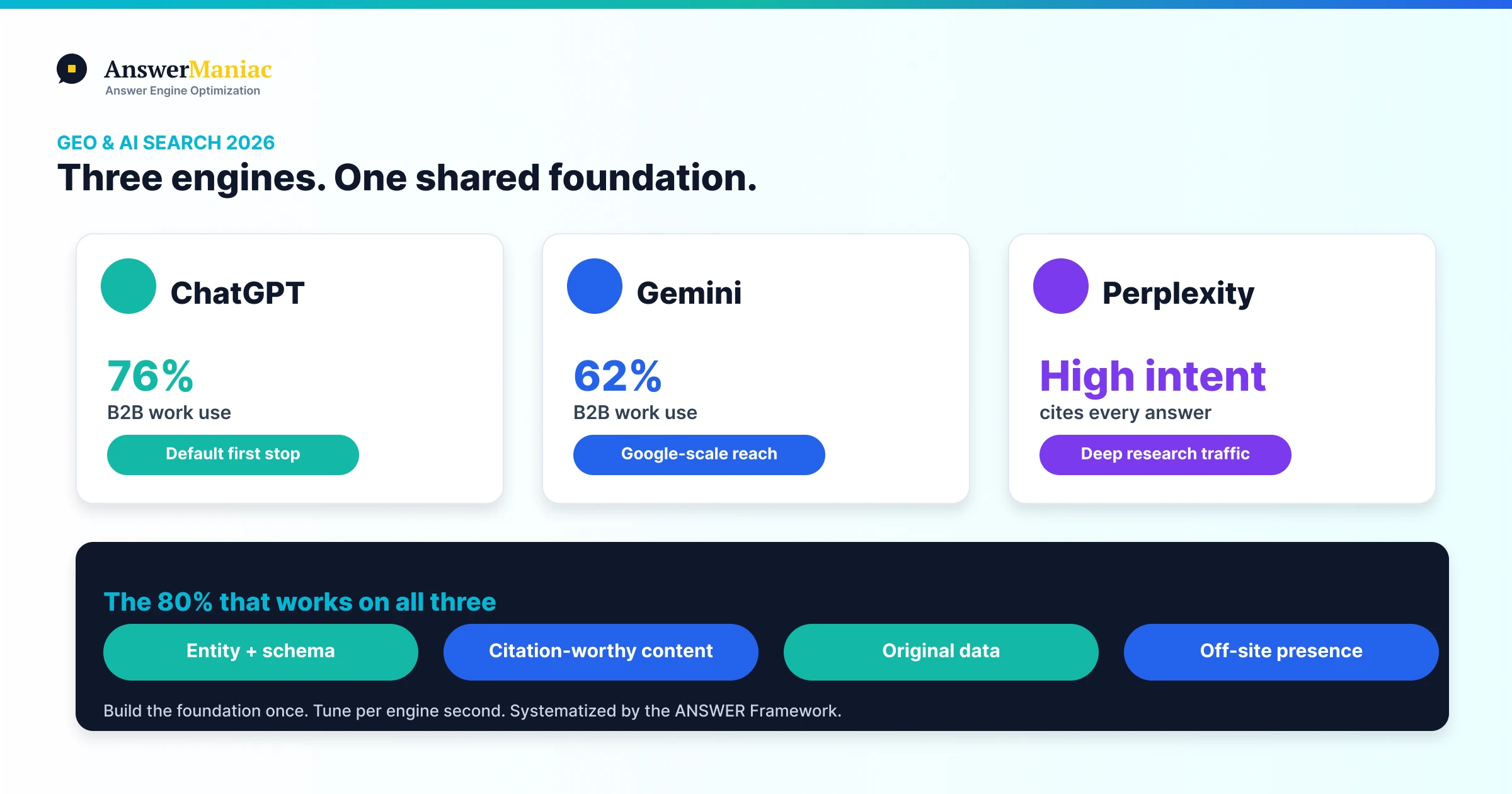
GEO shares that foundation but extends it into a different environment. Generative Engine Optimization targets systems like ChatGPT, Perplexity, Google AI Overviews, Gemini, and Microsoft Copilot. These systems don't rank pages in a list. They synthesize answers from multiple sources and cite the ones they trust most.
The distinction matters because the reward mechanism is different. In SEO, you win by being the highest-ranked link. In GEO, you win by being the most trusted source the AI reaches for when constructing its response.
Brands optimized for GEO see up to 3x more citations in AI answers than those relying on traditional SEO alone, according to Search Engine Journal's 2026 analysis.
Our research across 376 B2B SaaS companies found that 44% are completely invisible to AI buyers. Not ranked low. Not mentioned with caveats. Invisible. That's a market reality traditional SEO metrics won't flag for you.
How Do GEO and SEO Compare Across Key Factors?
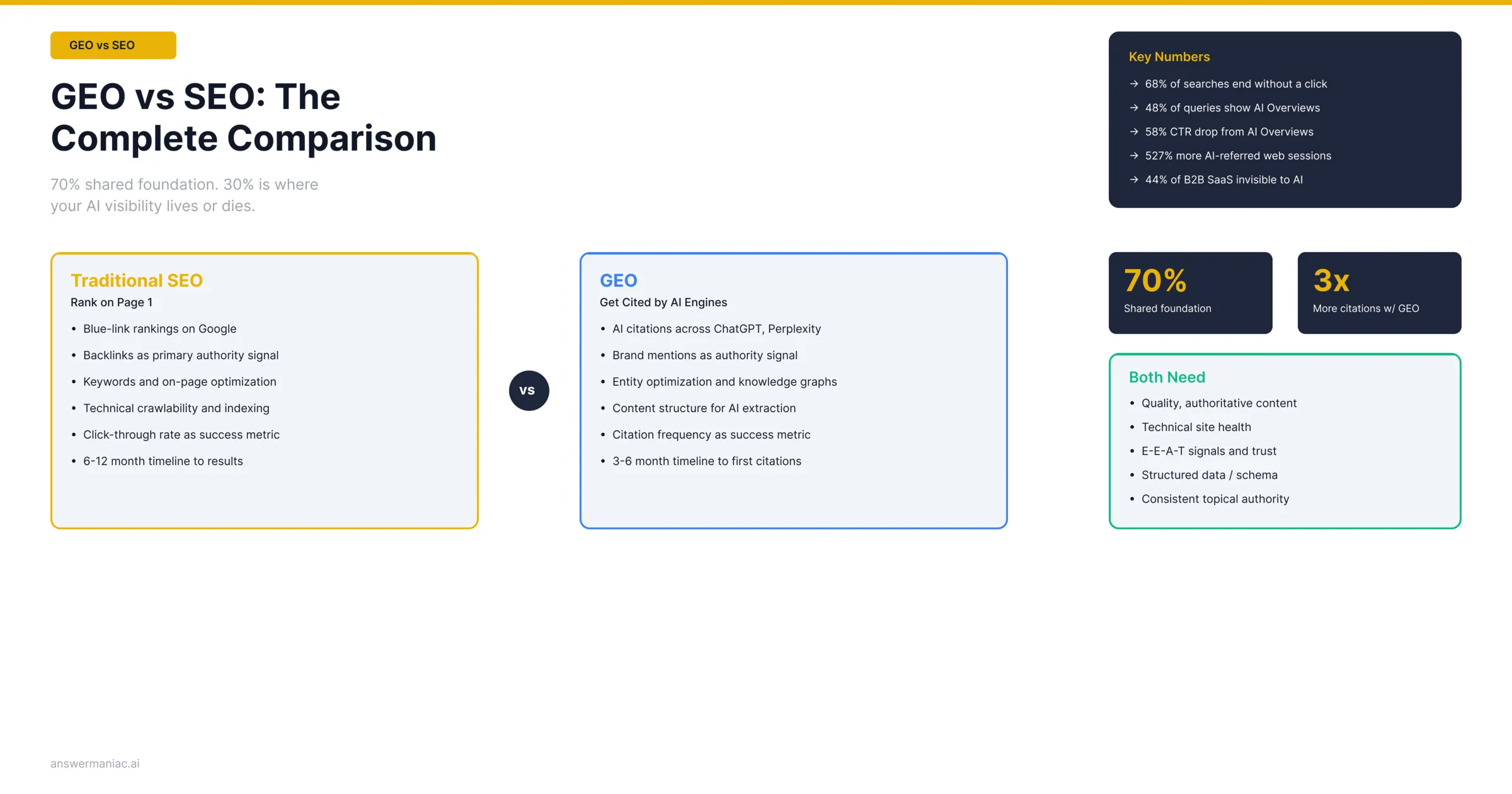
GEO and SEO overlap significantly in their technical and content quality requirements but diverge in their goals, metrics, and authority signals.
The comparison below breaks down where each strategy operates and where both converge. This is drawn from our work with B2B companies across fleet management, RegTech, franchise development, HR tech, and cybersecurity verticals.
| Factor | Traditional SEO | GEO | Both |
|---|---|---|---|
| Primary Goal | Rank #1 in organic results | Get cited in AI-generated answers | Increase brand visibility in search |
| Success Metric | Rankings, organic traffic, CTR | Citation frequency, AI visibility score, brand mention rate | Branded search volume, conversions |
| Content Format | Long-form, keyword-targeted pages | Entity-rich, statistic-heavy, citation-ready content | Well-structured, authoritative, original research |
| Authority Signals | Backlinks, domain authority, referring domains | Brand mentions, entity consistency, third-party validation | E-E-A-T signals, topical authority, trust |
| Technical Foundation | Core Web Vitals, crawlability, mobile-first | Schema markup, llms.txt, entity clarity, structured data | Site speed, clean architecture, proper indexation |
| Timeline to Results | 4-8 months for competitive keywords | 2-4 months for citation visibility | Ongoing (authority compounds over time) |
| Key Tools | Ahrefs, SEMrush, GSC, Screaming Frog | AI citation trackers, prompt audit tools, entity analyzers | GA4, schema validators, content quality frameworks |
One stat worth calling out: brand mentions correlate 3x more with AI visibility than backlinks do. That doesn't mean backlinks are useless for GEO. It means the weighting is different. AI systems assess whether your brand is discussed across the web, not just linked to.
Why Does GEO Matter Now for B2B Companies?
Gartner predicts a 30% drop in traditional search volume by the end of 2026. That prediction is already playing out.
Google AI Overviews reduced click-through rates for top-ranking content by 58%, according to Ahrefs data. You can rank #1 for your target keyword and still lose more than half your expected traffic because an AI Overview answered the query before anyone scrolled to your link.
The shift isn't hypothetical. Generative AI now drives 527% more web sessions than it did a year ago and converts at 4.4x the rate of traditional organic traffic. The visitors coming from AI citations aren't casual browsers. They're buyers who already have context because the AI pre-qualified your brand in its response.
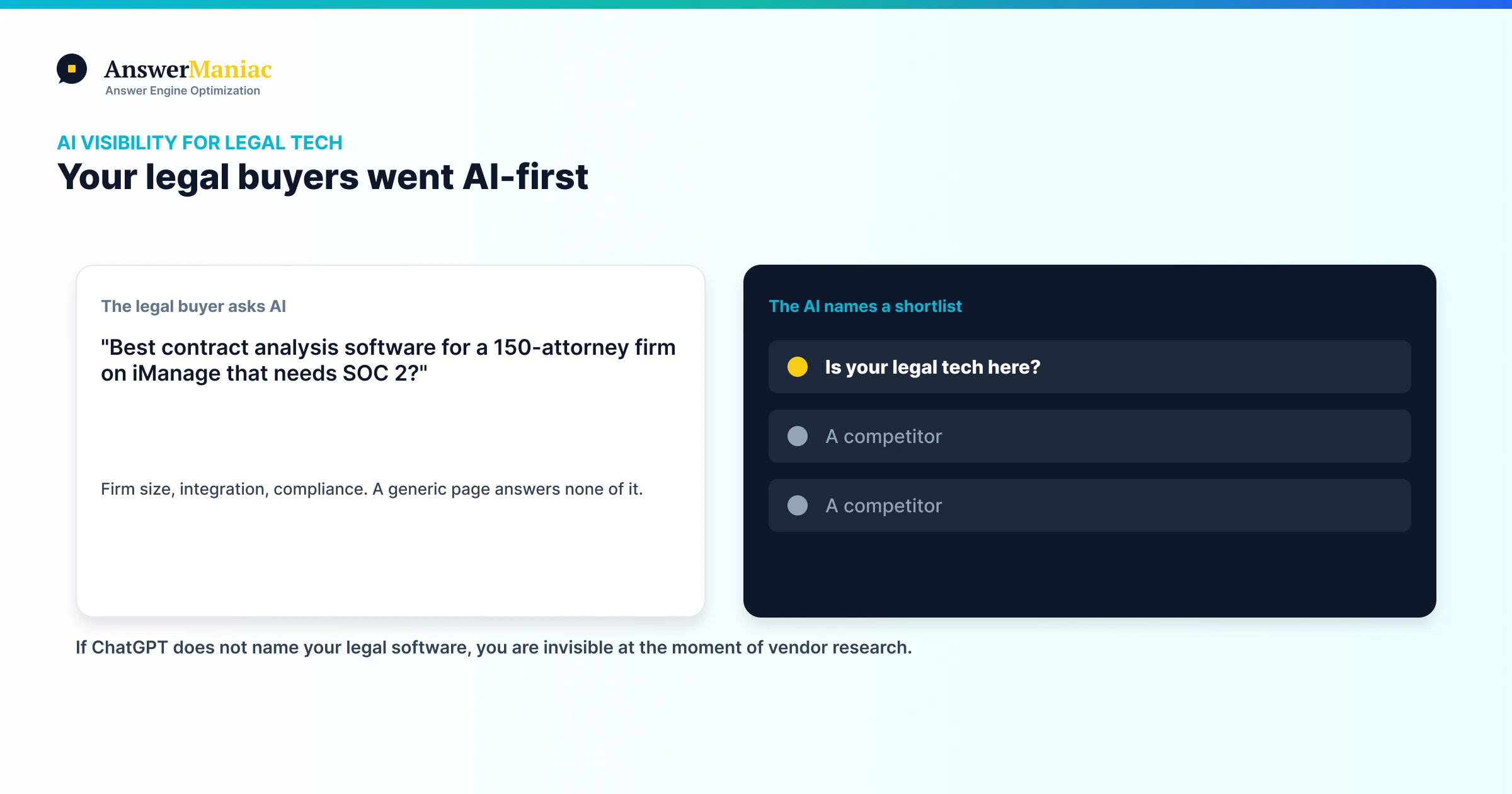
For B2B companies specifically, the stakes are higher. Your buyers are researching solutions through conversational AI queries. "Best fleet management software for mid-market companies." "RegTech platforms with SOC 2 compliance." "HR payroll solutions that integrate with SAP."
These queries go to ChatGPT and Perplexity before they go to Google. And when they do go to Google, AI Overviews intercept the intent.
If your company isn't showing up in those AI-generated answers, you're missing the top of the funnel entirely.
What Do GEO and SEO Share in Common?
About 70% of their foundation is identical. Both require technical health, quality content, and demonstrated authority.
This is where the conversation gets practical. If you're already doing SEO well, you're not starting from zero with GEO. You're building on existing infrastructure.
Technical health is table stakes for both. Fast-loading pages, clean site architecture, proper indexation, mobile responsiveness. AI crawlers like GPTBot and ClaudeBot have timeout thresholds just like Googlebot. A slow, poorly structured site gets skipped by both.
Content quality signals overlap heavily. E-E-A-T (Experience, Expertise, Authoritativeness, Trustworthiness) matters for traditional rankings and AI citations alike. Original research, clear writing, proper sourcing. AI systems prefer content that demonstrates genuine expertise because they need to avoid generating inaccurate answers.
Topical authority compounds across both channels. Building deep coverage across a subject area helps you rank organically and helps AI systems recognize your brand as a reliable source in that domain. This is where content strategy for AI visibility and traditional content clustering share the same playbook.
Schema markup serves double duty. Structured data helps Google understand your content for rich results. It also helps AI systems extract entities, relationships, and factual claims. Organization schema, FAQ schema, Article schema. All of them benefit both strategies.
Look, I'll be honest: a lot of agencies pitch GEO as if it's an entirely new discipline requiring a complete strategy overhaul. That's not accurate. The foundation is shared. The delta is specific.
Where Does GEO Diverge from Traditional SEO?
The 30% that separates GEO from SEO comes down to three areas: entity optimization, content structure for citation, and brand signal distribution.
Entity optimization goes beyond keywords. In traditional SEO, you optimize pages around target keywords. In GEO, you optimize your brand's entity presence across the web. AI systems use entity recognition and knowledge graphs to determine which brands are credible sources. Your Wikipedia presence, Crunchbase profile, G2 reviews, industry mentions, and social discussions all feed into how AI models perceive your brand.
Content structure shifts from "rank-worthy" to "citation-ready." Traditional SEO rewards comprehensive long-form content. GEO rewards content with clear, extractable claims supported by statistics and named sources. Statistics in content boost AI visibility by 25.9%, according to GEO research from the Georgia Tech team. That means a well-placed data point does more for your AI citation chances than 500 additional words of analysis.
Brand mentions matter more than backlinks for AI. Traditional SEO values backlinks as the primary authority signal. GEO values brand mentions, even unlinked ones. When your company is discussed on Reddit, referenced in industry reports, or named in comparison articles, AI systems register that as a trust signal. This is why digital PR for AI search and community-driven content strategies have become essential for GEO.
New technical requirements emerge. GEO adds the need for llms.txt files to guide AI crawlers, explicit bot access for GPTBot and ClaudeBot in robots.txt, and structured data patterns specifically designed for AI extraction. These aren't complex implementations, but they don't exist in the traditional SEO playbook.
Measurement requires new tooling. You can't measure GEO success with GA4 alone. You need AI citation tracking across ChatGPT, Perplexity, Gemini, and AI Overviews. Citation frequency, brand sentiment in AI responses, and share-of-voice within AI-generated answers are the metrics that matter. Traditional rankings and organic traffic tell you half the story.
How Should B2B Marketers Prioritize GEO vs SEO?
Don't choose one over the other. Run them as a unified strategy with GEO-specific additions layered on top of your existing SEO program.
The 70/30 overlap means most of your effort should go toward shared fundamentals. Then allocate dedicated resources to the GEO-specific elements that your SEO work doesn't cover.
Priority 1: Fix your shared foundation. Technical health, Core Web Vitals, site architecture, crawlability for all bots. Schema markup across your key pages. Content quality that meets E-E-A-T standards. This benefits both channels equally.
Priority 2: Build entity presence. Audit how AI systems currently perceive your brand. Run prompt tests across ChatGPT, Perplexity, Gemini, and Copilot for your core commercial queries. If you're not showing up, start building entity signals. Update your Wikipedia article (if eligible), claim and optimize your Crunchbase profile, and generate consistent brand mentions across industry publications, G2, Reddit, and Quora.
Priority 3: Restructure content for citation readiness. Review your top-performing pages and add clear, extractable claims. Include statistics with named sources. Use question-based headings that match conversational AI queries. Structure comparison tables that AI can easily parse. This aligns with the principles behind how AI search engines choose sources.
Priority 4: Add GEO-specific technical elements. Implement an llms.txt file. Ensure GPTBot and ClaudeBot aren't blocked. Add Organization and FAQ schema if you haven't already. These are small implementations with outsized impact on AI discoverability.
Priority 5: Measure what matters. Set up AI citation analytics alongside your existing SEO dashboards. Track citation frequency monthly. Monitor brand mention sentiment in AI responses. Compare your AI visibility against competitors using prompt audits. Traditional SEO metrics and AI visibility metrics together give you the full picture.
What Does GEO Marketing Look Like in Practice?
GEO marketing means adapting your content, PR, and technical strategy to earn citations from AI systems. Here's what it looks like for a B2B company.
A compliance management platform we studied was ranking on page one for 23 target keywords. Strong SEO. Good traffic. But when we ran their brand through ChatGPT, Perplexity, and Gemini for buyer-intent queries like "best compliance management software for mid-market," they appeared in zero AI-generated responses.
Their competitor, with weaker domain authority and fewer backlinks, appeared in 4 out of 5 AI responses. The difference? The competitor had consistent brand mentions across G2, Reddit, and Gartner peer reviews. They published original benchmark data that AI systems cited. They had proper entity optimization across their digital footprint.
That's the gap GEO marketing addresses. Ranking in Google and being invisible to AI systems are no longer contradictory outcomes. They're increasingly common ones.
For a zero-click SEO strategy to work in 2026, it must account for both traditional SERP features and AI-generated responses. The content that wins in both environments shares common traits: clear structure, verifiable claims, strong entity signals, and a brand presence that extends beyond your own domain.
What Is the Role of Content in GEO vs SEO?
Both strategies depend on high-quality content, but the definition of "quality" has expanded.
For SEO, quality means comprehensive coverage, good user experience, proper keyword targeting, and enough depth to outrank competing pages. The content serves the searcher who clicks through.
For GEO, quality means all of the above plus citation readiness. Your content needs to contain specific, extractable claims that AI systems can confidently reference. Vague statements like "our platform helps companies improve compliance" don't get cited. Specific ones like "our platform reduced audit preparation time by 67% across 140 mid-market clients" do.
This is where the distinction between AEO and GEO becomes practical. AEO focuses on structuring content for direct answer extraction. GEO focuses on making your content credible enough that AI systems cite it as a source. Both feed into how AI decides which sources to reference.
Content types that perform well for GEO:
- Original research with named data points. AI systems prefer citing primary sources. Publish benchmarks, survey results, or analysis with specific numbers.
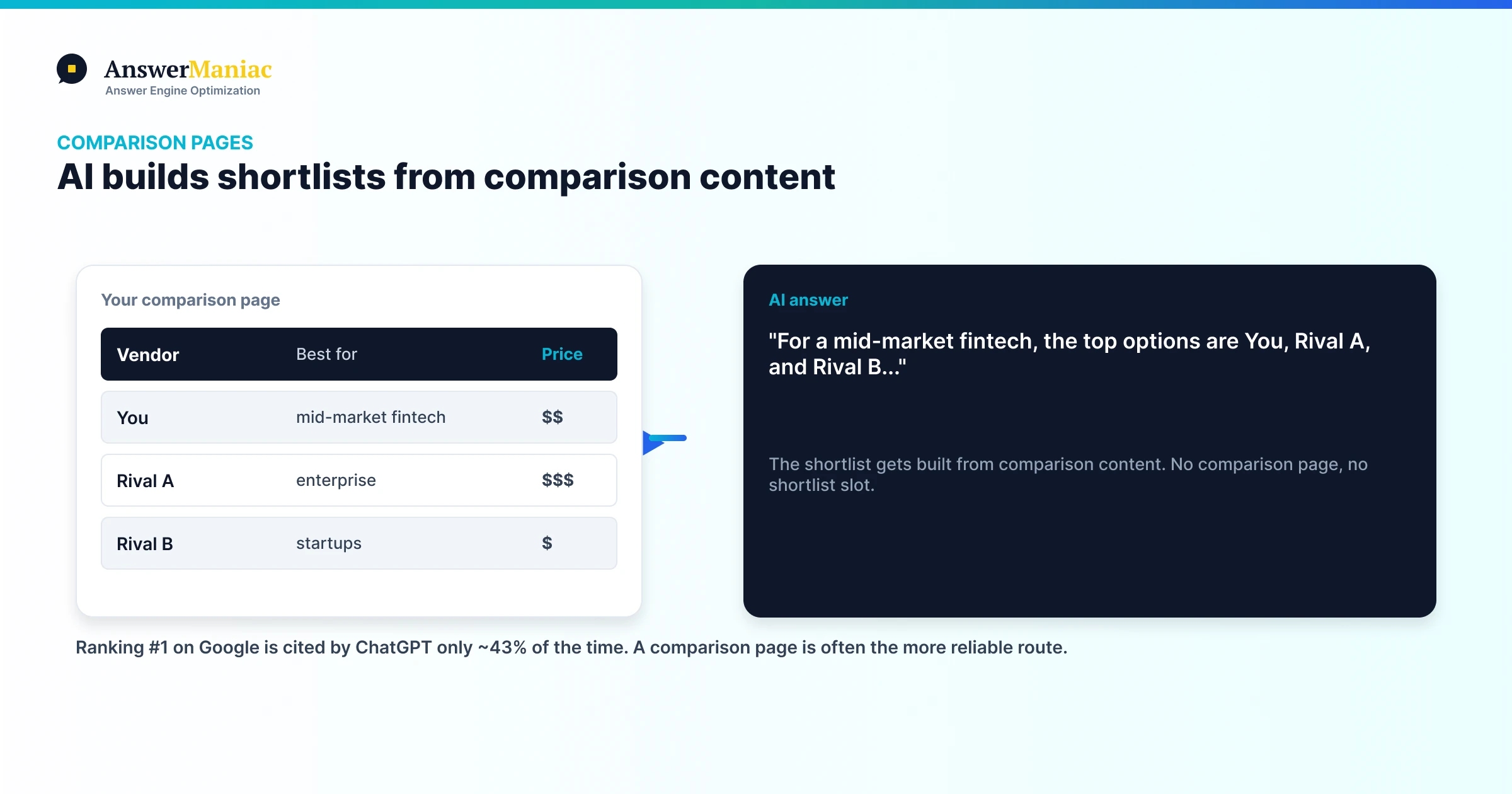
- Comparison content with structured tables. AI can parse tabular data efficiently and often reproduces comparisons in its answers.
- Expert-attributed claims. Content with named authors, credentials, and first-person expertise signals trustworthiness to AI models.
- FAQ sections with direct answers. Question-based formats match how users query AI chatbots, making your content structurally aligned with AI retrieval patterns.
- Community-referenced insights. Referencing discussions from Reddit, G2, Quora, or industry forums signals community consensus, which AI systems weigh as a validation signal.
Statistics in content boost AI visibility by 25.9%, but only when they're specific, sourced, and relevant. Dropping unsourced numbers doesn't help. Every stat should be traceable to a named source.
How Will GEO and SEO Evolve Together?
The convergence is accelerating. Google's own AI integration means that traditional SEO and GEO are increasingly targeting the same interface.
Google AI Overviews appearing in 48% of queries means that traditional organic results and AI-generated answers coexist on the same search page. Optimizing for one without the other leaves visibility on the table.
ChatGPT with 883 million monthly users and a 60.7% market share among AI chatbots has become a discovery channel. Perplexity, with 1 billion monthly queries and 370% year-over-year growth, is the fastest-growing search alternative. These platforms are pulling from the same content ecosystem that Google indexes.
The companies that win over the next 12-18 months will be the ones that recognize GEO and SEO as complementary layers of the same visibility strategy. Not competing approaches. Not sequential initiatives. A single framework that addresses both traditional and AI search surfaces.
For a deeper look at this integrated approach, see our guide on AI search engine optimization and the broader search everywhere optimization strategy that accounts for visibility across every discovery surface.
The ANSWER Framework: AnswerManiac's Approach to GEO + SEO
We built The ANSWER Framework specifically because B2B companies needed a structured methodology that treats GEO and SEO as one unified strategy. Six phases, each building on the last.
Audit. Map your current AI visibility alongside traditional SEO performance. Run prompt tests across all major AI platforms. Identify where you're cited, where you're invisible, and where competitors are filling the gap. This is the AI visibility audit that most agencies skip because they don't have the tooling.
Navigate. Prioritize opportunities based on commercial intent and competitive gaps. Not every keyword deserves a GEO strategy. Focus on the queries your buyers actually ask AI systems.
Structure. Implement the technical and content architecture that serves both SEO and GEO. Schema markup, entity optimization, llms.txt, site structure, and content frameworks designed for citation readiness.
Write. Create content that ranks organically and earns AI citations. Original data, expert attribution, extractable claims, and the structural patterns AI systems favor.
Earn. Build brand signals beyond your own domain. Digital PR, community presence, third-party mentions, review platform visibility. This is where GEO-specific authority building happens.
Refine. Measure, iterate, and compound. AI visibility isn't static. Citation patterns shift as models update. Monthly monitoring and quarterly strategy adjustments keep your brand in the AI conversation.
The ANSWER Framework is detailed in our full methodology breakdown. It's how we've helped B2B companies in overlooked verticals move from invisible to cited across ChatGPT, Perplexity, Gemini, and Google AI Overviews.
To see where your company currently stands, run a free AI visibility audit and get a baseline score across all major AI platforms.
FAQ
What is generative engine optimization (GEO)?
Generative Engine Optimization is the practice of optimizing your digital presence to be cited inside AI-generated answers from systems like ChatGPT, Perplexity, Google AI Overviews, Gemini, and Microsoft Copilot. Unlike traditional SEO, which targets organic rankings, GEO targets citation inclusion through entity optimization, structured data, brand mention signals, and citation-ready content formats. The goal is to become the trusted source that AI systems reference when constructing their responses.
Is GEO replacing SEO?
No. GEO and SEO share approximately 70% of their foundation. Technical health, content quality, E-E-A-T, and topical authority matter for both. GEO adds specific requirements around entity optimization, brand mention distribution, and AI-specific technical elements like llms.txt. The strategies are complementary, not competitive. Companies that perform well in traditional SEO have a head start on GEO because the foundational signals already exist.
How do I know if my company needs GEO?
Run a simple test. Open ChatGPT, Perplexity, and Gemini. Type commercial queries that your buyers would ask, such as "best [your category] software for [your market]." If your brand doesn't appear in the AI-generated answers but your competitors do, you need GEO. Our research across 376 B2B SaaS companies found that 44% are completely invisible to AI buyers despite having solid SEO performance.
What tools do I need for GEO?
You need AI citation tracking tools to monitor mentions across ChatGPT, Perplexity, Gemini, and AI Overviews. Prompt audit frameworks for regular testing. Entity analysis tools to assess your brand's knowledge graph presence. Schema validators for structured data. And your existing SEO stack (Ahrefs, SEMrush, GSC) for the shared foundation. See our guide on AI visibility tracking tools for specific recommendations.
How long does GEO take to show results?
Citation visibility improvements typically appear within 2-4 months, faster than traditional SEO timelines for competitive keywords. Entity optimization and brand mention signals take 3-6 months to compound meaningfully. Technical GEO implementations like schema markup and llms.txt can show impact within weeks. The timeline depends on your starting point. Companies with strong existing SEO and brand presence see faster GEO results because the foundational signals already exist.
Can a B2B SaaS company do GEO without an agency?
Yes, especially for the technical and content elements. Implementing schema markup, creating an llms.txt file, restructuring content for citation readiness, and running monthly prompt audits are all executable in-house. The harder part is entity building and brand mention distribution across third-party platforms, which often requires a dedicated digital PR and community strategy. Our article on AI SEO agency vs in-house breaks down where each approach makes sense.
Related Articles
- AEO vs GEO: Which Strategy Does Your Business Need?
- Zero-Click SEO in 2026: Winning When Users Never Leave the AI Answer
- AI Search Engine Optimization: The New SEO for 2026
- The ANSWER Framework: AEO Methodology for AI Visibility
- How AI Search Engines Choose Sources
- Our B2B SaaS AI Visibility Research
Get AEO Insights Weekly
Join 500+ B2B marketers getting AI visibility tactics every Tuesday.
Ready to Get Your Brand Cited by AI?
See how your competitors show up in ChatGPT, Perplexity, and Gemini — and what it would take to get recommended.