AI SEO Agency vs In-House: Cost & ROI Truth
AI SEO Agency vs In-House: What Actually Moves the Needle (Cost & ROI Breakdown) — we break down true costs, returns, and growth potential.
Quick Answer
For most mid-sized B2B companies, an AI SEO agency delivers faster results at lower total cost. Agencies run $24,000 to $240,000 per year with tools included and zero overhead, while building an in-house team costs $120,000 to $300,000 annually once you add salaries, benefits, software, and training. Agencies typically show measurable ROI within three to six months. In-house teams need 18 to 24 months to break even. The strongest long-term returns come from a hybrid approach: the agency handles technical audits, knowledge graph optimization, and competitive analysis while your internal team produces brand-authentic content using an AI-first content strategy built around direct answers and structured data.
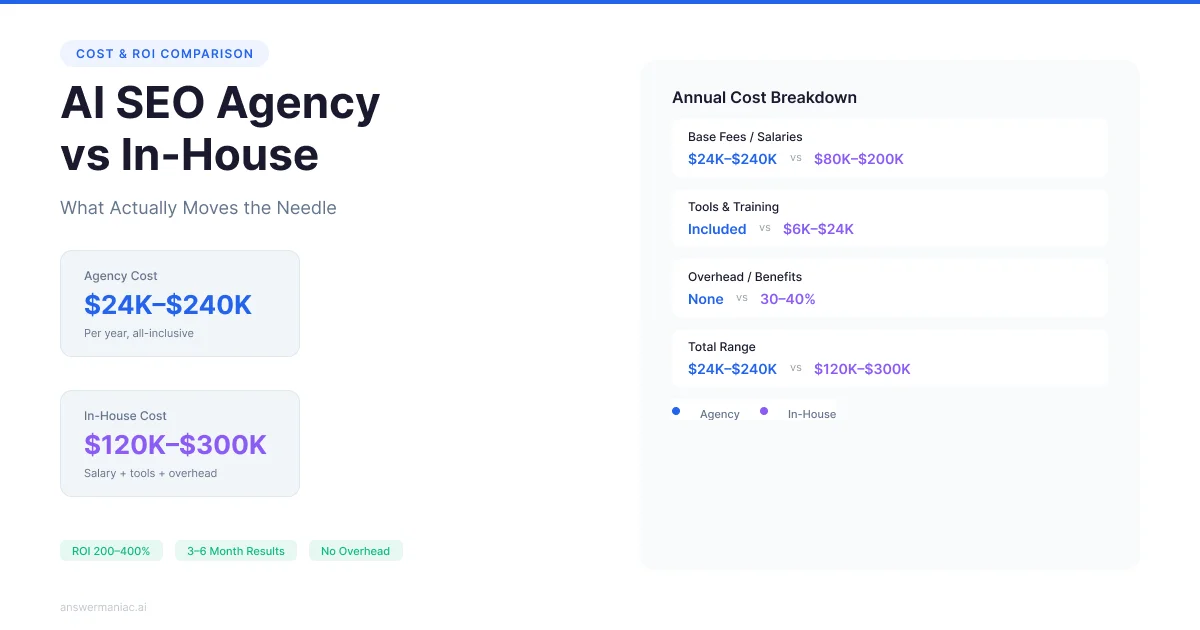
An AI SEO agency typically costs $24,000--$240,000 per year annually, depending on company size, scope of services, and region. By comparison, an in-house team can cost $120,000 to $300,000 per year annually when you add up salaries, software, and 30-40% in overhead costs.
This cost gap affects ROI, speed, and risk, as Google adds new AI search tools. Budgets are under a microscope now. The choice between an agency and building a team internally comes down to one thing: which option drives more measurable revenue for your business.
Keep reading to see further explanation.
Navigating the In-House vs. Agency AI SEO Landscape: Insights for Businesses in 2026
- Top AI SEO agencies often report 200--400% ROI within 3--6 months, based on mid-sized e-commerce case studies tracking revenue per organic visitor.
- True in-house costs frequently exceed $150,000 per specialist annually, including benefits, tools, and training.
- Hybrid SEO models usually deliver the highest long-term ROI by combining agency expertise with internal brand control.
These points highlight the core choices and trade-offs when deciding between agency, in-house, or hybrid AI SEO strategies.
What's the Real Cost Difference Between an AI SEO Agency and In-House Team?
Hiring an AI SEO agency costs $24,000--$240,000 per year. Building an in-house team with 1--2 specialists runs $120,000--$300,000 per year, including salaries, software, and benefits.
Clutch reports that most mid-sized companies spend $5,000--$15,000/month (Clutch.co 2025 averages) on agency services that cover everything from strategy to technical SEO and reporting. The perks? No payroll taxes, no benefits to handle, and no time lost hunting for the right person.
On the flip side, bringing on an SEO specialist yourself isn't cheap. Ematic Solutions points out salaries between $80,000--$170,000 (Ematic Solutions/Glassdoor), plus about 30--40% more for benefits and overhead. Don't forget tool subscriptions that can add hundreds or even thousands more per month. Plus, recruiting can drag on for months, slowing your SEO results and giving competitors a leg up.
| Cost Factor | AI SEO Agency (Annual) | In-House (1--2 Specialists) |
|---|---|---|
| Base Fees / Salaries | $24K--$240K | $80K--$200K* |
| Tools & Training | Included | $6K--$24K |
| Overhead / Benefits | None | 30--40% |
| Total Range | $24K--$240K | $120K--$300K |
US avg (Glassdoor); 40--60% lower ID/Bandung
Often missed costs are hiring fees, overlapping tools, training, and the time lost waiting for rankings to improve. For big companies, a fixed in-house team can offer long-term control. But for most growing businesses, an AI SEO agency gives you quicker results and keeps spending more flexible.
Which Delivers Stronger ROI (2026 Trends)?
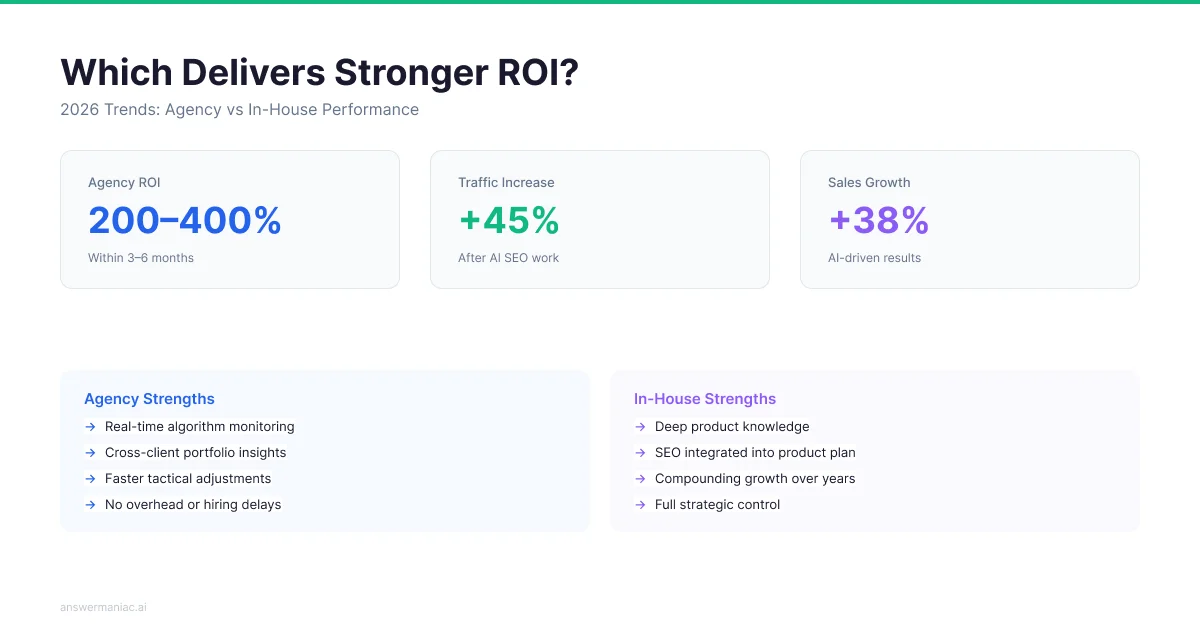
Why do agencies often win the short game? AI SEO agencies monitor real-time keyword ranking changes, algorithm updates, and competitor movements across their entire client portfolio, allowing rapid tactical adjustments. When search engines change their rules (which they do a lot), agencies catch it early and adjust quicker.
"If you consider salaries, benefits, ongoing training, and the purchase of pricey SEO tools, the costs can easily surpass what it would cost to outsource to an agency. Efficiency and Cost Savings: Compared to building and training a large in-house SEO team, AI SEO agencies provide advanced expertise without overhead." - Techmagnate
Long-term investment in an in-house team can generate steady, meaningful growth. A team that works with the same systems day in and day out builds a genuine, intuitive feel for SEO. They add SEO into the product plan and sales plan. That kind of deep integration is what usually drives steady, meaningful growth that compounds over the years.
Harvard Business Review says marketing should link to revenue. So, ROI isn't just about traffic; it's about how that traffic turns into real pipeline impact. Understanding the right AI search ROI metrics helps teams connect organic visibility with measurable revenue outcomes.
The data backs it up. Some firms saw 45% more traffic and 38% more sales after AI SEO work. This shows AI isn't just another piece of software you use. It becomes a core component of how the entire operation works.
What Are the Pros and Cons of Each Model?
Engaging an AI SEO agency provides rapid deployment of technical SEO audits, AI-driven content strategy, and entity optimization, leveraging expert teams without internal hiring. The downside is you lose some control.
Building your own team keeps everything in-house and true to your brand's vision. But it's more expensive, and you have to find people with the right skills and mindset.
Hiring an agency
The good: You get to use their specialized tools. You also benefit from their experience working with many different clients. They can start quickly. It's common to see the first results in just a few months.
The bad: An outside agency won't ever know your brand's unique voice. Communication can be slow or messages get mixed up. If the contract ends or the agency's priorities change, your project can just stop.
Building an in-house team
The good: The biggest advantage is that your team really learns your product and your customers inside out. You also have complete control over the strategy and direction. Every skill they learn stays with your company.
The bad: It's a big, fixed cost for salaries and software. Internal teams can be slow to adapt when search engines change their rules. They might also miss new tactics being used in other fields.
When Does an AI SEO Agency Move the Needle Faster?
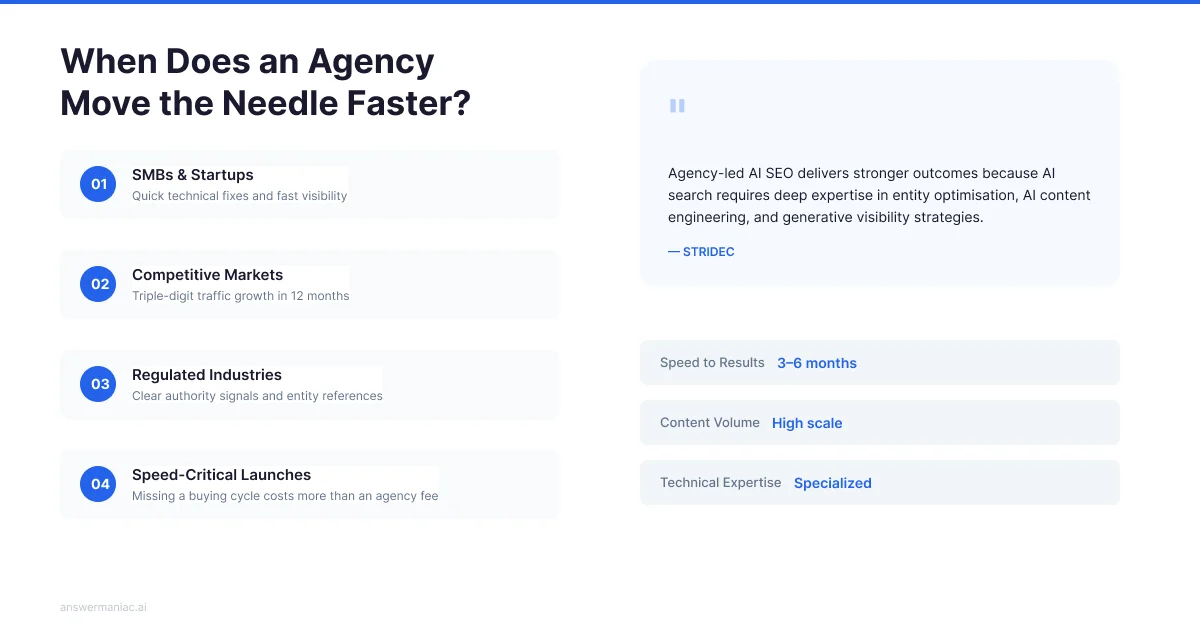
For small and medium businesses looking to grow fast or startups diving into tough search rankings, agencies often lead the way. AI SEO agencies can quickly address technical SEO issues, produce large volumes of content, and increase visibility driven by AI. They sometimes drive triple-digit traffic growth in just a year or so.
"In-house teams offer control and internal alignment, but agencies provide specialised expertise, proven frameworks, and faster results, especially for AI Overview visibility and generative search rankings. For most companies, agency-led AI SEO delivers stronger outcomes because AI search requires deep expertise in entity optimisation, AI content engineering, and generative visibility strategies." - STRIDEC
Google Search Central highlights the importance of structured data and clear entity signals, areas where agencies excel. This is especially critical in regulated industries where AI search optimization for healthcare or MedTech brands depends on clear authority signals and accurate entity references.
This industries fine-tune things like AI Overview citations, target long-tail keywords, and optimize content clusters with an eye on how generative search works.
Speed matters because search rankings build on themselves. Waiting six months to publish updated content can mean missing a full buying cycle. If an agency's onboarding process isn't right, the work can end up feeling generic. You only pay for what you actually get.
When Does an In-House AI SEO Team Become Profitable for Long-Term Investment?
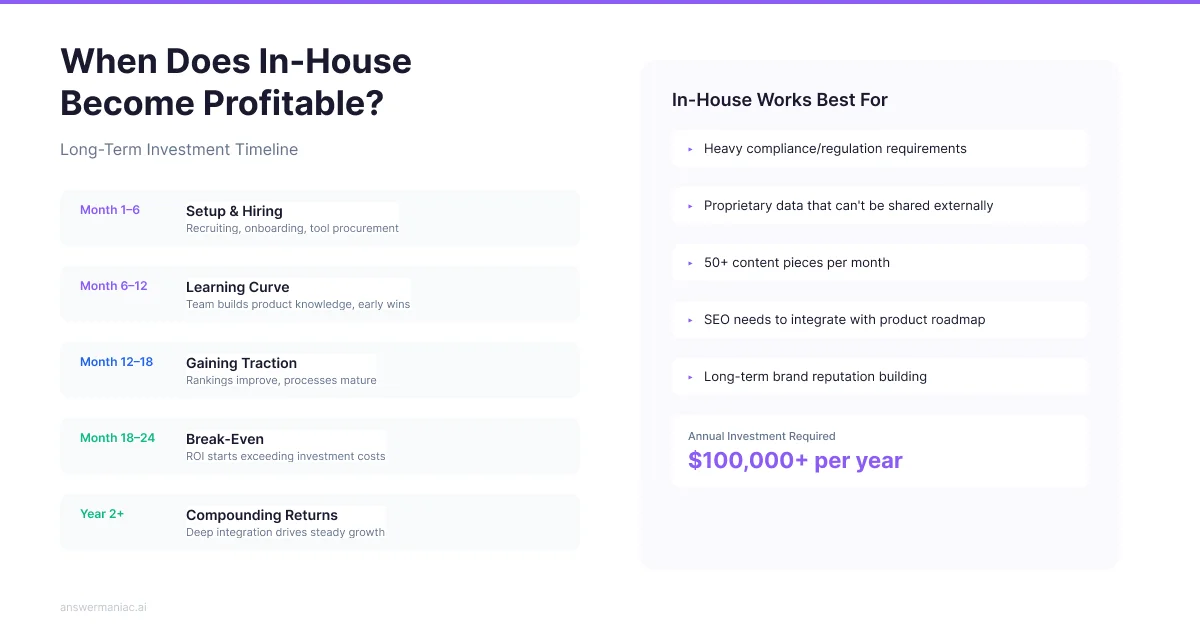
An in-house AI SEO team needs time, money, and focus. It often makes more financial sense for larger companies, especially those dealing with complex products or strict industry regulations.
The cost can pass $100,000 per year. It pays off if you post 50+ posts each month and link SEO to sales.
Two things shape in-house success. First, you need enough staff and energy; small teams juggling both tech and content often burn out or stop growing their skills. Second, it usually takes a year and a half to two years before the investment truly pays back in improved rankings and conversions.
Running an in-house AI operation makes the most sense for companies dealing with heavy regulations, sitting on proprietary data, or looking to cement their brand's reputation for the long haul.
The problem is, you can't just set it up and walk away. Progress stops if you quit investing in new tools or stop training your team. This approach needs steady money, a lot of patience, and a plan that looks years ahead.
Is a Hybrid AI SEO Model the Highest-ROI Strategy?
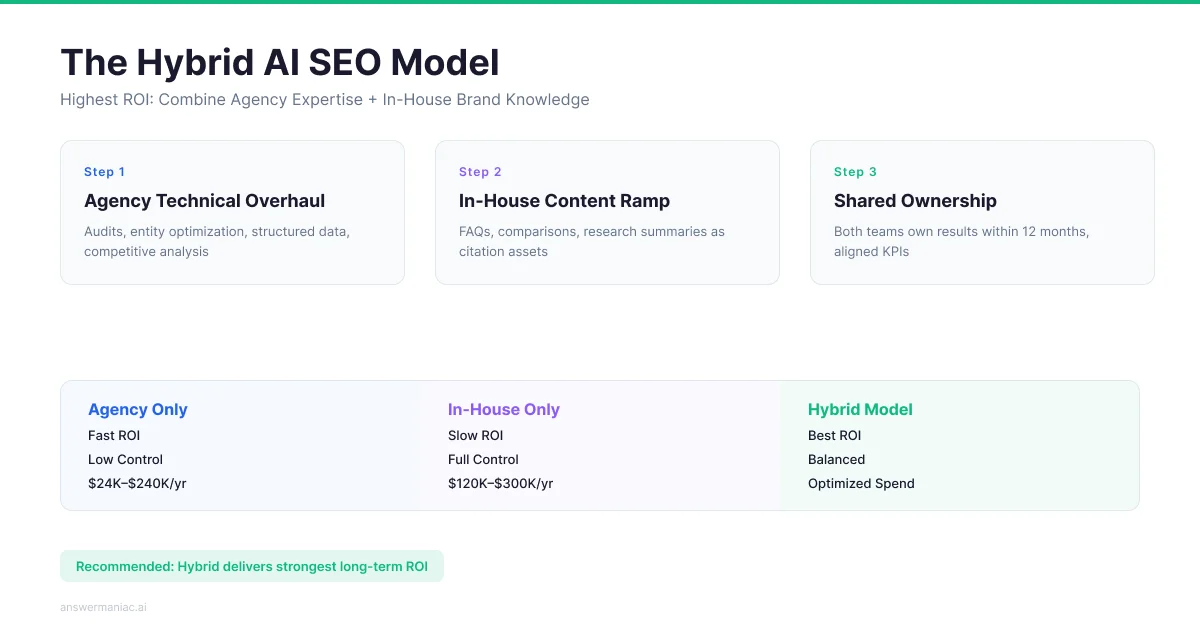
A hybrid model for AI SEO often delivers the best return. Agencies excel at the technical work: strategy, audits, and competitive analysis. Your team then uses that framework to write content that truly sounds like your brand.
This division of labor is proving effective, with businesses reporting clear financial improvements. Enterprises using hybrid models often see strong ROI gains (e.g., Gartner/Forrester 2025 martech trends on composable stacks)
How does it work? The agency quickly defines technical standards in a time- and cost-effective manner. Meanwhile, the in-house team focuses on producing authentic content that resonates with the target audience.
Shared KPIs keep all team members aligned, revenue and costs under control, and AI citation share within reach.
This implementation typically takes three steps:
- The agency drives a technical overhaul of the brand.
- The in-house team ramps up content creation using formats proven to earn visibility in AI answers, such as comparisons, FAQs, and research summaries that function as AI citation assets.
- Both teams share ownership of the SEO results within a year.
These steps offer flexibility and effectiveness, and this is often where brand marketing grows stronger.
What really matters when choosing between an AI SEO agency and an in-house team?
Watch: AI SEO Agency vs In-House Credits: Flying Cats
Don't get fooled by vanity metrics like a temporary traffic bump or a high ranking. According to the U.S. Small Business Administration, the only thing that counts is whether your SEO work makes you money.
Look for data that proves you're getting a return. How much revenue comes from each organic visitor? What does it cost to get a customer from search? Is your content being cited by AI Overviews? What share of your sales pipeline starts with organic search?
Ignore the flashy but meaningless stats. A number-one ranking is pointless if it doesn't convert. A traffic spike that fades by Tuesday is just noise. Ranking for a keyword temporarily does not guarantee lasting traffic or revenue.
Do not focus on graphs. Focus on revenue from search.
FAQ
How do I measure SEO ROI in-house vs agency?
Measure ROI by tracking conversions, traffic quality, and content performance. Compare agency costs with in-house salaries, tools, and training. Using a hybrid SEO model can combine agency expertise with internal knowledge. This approach gives clearer insights into SEO ROI, helps manage budgets, and shows which option generates real revenue.
When does in-house AI SEO make sense for a company?
In-house AI SEO is effective when a company has time, resources, and technical skills for content engineering, internal linking, and entity optimisation. It works best for complex products or strict compliance requirements. Consistently optimising AI Overview citations and generative search strategies helps the team improve long-term SEO ROI.
What advantages does an agency-led AI SEO approach offer?
An agency-led AI SEO approach provides fast technical SEO fixes, content engineering, and generative search optimisation. Agencies bring specialised AI SEO expertise, reduce internal workload, and scale quickly. This approach delivers early SEO ROI wins without the cost and time of hiring, training, and managing a full in-house team.
How does a hybrid SEO model improve performance?
A hybrid SEO model combines agency-led technical SEO, AI Overview optimisation, and internal linking with in-house content creation. Agencies handle technical work while internal teams focus on authentic content. This approach maximises SEO ROI, improves generative search visibility, and balances costs between agency services and internal investment effectively.
Which is more effective: in-house or agency AI SEO?
The choice depends on speed, cost, and expertise. Agencies excel at technical SEO and generative search, while in-house teams develop deep brand knowledge. Often, a hybrid model provides the best results by combining efficiency, measurable SEO ROI, and long-term growth for a company's online presence.
Make the Right Move for Your SEO ROI
If you're feeling stuck between hiring an AI SEO agency or building an in-house team, it's normal to worry about wasted budget and slow results. You need steady execution and clear tracking, or all the effort turns into guesswork. Don't get caught chasing rankings without seeing real revenue impact.
Answer Maniac AI makes this decision easier by showing the ROI side clearly, letting you compare options and plan smartly. It's a simple way to take control without overthinking every detail, so you can focus on growth instead of constantly second-guessing your strategy. Curious how this applies to you? We update our insights regularly every month, let us know your thoughts.
References:
Related Articles:
- AI Search Optimization for Healthcare & MedTech: Earning Citations in Life-Critical Categories
- The Citation Asset Playbook: 7 Content Formats That AI Systems Love to Reference
- How to Build an AI-First Content Strategy From Scratch
- Knowledge Graph Optimization: How to Get Your Brand Into Google's Entity Database
Get AEO Insights Weekly
Join 500+ B2B marketers getting AI visibility tactics every Tuesday.
Ready to Get Your Brand Cited by AI?
See how your competitors show up in ChatGPT, Perplexity, and Gemini — and what it would take to get recommended.