Boost MedTech & Healthcare Impact with AI Search Citations
Optimize healthcare content with AI search for MedTech, earning citations in life-critical queries to boost trust, visibility, and patient safety.
Quick Answer
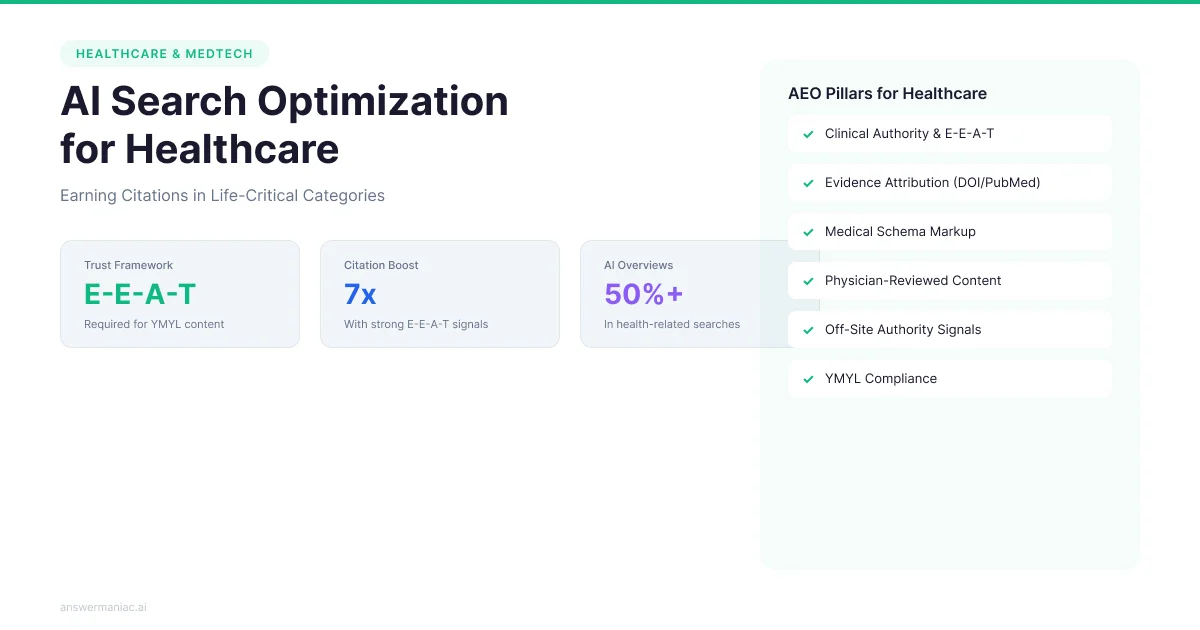
Healthcare and MedTech brands earn AI citations by meeting three requirements that standard SEO doesn't cover. First, every clinical claim needs evidence attribution through PubMed IDs, DOIs, or links to peer-reviewed studies — AI systems verify 20 or more references before citing a medical source. Second, content needs physician-reviewed authorship with visible credentials, institutional affiliations, and ORCID profiles. Third, pages need structured data using MedicalCondition, MedicalProcedure, and MedicalWebPage schema so AI can parse clinical topics accurately. These signals feed directly into knowledge graph optimization, helping AI systems connect your brand to verified medical entities. Teams that treat each evidence-backed page as a citation asset and structure content using an AI-first approach see significantly higher citation rates across Perplexity, Google AI Overviews, and ChatGPT.
AI Search Optimization (AEO) helps AI tools, like Google's AI, find and use your medical content. When people ask about health, these tools look for reliable, well-organized information. If your content is clear and cites good evidence, AI is more likely to share it.
AI tools may cite your site when your health facts are clear and well sourced. Ready to make your content AI-ready? Keep reading to see how it works.
Critical Insights for AI Search in Healthcare
- AI-driven healthcare search prioritizes clinical authority over traditional keyword tactics.
- E-E-A-T signals and structured data schema significantly increase the likelihood of AI citations.
- Evidence attribution, physician-reviewed content, and strong external authority build trust for life-critical AI search results.
What Is AI Search Optimization (AEO) in Healthcare and MedTech?
AI Search Optimization, or AEO, works differently in healthcare. Forget about keyword tricks. The point is to prepare medical information that AI systems, like the ones powering Google or ChatGPT, will actually trust and share. AI health answers can guide care choices. The facts must come from strong studies.
AEO works best when health facts are clear and backed by real study data. An article must show genuine medical understanding. Each claim must link to a study from PubMed or a peer review journal. The facts must match care rules used by doctors in clinics today.
Here's how it works for healthcare content.
First, it has to show genuine medical understanding. Every claim you make needs support from studies doctors trust. The information must also line up with current, standard medical guidelines.
Second, ideas must connect clearly. AI analyzes how topics relate, like explaining a treatment alongside its typical recovery timeline, or discussing a device within the context of the condition it manages. Clear links between topics help AI read and cite the page.
Third, matching what users need: the content must answer general questions (like "What causes arrhythmia?") and urgent ones ("Severe chest pain near me").
You'll find AI citations in places like ChatGPT summaries, Google's AI snippets, Perplexity's multi-source answers, and MedTech information panels. AI cites pages with clear facts and study links. Users trust those pages more. That makes creating accurate and well-organized content a must in healthcare.
Why Are Healthcare and MedTech Topics Treated as YMYL by AI Systems?
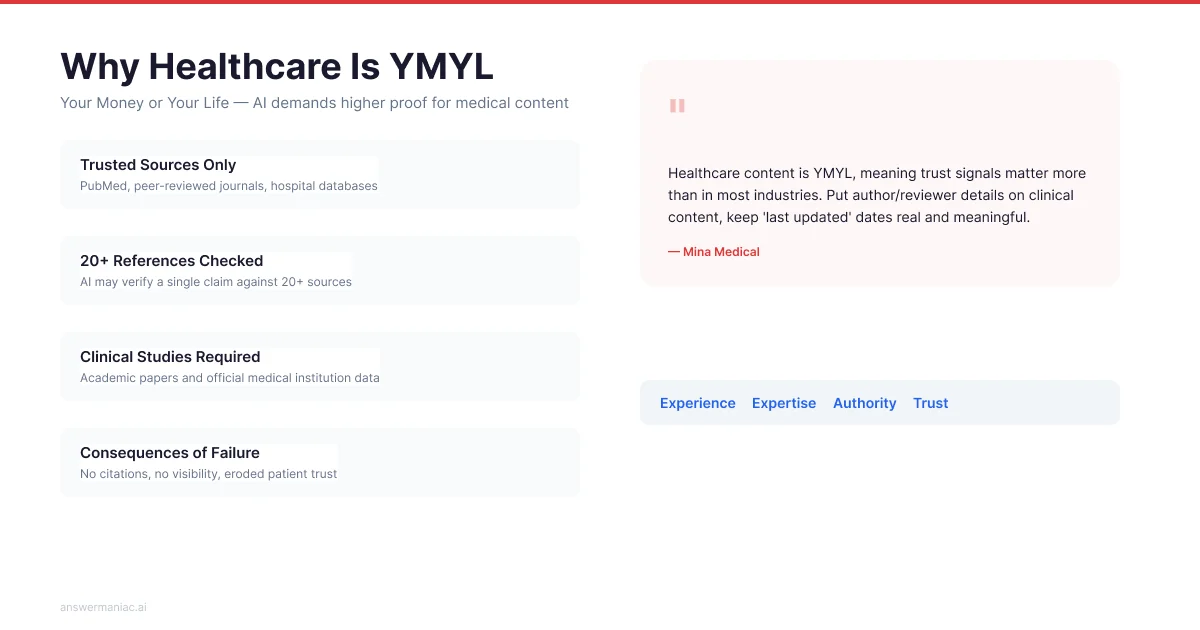
Healthcare and MedTech information is classified as YMYL, "Your Money or Your Life", by AI systems for a clear reason. A wrong answer here can cause real, physical harm. Because of that risk, AI is much more cautious. It requires stronger proof before it will trust and repeat any medical claim.
"Healthcare content is YMYL, meaning trust signals matter more than in most industries... For medical practices, prioritize: Organization / LocalBusiness, MedicalClinic / Physician, FAQPage (for your FAQ blocks), Review / AggregateRating (where legitimate)... Win trust signals (E-E-A-T) the Canadian way: Put author/reviewer details on clinical content (who wrote it, who reviewed it), Keep 'last updated' dates real and meaningful, [and] Cite reputable sources when making medical claims." - Mina Medical
It heavily favors established, authoritative sources. These include databases like PubMed, articles from peer-reviewed medical journals, and official information from recognized hospitals or health institutions. It's a higher standard, and it changes how content needs to be built.
The verification process is strict. AI won't share health advice without seeing citations from sources it trusts. To confirm one fact, it might review over twenty references. It looks for data from clinical studies, academic papers, and official medical sites.
For a single medical claim, an AI like Perplexity might reference over twenty different sources. It prioritizes a specific kind of source: clinical studies, peer-reviewed academic papers, and the official sites of hospitals or medical institutions.
And when your content lacks this credibility? The outcome is straightforward. The AI won't cite your work. Your visibility in AI search results plummets. Ultimately, you erode the trust of the patients and professionals who depend on these tools for accurate information.
Since Google AI Overviews pop up in more than half of health-related searches, following these rules isn't optional, it's critical for MedTech content to be seen and trusted.
How Does E-E-A-T Determine Whether Medical Content Gets Cited?
AI looks at four main things, Experience, Expertise, Authoritativeness, and Trustworthiness (E-E-A-T), to decide which medical content to cite. Content that scores well here can get cited more than seven times as often on sites like Perplexity.
| E-E-A-T Element | Healthcare Example | Citation Impact |
|---|---|---|
| Experience | Hospital case studies | Shows practical, real-life results |
| Expertise | Doctors writing with credentials | Builds trust |
| Authority | Links from places like Mayo Clinic | Boosts website credibility |
| Trustworthiness | Clear sources and disclosures | Raises chance of AI citations |
AI favors content checked by real clinicians because it's less likely to spread wrong info. When medical content proves it's safe and reliable through E-E-A-T, both patients and AI systems are more likely to trust and use it.
What Author Credentials Make Healthcare Content Citation-Ready?
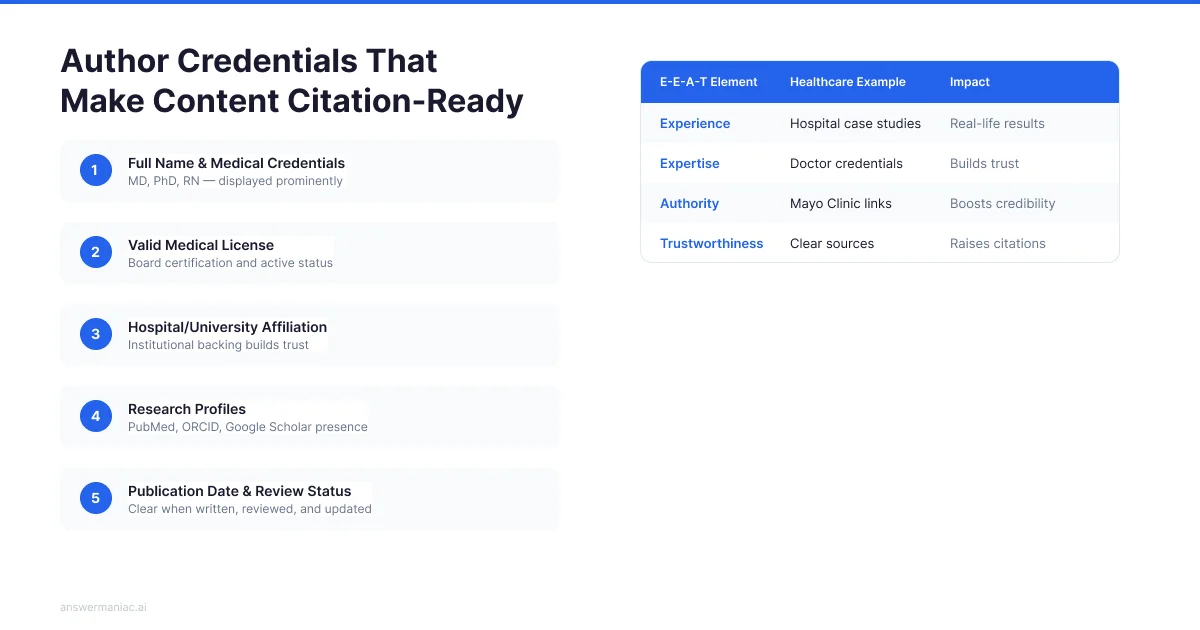
When it comes to healthcare content, AI systems trust articles more if they're written or checked by real medical professionals. These experts need to have clear, easy-to-find information about who they are and their qualifications.
What makes an author credible:
- Their full name and medical credentials are shown
- They hold a valid medical license or board certification
- They are connected to a hospital or university
- They have research profiles on places like PubMed or ORCID
- The article shows when it was written or reviewed
How Does Evidence Attribution Increase AI Citations in Medical Content?
Using trackable IDs is practical. It lets AI verify claims fast. Put DOIs or PubMed IDs right in your content. Here's the basic rule. Mention a clinical trial? Include its ID number. Reference a study? Add its DOI. This connects your statement straight to the evidence.
Here's how to implement this correctly. First, anchor every claim to its source. Don't just reference a study, embed its unique identifier, like a PubMed ID or DOI, directly alongside the statement.
Second, build a clear bibliography. This list should neatly organize all the research IDs you've used, giving readers and AI a straightforward way to check the original evidence.
Third, whenever possible, provide a direct hyperlink to the full study or trial record.
For instance, if you state a treatment's success rate, cite the supporting PubMed ID right after. Discussing a medical device's results? Study data show AI tools cite pages with study links. Research, including an NVIDIA report on healthcare AI, found these systems consistently prioritize content that ties every claim directly to verifiable evidence.
AI tools cite pages that link each claim to a clear study. In many cases, these verified studies become a citation asset that AI systems reference when generating healthcare answers.
Which Technical SEO Signals and Schema Help AI Filter Medical Factual Information?
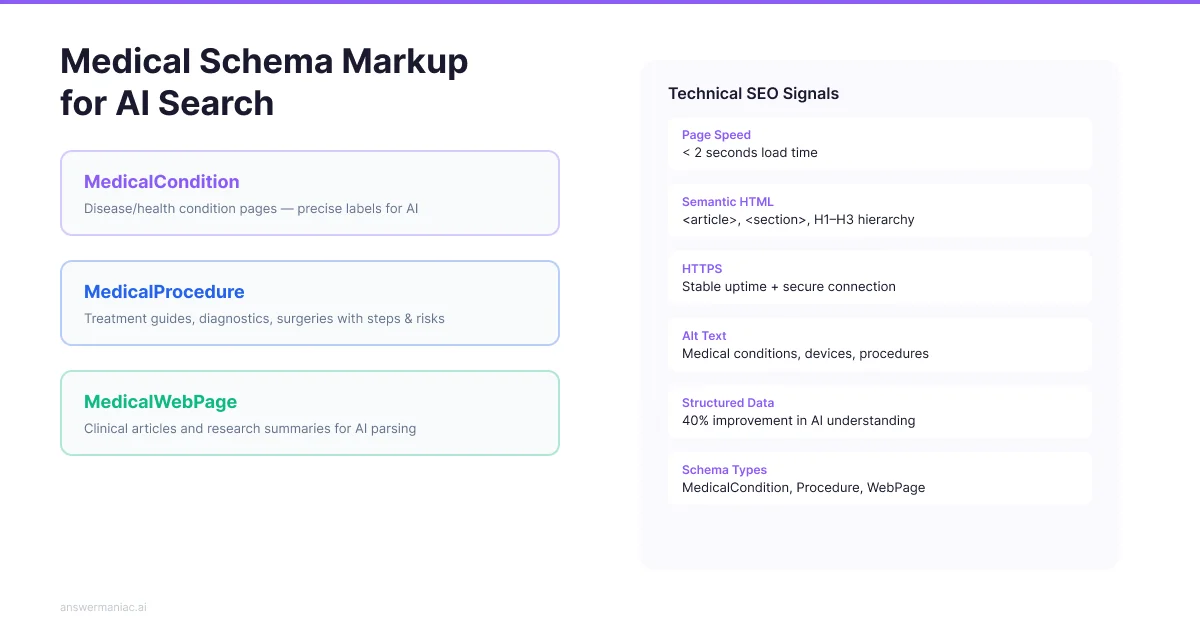
The most important signal is structured data presentation. Next comes the tag signal. When you tag a page with a specific schema, for example, using MedicalCondition for a disease page or MedicalProcedure for surgical instructions, your content can be easily mapped by AI systems.
Research shows that this structured presentation of data can improve AI's understanding of content by about 40%.
There are three main schema types that deserve attention here. MedicalCondition applies to pages focused on specific diseases or health conditions, offering AI a precise label to grasp medical terminology clearly.
MedicalProcedure is used for guides on treatments, diagnostic tests, or surgeries, breaking down complex information, like steps to follow, risks involved, and expected outcomes, into a standard format AI can easily read.
Lastly, MedicalWebPage schema fits clinical articles, research summaries, or authoritative health content. It helps AI systems pull out and interpret important facts with higher accuracy.
Fast page load speed (under 2 seconds), structured HTML tags like <article>, <section>, and schema markup help AI systems parse medical content accurately. Well-structured HTML with hierarchical headings (H1-H3), clear section labels, and semantic tags helps AI systems identify medical topics, treatments, and evidence relationships.
For example, descriptive alt text that names medical conditions, devices, or procedures helps AI associate images with clinical topics and improves medical content indexing. A fast, secure HTTPS website with stable uptime and structured metadata strengthens technical trust signals used by AI search systems when evaluating healthcare sources.
How Do AI Platforms Differ in Citing Healthcare Sources?
AI platforms don't all follow the same rules when it comes to citing healthcare sources. They each have their own way of picking what counts.
| Platform | Citation Pattern | Optimization Focus |
|---|---|---|
| Perplexity | Cites multiple sources | Focuses on expert and academic sites |
| Google AI | Extracts from top results | Prioritizes strong E-E-A-T and local info |
| ChatGPT | Generates answers by synthesizing information from multiple trusted web sources and structured knowledge bases | Often prioritizes widely referenced sources such as encyclopedic databases, academic publications, and highly cited informational websites |
What sets them apart? The number of citations matters, as does the trust in big-name medical institutions. The information also needs to be current. Knowing this lets MedTech creators tailor their material. They can build content AI is more likely to pick up and trust.
What Off-Site Authority Signals Improve AI Citation Probability?
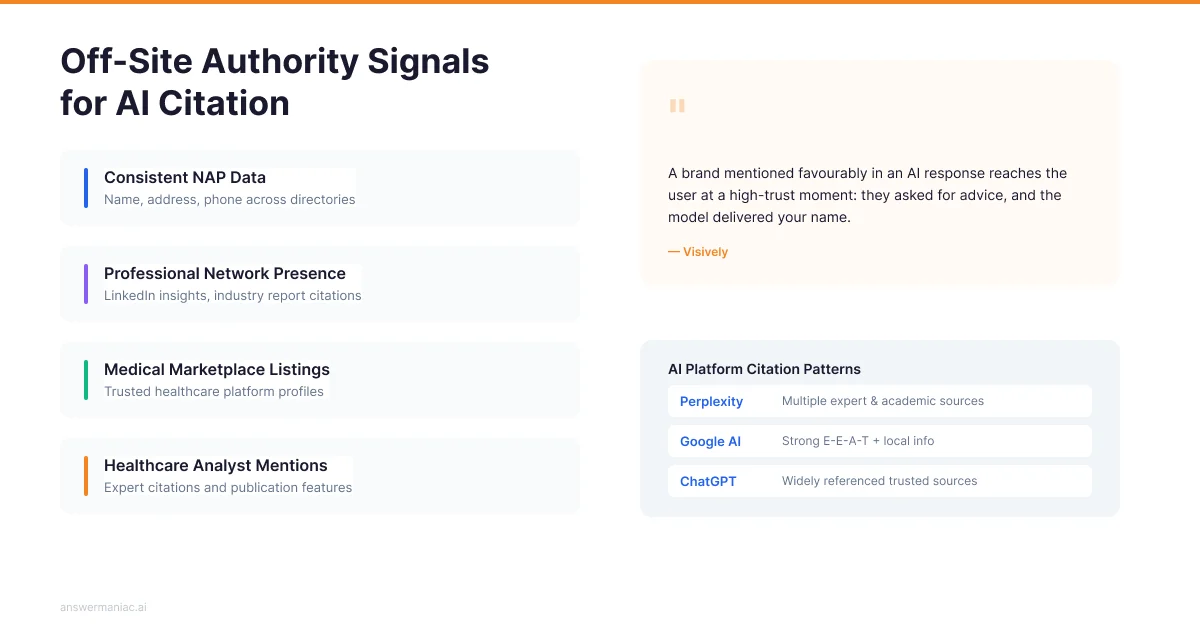
AI search systems evaluate off-site authority signals beyond your website when determining whether to cite healthcare content. They analyze brand mentions, expert citations, backlinks from medical organizations, and references from reputable health publications.
"A brand mentioned favourably in an AI response reaches the user at a high-trust moment: they asked for advice, and the model delivered your name. Even if they don't click through immediately, that mention registers. The next time they're in-market, your brand is familiar." - Visively
So, what's important beyond your website and content to support your brand's credibility? Consistent business information (name, address, phone number) across directories and professional listings helps confirm organizational legitimacy. Additionally, include relevant external links containing professional reviews.
Publish insights on professional networks, appear in industry reports, and earn mentions from healthcare analysts or medical publications. Participation on professional platforms like LinkedIn, citations by healthcare analysts, and listings in trusted medical marketplaces strengthen off-site authority signals, signals that healthcare teams often analyze when deciding between an AI SEO agency or in-house optimization strategies.
These actions confirm you're a real player. When AI sees you consistently in these credible spots, it trusts your content more. In the crowded world of healthcare, these off-site indicators act like a spotlight, guiding AI to credit the right sources, and that means better visibility and patient trust.
How Can Healthcare Teams Measure AI Citation Visibility?
Teams can test AI search to see if their site gets cited and begin to measure AI search ROI and key metrics that reveal whether their medical content is actually appearing in AI-generated answers.
How do you know if AI is using your content?
Start by searching for what people commonly ask in search engines. Also, use phrases like "best devices for..." Next, set up a Google Alert to advertise your company or product name.
Tools like Ahrefs can help you spot new backlinks, which often mean a citation. Keep a simple record of when you see your information in an AI summary.
To stay visible, your content needs support from doctors and good evidence. Watch how AI cites you, update your medical info yearly, and have a healthcare professional check your facts.
Teams must update facts each year so AI keeps citing the page.
FAQ
Why is clinical research important for medical SEO?
Clinical research supports medical SEO and AI citations healthcare. Search systems prefer content that references verified studies. Using clinical research citation SEO and PubMed citation SEO strategy helps connect medical claims to real data. This improves healthcare AI answer ranking factors.
What role does structured data schema play in healthcare AI search results?
Structured data schema helps search engines understand medical content and identify key details about diseases, treatments, and procedures. It organizes information in a clear format that AI systems can process quickly. This structure improves medical search visibility and helps AI systems recognize credible information when generating answers.
How is generative AI search changing healthcare rankings?
Generative AI search changes how healthcare pages rank. Answer engines healthcare now select trusted sources to build direct answers. Pages with strong E-E-A-T healthcare signals, clear medical explanations, and clinical evidence perform better. This shift means healthcare SEO focuses more on credibility and reliable information.
How can clinics optimize content for AI answer engines?
Clinics can improve visibility by answering common patient questions clearly and supporting information with trusted medical evidence. Using structured data, clear headings, and physician-reviewed content also helps. These practices make it easier for AI search systems to understand the page and include it in generated answers.
Show Up When Healthcare Searches Matter
You know how frustrating it is when your healthcare content is packed with solid information, yet it barely appears when people search. You put in the work, doctors review the material, sources are credible, but AI still pulls answers from somewhere else. It feels unfair. And it happens a lot.
That's where AnswerManiac AI can help. It's a simple way to tighten your AI Search Optimization, so your medical content has a better shot at being cited by AI tools people rely on today. If you want your work to actually show up when patients or professionals search, this is a practical next step. Curious how your content measures up? We update strategies regularly as AI evolves.
References:
- https://minamedical.ca/ai-seo-for-healthcare-medical-clinics-doctors-the-ultimate-guide/
- https://visively.com/kb/ai/earning-ai-citations
Related Articles:
Get AEO Insights Weekly
Join 500+ B2B marketers getting AI visibility tactics every Tuesday.
Ready to Get Your Brand Cited by AI?
See how your competitors show up in ChatGPT, Perplexity, and Gemini — and what it would take to get recommended.