Do G2 and Capterra Reviews Get You Cited by AI? What 332 Companies Show
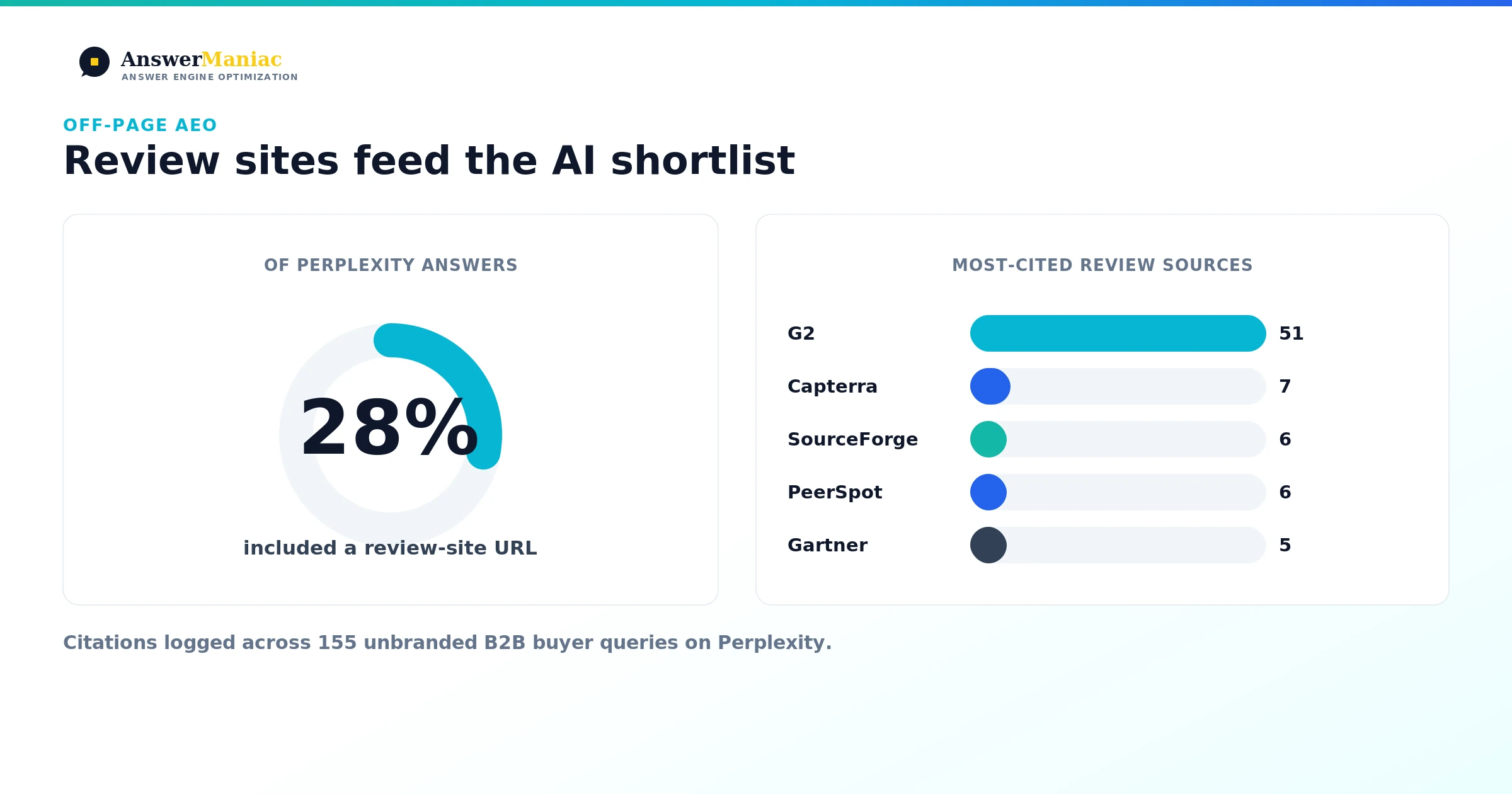
We analyzed the sources AI engines cited across 155 B2B buyer queries. Review-site URLs appeared in 28% of Perplexity answers, with G2 the single most-cited source. Here's what that means for your AEO strategy.
Quick Answer
Do review sites get you cited by AI? In our Q3 2026 study, review-site URLs appeared in 28% of Perplexity answers across 155 B2B buyer queries, and G2 was the single most-cited review platform (51 citations), well ahead of Capterra, SourceForge, PeerSpot, and Gartner. Review sites don't guarantee a citation, but they are one of the most reliable third-party sources AI engines pull from when answering "best software for X" questions. A specific, current presence on the review platforms your category uses materially improves your odds of being named, especially on Perplexity.
B2B marketers have treated review sites as a buyer-stage asset: somewhere a prospect checks before a demo. That framing is now out of date. Review sites have quietly become one of the feedstocks AI engines use to answer category questions, which means your G2 profile isn't just influencing buyers directly anymore. It's influencing the AI that influences the buyers.
We can put numbers on it. As part of our Q3 2026 State of AI Search study, we logged the source URLs the engines cited across 155 unbranded B2B buyer queries. The role of review sites was larger and more concentrated than we expected.
What the citation data shows
Perplexity returns the sources behind its answers, so we could see exactly what it was reading. Across the 155 query responses:
- Review-site URLs appeared in 28% of answers (44 of 155).
- G2 was the most-cited review platform by a wide margin: 51 citations (including its learning subdomain), versus 7 for Capterra, 6 for SourceForge, 6 for PeerSpot, 5 for Gartner, and a handful for Software Advice and GetApp.
- Review sites sat alongside independent editorial and category-roundup sites (ERP-focused publications, cybersecurity news, HR-focused editorial) as the dominant third-party sources.
A couple of honest caveats. These URLs come from Perplexity, because ChatGPT's gpt-4o API doesn't return its citation sources, so this is a read on the retrieval engine specifically. And 28% is the share of answers that included at least one review-site URL, not a promise that a review profile gets you named. But the direction is unambiguous: when an AI engine assembles a B2B shortlist, review sites are one of the places it looks, and G2 is the one it looks at most.
That lines up with how buyers rate these sources too. G2's March 2026 research found review sites remain one of the top influences on vendor shortlists, just behind AI chatbots themselves. The engine and the buyer are reading the same sources.
Why AI engines lean on review sites
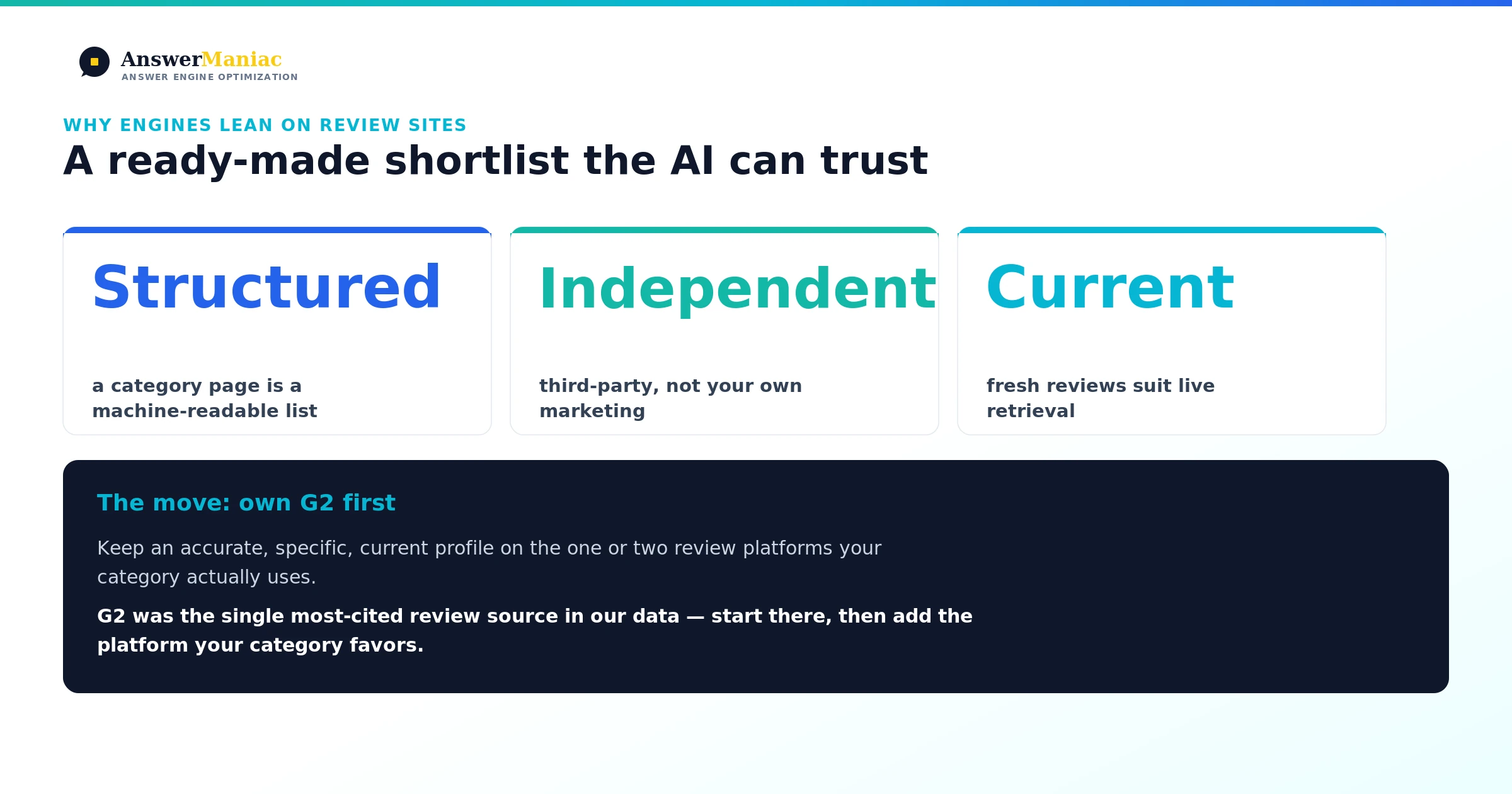
Three reasons, and understanding them tells you how to use review sites well.
They're structured and comparative. A G2 category page is a clean, machine-readable list of the vendors in a category, with consistent descriptions and a clear category label. That's exactly the shape an engine wants when it's answering "best X software." It's far easier to extract a shortlist from a review-site category page than from fifty separate vendor homepages. We made the same point about owned comparison content in comparison pages for AI citations.
They carry third-party credibility. An engine answering a buyer question prefers independent sources over a vendor's self-description. A review site is independent by construction, so a vendor present there has a credibility signal the engine trusts more than the vendor's own marketing. This is the same dynamic behind community consensus and digital PR for AI search.
They're kept current. Active review platforms update constantly, which suits Perplexity's live retrieval. A stale directory listing is weak; a profile with recent, specific reviews is a fresh, repeatedly-crawled source.
How to use review sites for AI visibility
This isn't "go buy reviews." It's a structural play that happens to also help buyers. Five moves.
1. Be present on the platforms your category actually uses. For most B2B software, that's G2 first, given how heavily it's cited, then the platform your specific category favors (Capterra and GetApp for SMB software, PeerSpot and Gartner for enterprise and security). Don't spread thin. Own the one or two that matter for your category.
2. Get your category and description exactly right. The engine reads your category label and description off the review site. If you're filed under a vague or wrong category, you surface for the wrong queries or none. Match the plain category language buyers search, the same principle from how B2B buyers prompt AI.
3. Keep reviews current, not just numerous. A recent flow of specific reviews beats a pile of three-year-old ones. Freshness signals an active vendor and keeps the profile in the engine's live retrieval.
4. Make the detail specific. Reviews and profile copy that name the use case, the industry, and the integration are what match specific buyer queries. "Great product" helps nobody. "Cut our month-end close from 10 days to 3 for a mid-market manufacturer" matches a real query.
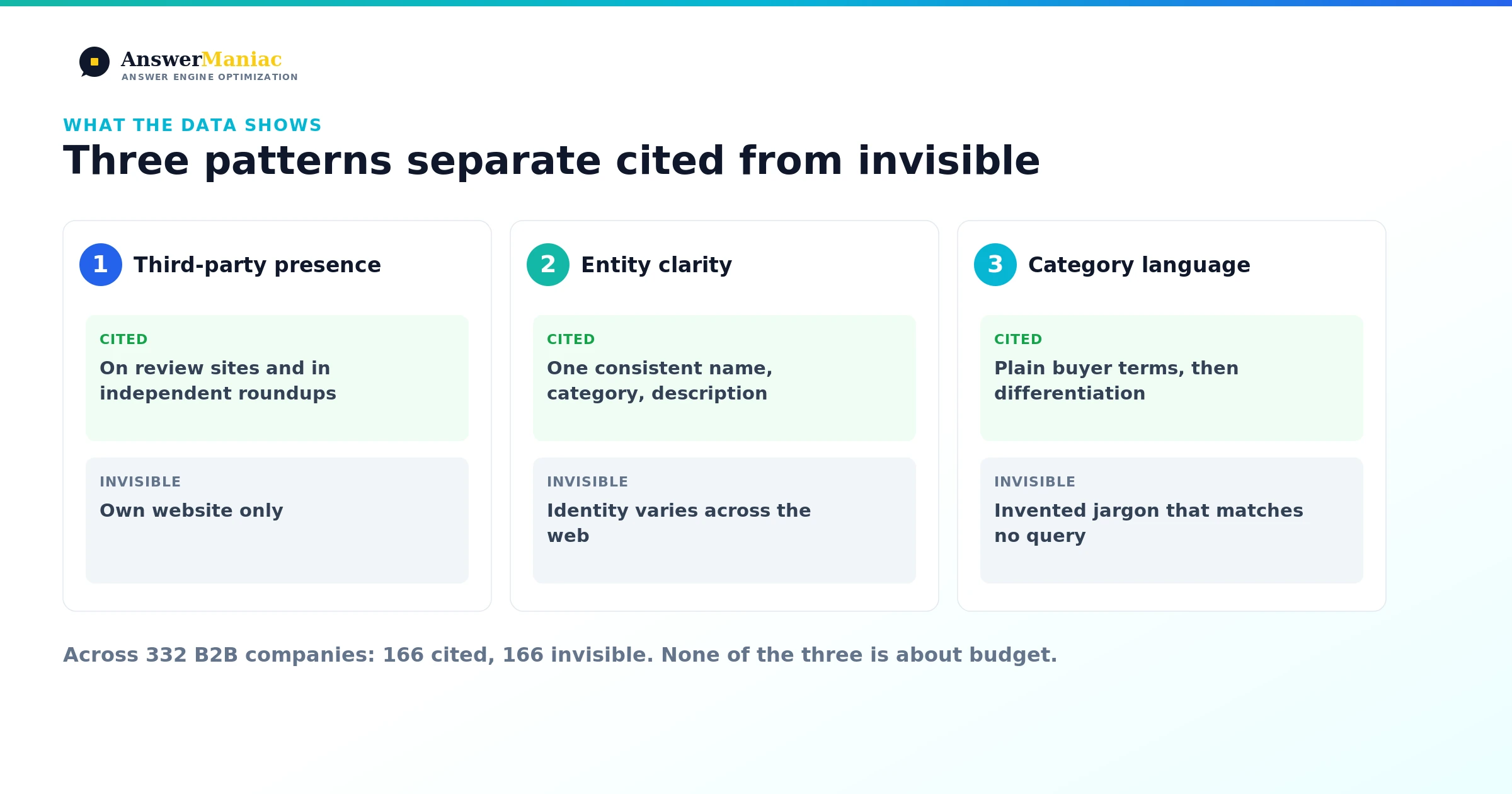
5. Don't stop at review sites. They're one source among several. Independent roundups, industry editorial, and a clean entity presence all compound. Review sites are the highest-frequency single source we found, but the cited companies in our study had presence across multiple third-party sources, which is the first pattern in cited vs invisible.
Where review sites fit in the bigger picture
Review-site presence is a third-party signal, and third-party signals are what move the retrieval engines fastest. That's why this is such a practical lever for growth-stage companies: you don't control G2's authority, but you fully control whether you have an accurate, specific, current profile there. It's some of the highest-impact off-page work available, and it feeds both the AI answer and the human who reads it.
It won't do everything. ChatGPT's entity-driven approach needs the slower identity work we cover in entity optimization for AI knowledge graphs. But if you're trying to move your Perplexity visibility this quarter, a tightened review-site presence is one of the first things we'd fix, and it's built into the Earn stage of the ANSWER Framework.
Frequently asked questions
Does having a G2 profile guarantee AI will cite me? No. In our data, review-site URLs appeared in 28% of Perplexity answers, which means they're frequently used but not universal, and presence raises your odds rather than guaranteeing a citation. Treat it as one strong signal among several.
Which review site matters most for AI visibility? In our Q3 citation data, G2 was cited far more than any other review platform. The right secondary platform depends on your category: Capterra and GetApp skew SMB, PeerSpot and Gartner skew enterprise and security.
Does this work for ChatGPT too? Our source data is from Perplexity, since ChatGPT's API doesn't expose its citations. Review sites clearly help on the retrieval engines like Perplexity. ChatGPT visibility depends more on settled entity authority, which review presence supports indirectly over time.
Should I buy reviews to speed this up? No. Beyond the obvious authenticity and platform-policy problems, engines and buyers both reward specific, credible, current reviews. Fake or generic reviews don't match buyer queries and can backfire.
This analysis is drawn from the source data behind AnswerManiac's Q3 2026 study of 332 B2B companies. See the full dataset on our research hub, or get a free AI citation audit to see which sources AI is using to answer your category.
Get AEO Insights Weekly
Join 500+ B2B marketers getting AI visibility tactics every Tuesday.
Ready to Get Your Brand Cited by AI?
See how your competitors show up in ChatGPT, Perplexity, and Gemini — and what it would take to get recommended.