Cited vs Invisible: The 3 Patterns That Separate B2B Challengers AI Recommends
We compared the 166 B2B challengers AI cited against the 166 it ignored. Three patterns separate them, and none is about budget. Here's what the cited companies do differently.
Quick Answer
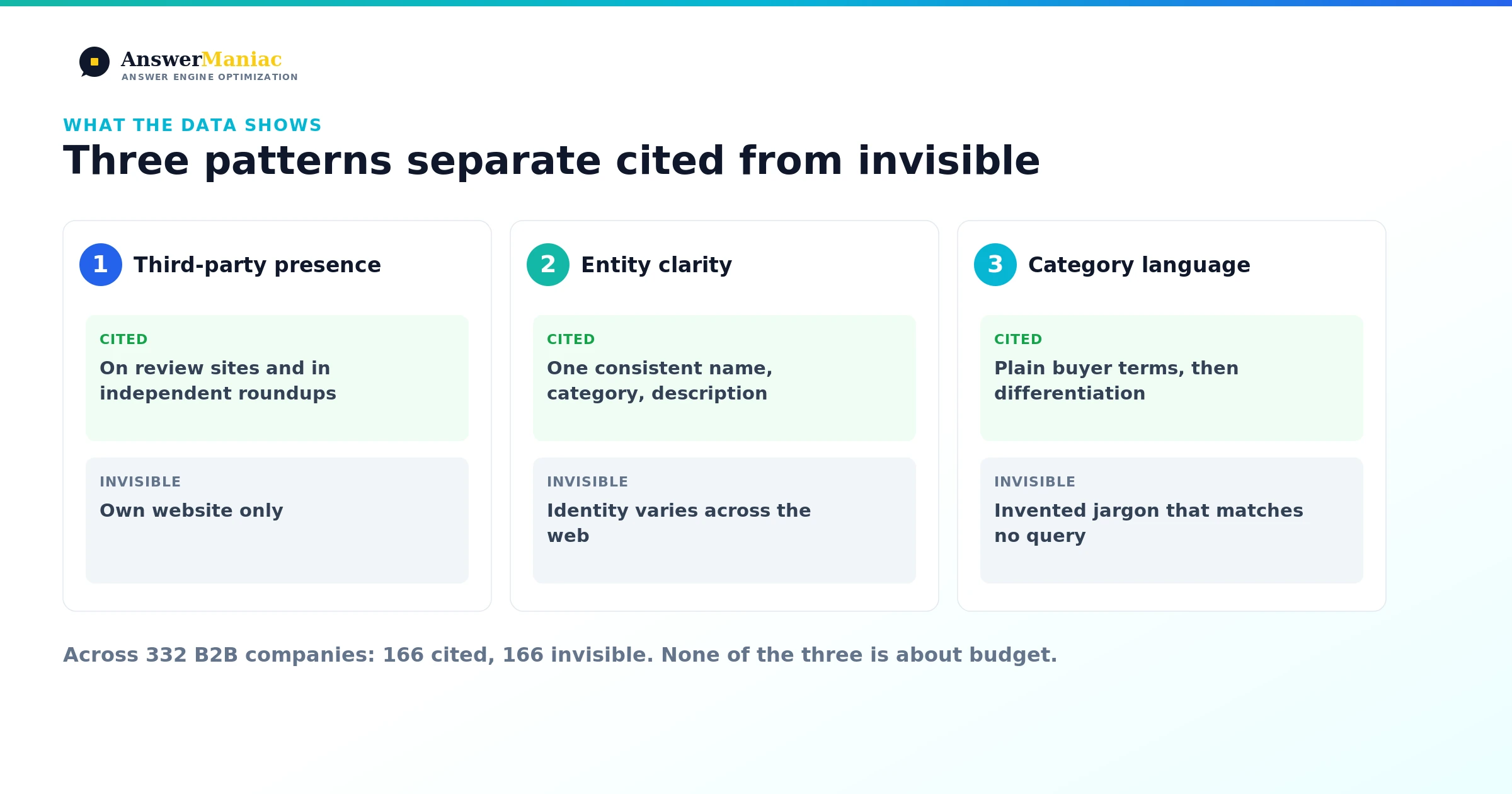
What separates cited B2B companies from invisible ones: Across our 332-company Q3 study, the 166 companies AI cited differed from the 166 it ignored on three structural patterns, none of which is budget. First, the cited companies had real third-party presence (review sites, independent roundups), not just their own website. Second, they had entity clarity: one consistent name, category, and description everywhere. Third, they described themselves in the exact category language buyers search, not clever internal jargon. Build those three and you move from the invisible half to the cited half.
In our Q3 2026 State of AI Search study, 332 growth-stage B2B companies split perfectly in half: 166 earned at least one citation from ChatGPT or Perplexity, 166 earned zero. That clean split is an unusual gift for analysis. It let us line the two groups up and ask a simple question: what do the cited companies do that the invisible ones don't?
We expected the answer to be money, or age, or team size. It wasn't. The companies that got cited weren't richer or older. They were structurally more legible to AI. Three patterns explain most of the gap, and all three are buildable.
First, the engine reality you have to design around
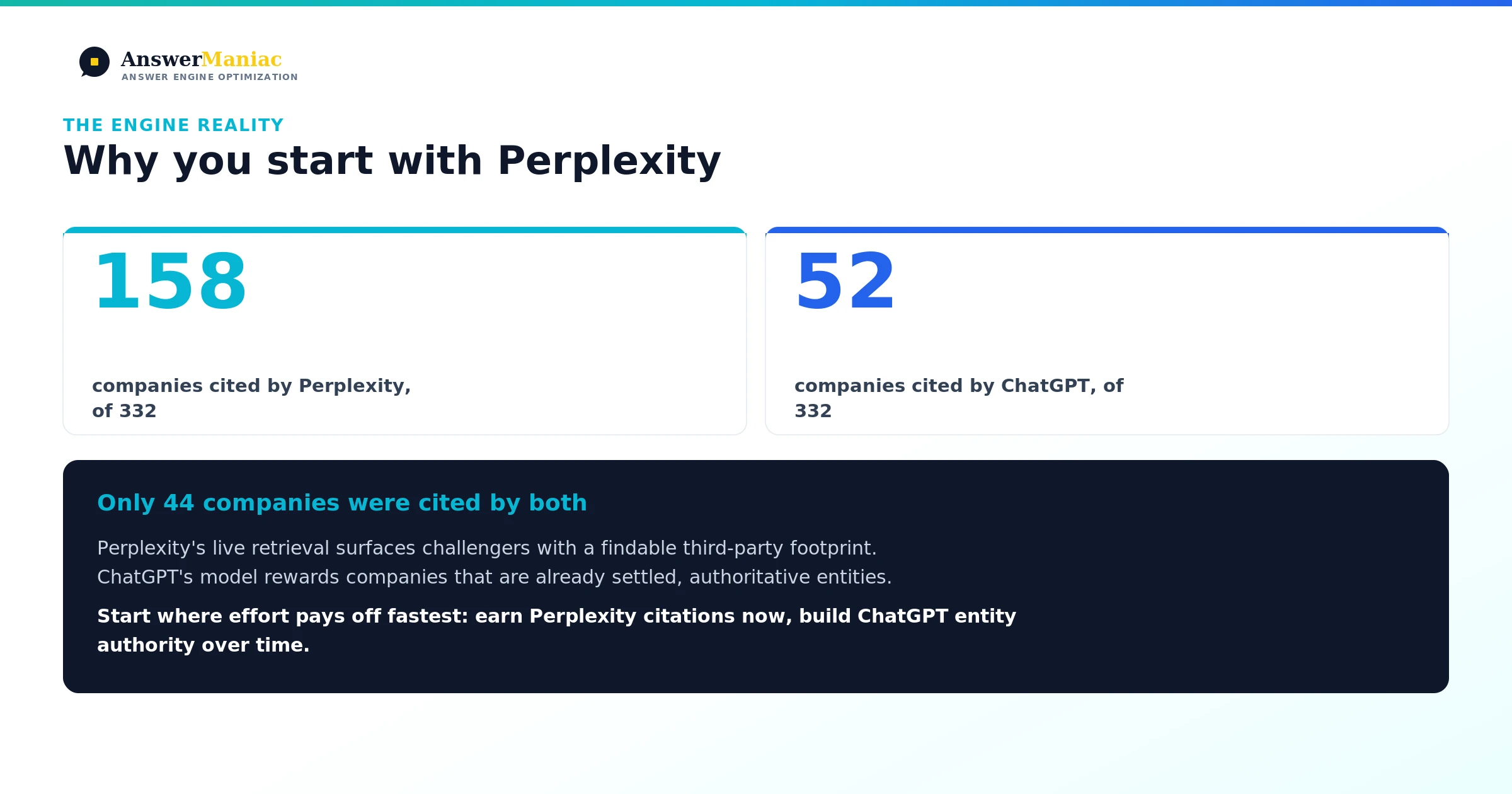
Before the patterns, one fact that frames all of them. Across the 332 companies, Perplexity cited 158 and ChatGPT cited just 52. Only 44 companies were cited by both.
That matters because the two engines reward different things. Perplexity runs live retrieval and summarizes third-party pages, so it surfaces companies with a findable external footprint. ChatGPT's gpt-4o leans on settled entity knowledge, so it names companies it already "knows" as distinct, authoritative entities. The three patterns below map onto that split: patterns one and three move Perplexity fastest, pattern two is what eventually unlocks ChatGPT.
If you take nothing else away: start with the engine you can win. For growth-stage B2B, that's Perplexity. We explain the mechanics in ChatGPT vs Gemini vs Perplexity for B2B buyers.
Pattern 1: Third-party presence, not a prettier homepage
The clearest difference between the cited and invisible groups was where they existed on the web.
The cited companies showed up on sites they don't own: review platforms, independent category roundups, industry editorial. In our Perplexity citation data across the study, review-site URLs appeared in 28% of answers, and independent editorial and roundup sites made up most of the rest. The invisible companies, by contrast, often had excellent websites and nothing else. No reviews that an engine could read, no roundup placements, no third-party description to summarize.
This is the uncomfortable part for a lot of marketing teams, because it means the highest-impact visibility work happens off your own domain. An AI engine answering "best expense management software for startups" isn't reading your homepage. It's reading what other credible sources say about your category, and checking whether you're in them. We go deep on this in do G2 and Capterra reviews get you cited by AI and in comparison pages for AI citations.
The move: get into the third-party sources your buyers and the engines already read. Review profiles kept current and specific, placements in category roundups, independent coverage. This is the fastest lever on Perplexity visibility.
Pattern 2: Entity clarity beats content volume
The second pattern was subtler and showed up most on ChatGPT. The cited companies were legible as entities. One canonical name, used consistently everywhere. A clear, stable category. A description that matched across their site, their profiles, and third-party mentions. In many cases, a Wikipedia or Wikidata presence that pinned the entity down.
The invisible companies were often fuzzy. The name appeared three different ways across the web. The category description shifted from page to page. There was nothing authoritative tying "this company" to "this thing it does." When an AI engine can't confidently resolve who you are and what you do, it does the safe thing and names a competitor it can resolve.
This is why content volume alone doesn't move ChatGPT. You can publish fifty blog posts and still be an ambiguous entity. The companies ChatGPT named had done the identity work, not just the content work. We lay out the specifics in entity optimization for AI knowledge graphs and Wikipedia and Wikidata for AI visibility.
The move: standardize your name and category everywhere, build or clean up your structured entity presence, and make sure third parties describe you consistently. This is slow, it compounds, and it's what opens the harder engine.
Pattern 3: Category language, not internal jargon
The third pattern was about words. The cited companies described themselves in the exact language buyers use to search. The invisible ones described themselves in language they invented.
A buyer asks for "NetSuite implementation partner for manufacturing." The cited partner calls itself a NetSuite implementation partner for manufacturing. The invisible one calls itself a "unified business transformation studio." The first matches the query and the sources that answer it. The second matches nothing.
This sounds obvious and it's the most common self-inflicted wound we see. Marketing teams fall in love with differentiated language that no buyer types and no third party repeats. AI engines match on the category terms people actually use. If your positioning doesn't contain those terms, in plain form, you've opted out of the queries that matter. We covered the buyer side of this in how B2B buyers prompt AI.
The move: audit your own category language against the queries buyers actually ask. Lead with the plain category term, then differentiate. Clever is fine after you're findable, not before.
Putting the three together
Here's the side-by-side, simplified from what we saw across the two groups.
| Signal | Cited companies (166) | Invisible companies (166) |
|---|---|---|
| Third-party presence | On review sites and in independent roundups | Mostly their own website only |
| Entity clarity | One consistent name, category, description | Name and category vary across the web |
| Category language | Plain buyer terms, then differentiation | Invented jargon that matches no query |
| Fastest engine | Perplexity, then ChatGPT over time | Absent on both |
The encouraging part: none of these is gated by budget or company size. In our data, specialist firms in tiny categories out-scored far larger SaaS companies, because they nailed these three patterns in a less contested space. The work is structural, it compounds, and it's exactly what the ANSWER Framework is built to systematize.
If you're in the invisible half today, the path out isn't a bigger content budget. It's third-party presence, entity clarity, and honest category language, applied in that order, starting with Perplexity.
Frequently asked questions
Is getting cited by AI mostly about having more content? No. In our data, content volume didn't separate the cited from the invisible. Third-party presence, entity clarity, and category-matched language did. A company with modest content but strong external signals beat content-heavy companies with fuzzy identities.
Why does Perplexity cite so many more companies than ChatGPT? Perplexity retrieves and summarizes third-party pages live, so it surfaces any company with a findable external footprint. ChatGPT's gpt-4o leans on settled entity knowledge, so it names far fewer challengers. In our study the ratio was 158 to 52.
How long does it take to move from invisible to cited? Perplexity visibility can respond within a quarter or two to third-party and category-language work. ChatGPT visibility tracks entity authority and moves more slowly. We never guarantee a specific result, but the order of operations is consistent.
What's the single highest-impact first step? Get accurate, specific presence on the third-party sources your buyers and the engines already read. That's the fastest path off zero.
This analysis draws on AnswerManiac's Q3 2026 study of 332 B2B challengers. See the full dataset on our research hub, or get a free AI citation audit to find out which half you're in.
Get AEO Insights Weekly
Join 500+ B2B marketers getting AI visibility tactics every Tuesday.
Ready to Get Your Brand Cited by AI?
See how your competitors show up in ChatGPT, Perplexity, and Gemini — and what it would take to get recommended.
Related Articles
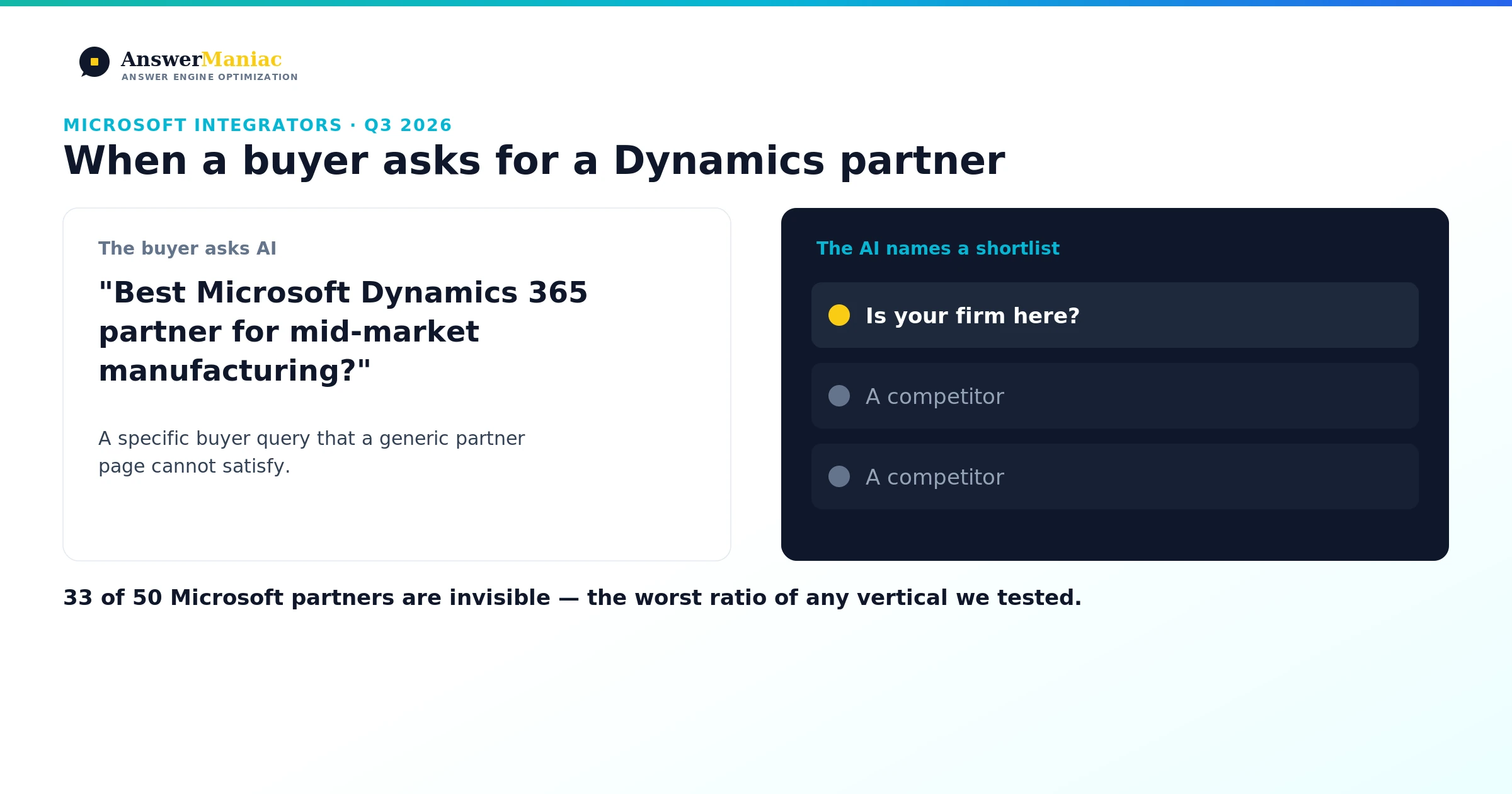
Microsoft Dynamics and Azure Partners in AI Search: 50 Integrators, Only 17 Cited
NetSuite Implementation Partners in AI Search: Which Firms ChatGPT and Perplexity Recommend