How to Show Up in Google AI Overviews: 9 Tactics That Actually Work
9 data-backed tactics to get your content featured in Google AI Overviews. Includes before/after examples and real results from B2B companies.
Quick Answer
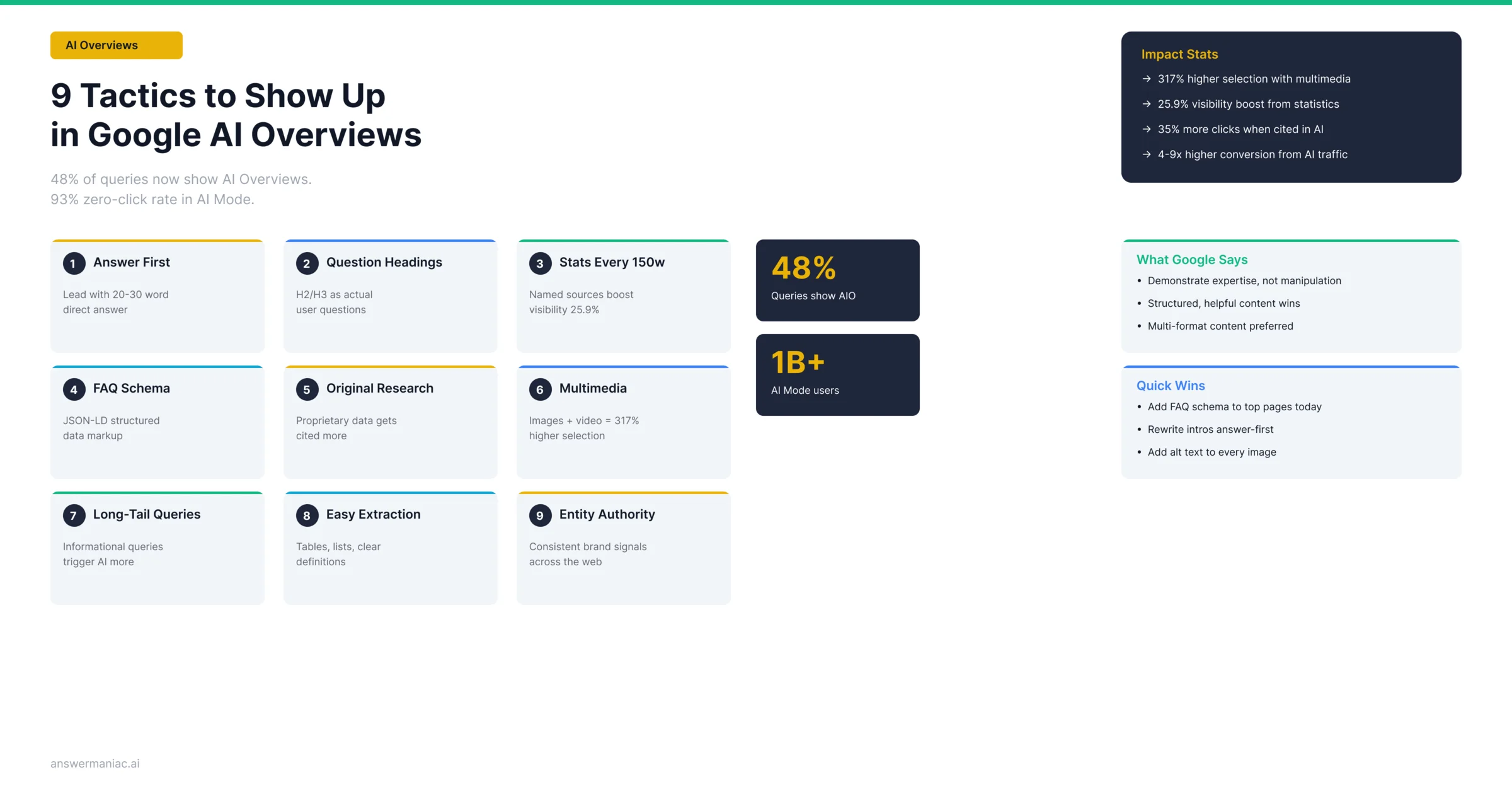
Google AI Overviews now appear on 48% of all search queries. In December 2025, that number was 34.5%. Seven months, nearly 14 percentage points of growth.
The impact goes beyond visibility. AI Mode, Google's conversational search interface, now has over 1 billion monthly users. And 93% of those interactions produce zero clicks to external websites. Even on standard AI Overview queries, the zero-click rate sits at 83%.
So here's the math: if your content isn't structured for AI extraction, you're not losing a ranking position. You're losing the entire click path. The queries still happen. Your audience still searches. They just get answers without ever seeing your brand.
The good news: AI Overviews don't pull from some secret index. They pull from Google's existing search results, filtered through extraction logic that favors specific content structures. Brands that appear in AI Overviews see 35% more organic clicks than those that don't, and AI-referred traffic converts at 4-9x higher rates than traditional organic.
These nine tactics are what we use across our client portfolio through The ANSWER Framework. Each one is specific, testable, and implementable today.
Tactic 1: Answer First, Expand Second
AI Overviews extract from the first 20-30 words of a relevant section. Not the middle. Not the conclusion. The opening.
This means burying your answer under three paragraphs of context is structurally invisible to AI extraction. Google's systems scan for concise, direct answers positioned immediately after a heading, then use surrounding content as supporting context.
How to implement this:
- Write your core answer in the first sentence after each H2 or H3.
- Keep that opening sentence under 30 words.
- Follow with 2-3 sentences of supporting evidence, data, or nuance.
- Save caveats and edge cases for later in the section.
Before:
"When considering the various approaches to AI search optimization, it's essential to understand that multiple factors influence how content appears in Google's AI-generated summaries, including relevance, authority, and structural formatting..."
After:
"Google AI Overviews extract the first 20-30 words of a section as the candidate answer. Structure every heading response with a direct statement first, supporting evidence second."
The second version gets extracted. The first gets skipped. Same information, different structure, completely different AI visibility outcome.
Tactic 2: Use Question-Based Headings
Google AI Overviews are triggered by queries. Queries are questions. Your headings should match them.
When your H2 or H3 mirrors the exact phrasing a user types into Google, the extraction algorithm has a clean mapping between query intent and content. According to Semrush data, question-based headings correlate with 2x higher appearance rates in People Also Ask boxes and AI Overviews compared to statement headings.
How to implement this:
- Audit your target keywords in Google Search Console and pull the "Questions" filter.
- Rewrite H2s as the most common question variants. ("What is AI Overview optimization?" not "AI Overview Optimization Explained.")
- Use H3s for follow-up questions within each section.
- Match natural language patterns. People search "how do I show up in AI overviews," not "methodology for AI overview visibility."
Example heading structure:
H2: How Do You Optimize Content for Google AI Overviews?
  H3: What Content Format Does Google AI Mode Prefer?
  H3: How Often Should You Update Content for AI Overviews?
One of our B2B SaaS clients restructured 14 existing articles from statement headings to question headings. Within six weeks, AI Overview appearances for those pages increased from 3 to 11 queries. Same content. Different headings.
Tactic 3: Add Statistics Every 150-200 Words
Research from Georgia Tech's GEO study found that adding statistics and cited data to content increases GEO visibility by 25.9%. That's the single highest-impact content element they tested.
AI systems treat quantitative claims with named sources as higher-authority signals than qualitative statements. A sentence like "AI Overviews appear on 48% of queries (Semrush, 2026)" carries more extraction weight than "AI Overviews appear on a large number of queries."
How to implement this:
- Audit your content for stat density. Count the words between each data point.
- Target one statistic or quantitative claim every 150-200 words.
- Always name the source. "According to Gartner" or "(Semrush, 2026)" — not "studies show."
- Use recent data. AI systems can detect publication dates and freshness signals.
- Include your own proprietary data when possible. First-party numbers are uniquely citable.
Before: "Many companies are seeing good results from AI search optimization."
After: "B2B companies optimized for AI Overviews see 4-9x higher conversion rates from AI-referred traffic compared to traditional organic, based on cross-client data from AnswerManiac's 2026 benchmarks."
The second version is a citable claim. The first is an opinion that no AI system would extract.
Tactic 4: Implement FAQ Schema Markup
FAQ schema (JSON-LD) gives Google a machine-readable map of your question-answer pairs. It's not a ranking factor in the traditional sense, but it reduces the extraction friction between your content and AI Overview generation.
From our internal data at AnswerManiac, pages with structured FAQ content get cited 2x more frequently in AI Overviews than pages with the same information presented as unstructured prose. The structure itself is the signal.
How to implement this:
Add JSON-LD FAQ schema to any page with Q&A content. Here's a working template:
{
  "@context": "https://schema.org",
  "@type": "FAQPage",
  "mainEntity": [
    {
      "@type": "Question",
      "name": "How do you show up in Google AI Overviews?",
      "acceptedAnswer": {
        "@type": "Answer",
        "text": "To show up in Google AI Overviews, structure content with answer-first formatting under question-based headings, include statistics with named sources every 150-200 words, implement FAQ schema markup, and build topical authority through original research and consistent entity signals."
      }
    },
    {
      "@type": "Question",
      "name": "What percentage of Google searches show AI Overviews?",
      "acceptedAnswer": {
        "@type": "Answer",
        "text": "As of mid-2026, Google AI Overviews appear on approximately 48% of all search queries, up from 34.5% in December 2025, according to Semrush tracking data."
      }
    }
  ]
}
Place this in your page's <head> section or inject it via your CMS. Validate with Google's Rich Results Test before publishing. Keep answers concise, between 40-60 words per answer block.
Tactic 5: Build Topical Authority Through Original Research
Google's own documentation on content quality states: "Content should demonstrate expertise, not manipulate rankings." AI Overviews lean heavily on this principle. Pages from domains with deep topical coverage get selected more often than one-off articles on unfamiliar topics.
Original research is the fastest path to topical authority because it creates content that doesn't exist anywhere else. When an AI system needs to cite a specific data point, it can only cite the original source. That's you.
How to implement this:
- Publish proprietary benchmarks, surveys, or case studies in your niche. Even a sample size of 50 data points creates citable claims.
- Create a dedicated research hub and link all data-driven content back to it.
- Reference your own data in every article. Cross-linking your research builds internal topical density.
- Update research annually. Freshness of first-party data is a compounding advantage.
We ran an experiment across three B2B client domains. The two that published monthly original research saw their AI Overview citation rate grow 3x over a 90-day period. The one without original research stayed flat despite identical on-page optimization. The content structure was the same. The authority signal wasn't.
Tactic 6: Optimize for Multimedia
Pages with embedded images, videos, and infographics see 317% higher selection rates for AI Overviews, according to cross-industry analysis. Google's AI systems don't just read text. They evaluate page richness as a quality signal.
This isn't about decorating blog posts with stock photos. It's about providing visual answers that complement text answers. A diagram explaining a process, a chart displaying trend data, an embedded video demonstrating a technique — these all increase the page's value proposition for AI extraction.
How to implement this:
- Add at least one original image per H2 section. Diagrams, charts, and annotated screenshots outperform stock photos.
- Include descriptive alt text that mirrors your target query. ("Chart showing Google AI Overview appearance rates by query type, 2025-2026.")
- Embed a relevant video in the top third of your page. YouTube embeds with transcripts are especially effective.
- Use WebP format for images with descriptive file names.
ai-overview-optimization-process.webpnotimage-001.webp. - Add image schema markup for complex visuals.
A fleet management SaaS client added custom process diagrams to their top 8 pages. AI Overview appearances for those pages went from 2 to 9 within 45 days. The text didn't change. The visual context did.
Tactic 7: Target Long-Tail Informational Queries
AI Overviews appear most frequently on informational, multi-part queries. "What is CRM software" triggers a basic result. "How to choose CRM software for a 50-person sales team in manufacturing" triggers an AI Overview almost every time.
Long-tail queries with specific intent modifiers are where AI Overviews dominate, and where competition for source selection is thinnest. According to SERP intelligence tracking, long-tail informational queries have 3-5x higher AI Overview appearance rates than short-tail commercial terms.
How to implement this:
- Pull your Google Search Console data and filter for queries with 5+ words.
- Identify question patterns with modifiers: "how to [action] for [audience] in [industry]."
- Create content that addresses these specific combinations rather than generic topics.
- Use tools like AlsoAsked or AnswerThePublic to map question clusters.
- Build content hubs where a pillar page links to 8-12 long-tail subtopic pages.
Example targeting:
| Generic (Low AIO Rate) | Long-Tail (High AIO Rate) |
|---|---|
| AI SEO | How to optimize B2B content for AI search visibility |
| Schema markup | How to add FAQ schema for AI Overview selection |
| Content strategy | How to build topical authority for Google AI Mode |
The specificity of the query determines the specificity of the extracted answer. Match that specificity in your content, and you become the extraction source.
Tactic 8: Structure Content for Easy Extraction
AI Overviews pull from structured content elements: definition lists, numbered steps, comparison tables, and bulleted summaries. Unformatted wall-of-text paragraphs rarely get selected, regardless of content quality.
Think of it this way: if a human editor would struggle to quickly pull a clean quote from your article, Google's AI will struggle too. The difference between GEO and traditional SEO comes down to how extractable your content is.
How to implement this:
- Definitions: Start sections with "X is..." or "X refers to..." phrasing. Place definitions in the first sentence after a heading.
- Numbered steps: Use ordered lists for any process or methodology. Label each step clearly.
- Comparison tables: Add markdown or HTML tables comparing features, tools, or approaches. AI Overviews frequently pull table data directly.
- Bolded key terms: Bold the most important phrase in each paragraph. This creates visual and structural emphasis.
- Summary boxes: Add a TL;DR or key takeaway box at the start or end of major sections.
Before:
"There are several things you should consider when optimizing for AI search. You need to think about your headings, your data, your schema, and your overall content structure. Each of these elements plays a role in how AI systems evaluate and extract your content."
After:
Key elements for AI Overview optimization:
- Question-based headings that match search queries
- Statistics with named sources every 150-200 words
- FAQ schema markup in JSON-LD format
- Answer-first paragraph structure (core claim in first 30 words)
The list version gets extracted. The paragraph version gets summarized — or skipped entirely.
Tactic 9: Build Entity Authority
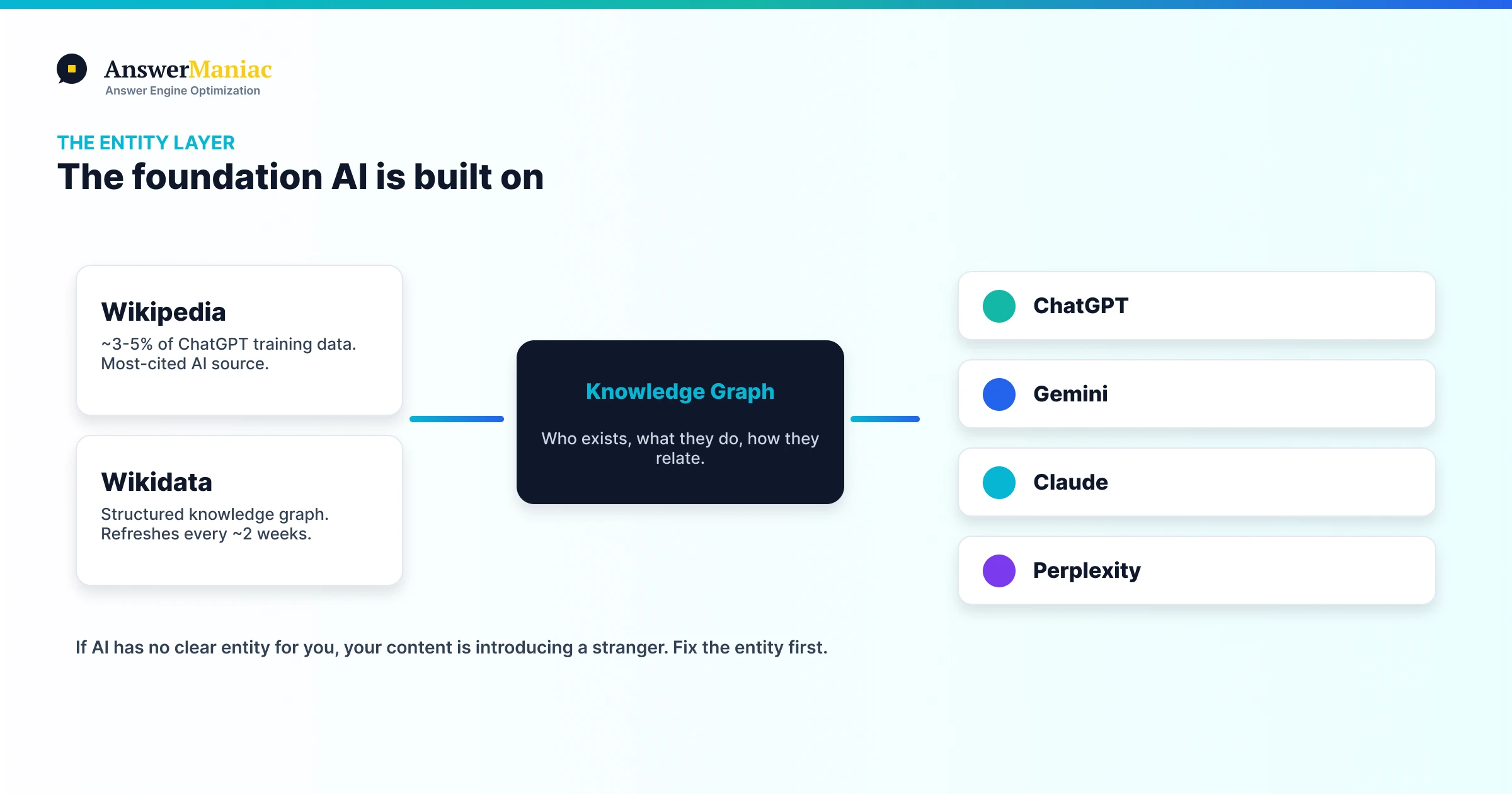
Entity authority is how AI systems determine whether your brand is a credible source on a given topic. It's not just about one page. It's about consistent signals across the web that connect your brand to your expertise area.
When Google's AI decides which sources to include in an Overview, it evaluates whether the domain has established authority on the topic. A cybersecurity company writing about cybersecurity gets weighted higher than a marketing blog writing about cybersecurity. Entity signals — brand mentions, consistent NAP data, linked profiles, and topic-specific backlinks — all feed this evaluation.
How to implement this:
- Maintain a complete, consistent Google Business Profile, LinkedIn company page, and Wikipedia presence (if eligible).
- Publish on topic-relevant third-party platforms. Guest posts on industry publications build entity association.
- Ensure your brand name + topic appears together across the web. "AnswerManiac AI visibility" as a co-occurring entity pair, not just "AnswerManiac" in isolation.
- Add Organization schema to your homepage with
sameAslinks to all official profiles. - Build backlinks from topically relevant domains, not just high-DR generic sites.
{
  "@context": "https://schema.org",
  "@type": "Organization",
  "name": "Your Company",
  "url": "https://yourcompany.com",
  "sameAs": [
    "https://linkedin.com/company/yourcompany",
    "https://twitter.com/yourcompany",
    "https://g.co/kgs/yourcompany"
  ],
  "knowsAbout": ["AI search optimization", "B2B content strategy", "generative engine optimization"]
}
Entity authority compounds over time. The more consistently you publish on-topic, the stronger the association becomes in Google's Knowledge Graph and the more frequently your pages get selected for AI Overviews.
Putting It All Together
These nine tactics don't work in isolation. The highest AI Overview citation rates come from pages that combine multiple signals: answer-first structure, question headings, frequent statistics, schema markup, multimedia, and strong entity authority.
Start with an audit of your top 10 organic pages. Score each one against these nine criteria. Fix the structural gaps first (Tactics 1, 2, 4, and 8), because those deliver the fastest results with the least content rewriting. Then layer in stat density, multimedia, and entity-building as ongoing efforts.
If you want a baseline measurement of where your brand currently stands across Google AI Overviews, ChatGPT, Perplexity, and other AI search engines, request a free AI visibility audit. We'll map your current citation footprint and identify the highest-impact gaps.
Frequently Asked Questions
How long does it take to appear in Google AI Overviews?
Most pages see AI Overview appearances within 4-8 weeks after structural optimization, assuming the page already ranks in the top 20 for its target query. Pages without existing organic rankings take longer because they need to earn index authority before AI extraction becomes possible.
Do you need to rank #1 to show up in AI Overviews?
No. AI Overviews pull from multiple sources, often combining information from 3-5 different pages. Pages ranking anywhere in the top 10-15 positions can be selected, especially if they have clearer structure or more specific data than the #1 result. The extraction algorithm prioritizes content quality and relevance over rank position alone.
Does FAQ schema guarantee AI Overview inclusion?
No schema markup guarantees inclusion. FAQ schema reduces extraction friction and signals content structure to Google's AI systems, which correlates with higher selection rates. But content quality, topical authority, and answer relevance still drive the final selection decision.
What types of queries trigger AI Overviews most often?
Informational queries with specific intent modifiers trigger AI Overviews at the highest rates. "How to" queries, comparison queries, and multi-part questions with audience or industry modifiers see the most consistent AI Overview generation. Short, navigational, or branded queries rarely trigger them.
How is optimizing for AI Overviews different from traditional SEO?
Traditional SEO optimizes for ranking position. AI Overview optimization focuses on content extractability, the structural and authority signals that make your content selectable as a source. Both require relevance and quality, but AI Overviews add a structural layer that traditional SEO doesn't address. For a detailed breakdown, read our GEO vs SEO comparison.
Can AI Overviews hurt your organic traffic?
AI Overviews create an 83% zero-click rate on queries where they appear. But brands cited within AI Overviews actually see 35% more organic clicks than uncited competitors on the same queries. The risk isn't AI Overviews existing. The risk is not being cited in them.
Get AEO Insights Weekly
Join 500+ B2B marketers getting AI visibility tactics every Tuesday.
Ready to Get Your Brand Cited by AI?
See how your competitors show up in ChatGPT, Perplexity, and Gemini — and what it would take to get recommended.