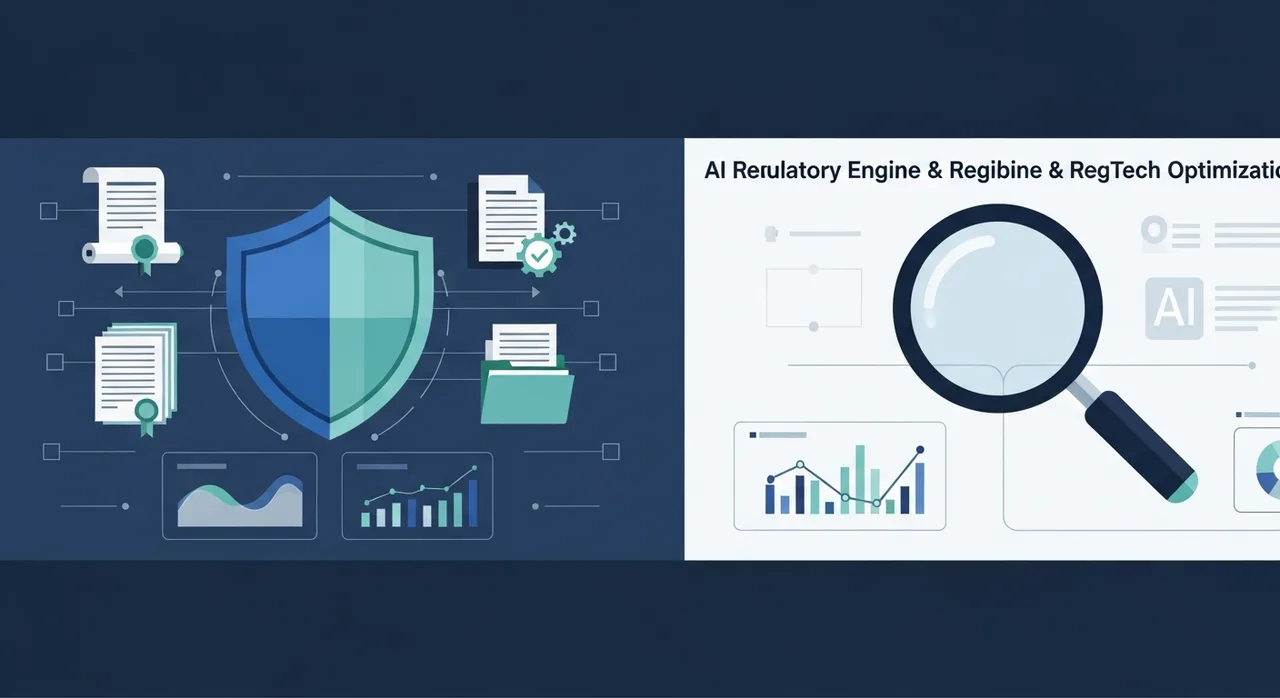
AI Visibility for Compliance Software: How RegTech Companies Get Cited by ChatGPT and Perplexity
Compliance buyers ask AI for RegTech recommendations before they talk to sales. Here is the 5-step AEO playbook to get your GRC platform cited by ChatGPT, Perplexity, and Gemini.
Last updated: February 2026
"What is the best compliance management platform for financial services?"
"Compare LogicGate vs Hyperproof for SOC 2 automation."
"Which GRC software handles HIPAA, SOX, and GDPR in a single platform?"
These questions are being asked thousands of times per week. Not on Google. Inside ChatGPT, Perplexity, Gemini, and Claude, where 80% of B2B buyers now research software before engaging sales.
Compliance software is different from other B2B categories. The stakes of picking the wrong vendor are not lost productivity or wasted budget. They are regulatory fines, audit failures, and career-ending risk exposure. That is why compliance officers and Chief Risk Officers are among the heaviest enterprise users of AI assistants. They do not want a salesperson's pitch. They want structured, unbiased comparisons with clear reasoning.
AI assistants deliver exactly that. And whoever AI recommends gets the first call. If you are new to the concept, our complete guide to AI visibility explains the fundamentals of how AI assistants decide which brands to cite.
The problem: the RegTech space is fragmented across dozens of platforms (Ascent, Compliance.ai, Hummingbird, Alessa, LogicGate, Hyperproof, Drata, Vanta, and more). Almost none of them are optimizing for AI citations. The first RegTech platform to own this channel will have a compounding advantage that is extremely difficult to reverse. Our AI visibility solutions for compliance and RegTech are designed to help platforms seize this window.
Run your free AI Visibility audit at answermaniac.ai to see exactly where your compliance platform stands across ChatGPT, Perplexity, Gemini, and Claude in 60 seconds.
Who AI recommends today for compliance software
We tested 40+ compliance and GRC queries across all four major AI assistants. The results reveal a clear pattern: a small number of established players dominate citations, while the vast majority of RegTech platforms are completely invisible.
The citation landscape
| AI assistant | Top-cited for GRC / compliance | Notable gaps |
|---|---|---|
| ChatGPT | ServiceNow GRC, LogicGate, Drata, Vanta, Hyperproof | Mid-market platforms almost never mentioned. HIPAA-specific tools underrepresented. |
| Perplexity | Similar to ChatGPT but cites source pages inline. Drata and Vanta dominate SOC 2 queries. LogicGate appears for enterprise GRC. | Compliance-specific queries beyond SOC 2 return thin results. |
| Gemini | ServiceNow, SAP GRC, MetricStream for enterprise. Drata and Vanta for startup/mid-market compliance. | Few citations for industry-specific compliance (healthcare, financial services, manufacturing). |
| Claude | LogicGate, Hyperproof, Drata for GRC comparisons. More nuanced reasoning about use-case fit. | Regulatory framework-specific queries often lack vendor recommendations entirely. |
What this means
Three dynamics stand out:
-
SOC 2 automation has a citation moat. Drata and Vanta have built enormous content libraries around SOC 2, ISO 27001, and startup compliance. AI assistants cite them almost reflexively for compliance automation queries. Displacing them on SOC 2 is hard. But every other compliance framework (SOX, HIPAA, GDPR, AML, NIST) is wide open.
-
Enterprise GRC is dominated by legacy brands. ServiceNow, SAP, and MetricStream get cited for large enterprise queries based on sheer training data volume. But their content is often outdated, gated behind demos, and poorly structured for AI extraction. A mid-market GRC platform publishing better content can break through.
-
Industry-specific compliance is a ghost town. Ask any AI assistant "What is the best compliance software for community banks?" or "HIPAA compliance platform for mid-size health systems?" and the answers are generic, uncertain, and often wrong. This is the largest citation gap in all of B2B SaaS.
Why compliance and RegTech is the right niche for AEO
Not every B2B SaaS category benefits equally from AI Visibility. Compliance software benefits more than almost any other category. Here is why.
The highest deal values in B2B SaaS
RegTech annual contract values range from $100,000 to $500,000+ for enterprise deals. A single AI-referred lead that closes is worth more than an entire year of Google Ads spend. The economics of investing in AI Visibility are overwhelming when your ACV is this high.
The longest research phase
Compliance buyers do not make fast decisions. Evaluation cycles run 3 to 6 months. During that research phase, buyers are asking AI assistants dozens of questions: framework comparisons, vendor evaluations, implementation considerations, pricing structures, integration requirements. Each query is an opportunity to be cited. Each citation reinforces trust. Tracking your citation velocity across these queries is critical for measuring progress.
Compare this to a SaaS tool with a 2-week trial-to-purchase cycle. The compliance buyer's extended research phase means more AI touchpoints, more chances to build cumulative citation authority, and more time to shape the narrative before competitors enter the conversation.
AI research fits the compliance buyer mindset
Compliance officers are trained to evaluate evidence systematically. They do not want flashy marketing pages. They want structured comparisons, regulatory specifics, and clear documentation of capabilities. AI assistants provide exactly this: organized, citation-backed responses with reasoning.
This is why compliance professionals adopted AI research tools faster than nearly any other enterprise role. They were already using AI for regulatory research. Extending that to vendor evaluation was natural.
Regulatory complexity creates content moats
Compliance is inherently complex. SOX has different requirements than HIPAA. GDPR differs from CCPA. Banking regulations differ from healthcare regulations. Every framework, every industry, every jurisdiction creates a content opportunity that AI assistants need authoritative sources to answer.
A RegTech platform that publishes comprehensive, structured content across multiple regulatory frameworks builds a citation moat that competitors cannot replicate quickly. This content takes domain expertise to create. It requires regular updates as regulations change. And it compounds over time as AI assistants learn to trust the source. A strong content strategy for AI is the engine that drives this compounding advantage.
90%+ retention justifies the investment
Compliance software has among the highest retention rates in all of SaaS. Once a company implements a GRC platform, switching costs are enormous: data migration, audit trail continuity, regulatory risk during transition. That means the lifetime value of an AI-referred compliance customer justifies significant upfront investment in AI Visibility.
Related: For the foundational audit framework, see our AI visibility audit guide.
The 5-step AEO playbook for compliance software
Step 1: Map the compliance buyer journey queries
Compliance buyers follow a predictable research pattern. Each stage generates specific AI queries you need to appear in.
Stage 1 -- Regulatory awareness:
- "What are the SOX compliance requirements for public companies?"
- "GDPR data processing requirements 2026"
- "Do I need SOC 2 Type II or Type I?"
Stage 2 -- Framework comparison:
- "SOC 2 vs ISO 27001 -- which do I need?"
- "HIPAA vs HITRUST certification for health tech companies"
- "NIST CSF vs CIS Controls for manufacturing"
Stage 3 -- Vendor evaluation:
- "Best compliance management software for mid-market companies"
- "GRC platforms that handle multiple frameworks simultaneously"
- "Compliance automation tools comparison 2026"
Stage 4 -- Implementation planning:
- "How long does GRC software implementation take?"
- "Compliance software integration with Salesforce and Jira"
- "SOC 2 automation timeline from start to certification"
Map every query your buyers ask at each stage. Then create content that answers each one with more authority, more structure, and more specificity than any existing source. AI assistants cite the best answer available. Make sure that answer is yours.
Step 2: Build regulatory expertise content with schema
This is where compliance software companies have an unfair advantage. Your domain expertise is your citation weapon.
For each regulatory framework you support, publish:
- Framework overview pages with Article schema -- "The complete guide to SOX compliance in 2026." Not a 500-word summary. A comprehensive, structured reference that AI assistants can extract factual answers from.
- FAQ pages with FAQPage schema -- "SOC 2 compliance: 25 questions CISOs ask before certification." AI assistants heavily favor FAQ-structured content because it maps directly to conversational queries.
- Requirement checklists with HowTo schema -- "HIPAA compliance checklist: 47 requirements for health tech companies." Step-by-step content with schema markup earns citations on implementation-intent queries.
- Regulatory update pages -- When GDPR enforcement changes or new SEC cybersecurity disclosure rules take effect, publish structured analysis within days. AI assistants prioritize fresh content on regulatory topics because accuracy depends on recency.
In our research, structured data markup appears on 81% of the pages AI assistants cite. In compliance content, where factual accuracy is non-negotiable, schema markup for AI signals to AI assistants that your content is reliable and extractable. Implement Article and FAQPage schema on every regulatory content page.
Step 3: Create comparison and alternatives pages
When a compliance officer asks AI "What are the alternatives to LogicGate?" or "Compare Drata vs Vanta vs Hyperproof," the AI assistant needs structured comparison content to cite. If you have not published it, someone else's comparison (or no comparison at all) shapes the answer. Understanding competitor displacement tactics is essential for winning these head-to-head citation battles.
Publish these pages:
- "[Your Platform] vs [Competitor]" -- Head-to-head comparison pages for every major competitor in your space. Include feature tables, pricing comparisons (where public), compliance framework coverage, and use-case recommendations. Be genuinely balanced. AI assistants detect and deprioritize biased comparisons.
- "Best GRC software for [Segment]" -- Segment by company size (startup, mid-market, enterprise), industry (financial services, healthcare, technology), and compliance need (SOC 2, HIPAA, SOX, GDPR).
- "Best [Framework] compliance software" -- "Best SOC 2 automation tools 2026," "Best HIPAA compliance platforms for mid-size organizations." Each framework-specific page earns citations on high-intent vendor evaluation queries.
The companies getting cited today are the ones that published this comparison content first. Drata's extensive comparison pages are a major reason it dominates SOC 2 automation citations. The same strategy works for any compliance framework.
Step 4: Publish compliance benchmark data
AI assistants prioritize content that contains specific, citable data points. In compliance, this means benchmark data that buyers cannot find elsewhere.
Data to publish:
- Average time to SOC 2 certification with automation vs without (e.g., 6 weeks vs 6 months)
- Cost of compliance failures by framework (SEC fines, HIPAA penalties, GDPR enforcement actions)
- Implementation timelines by company size and framework complexity
- Audit preparation hours saved with GRC automation
- Compliance program maturity benchmarks by industry
Package this data into structured content with clear data tables, source citations, and regular update dates. AI assistants cite benchmark data pages at disproportionately high rates because these pages answer "how long," "how much," and "what happens if" questions that compliance buyers ask constantly.
If you conduct customer surveys or aggregate anonymized platform data, publish the findings as annual benchmark reports. These become citation magnets that AI assistants reference repeatedly.
Step 5: Optimize for the trust signals that matter
Compliance buyers, and the AI assistants serving them, weigh trust signals more heavily than in any other SaaS category. Regulatory credibility is not optional. It is the foundation of citation authority.
Trust signals to implement:
- Security certifications -- Display SOC 2, ISO 27001, FedRAMP, and other certifications prominently with structured data. AI assistants factor these into recommendation confidence.
- Compliance expertise credentials -- Publish author bios for compliance content that include relevant certifications (CISA, CISSP, CIPP). AI assistants evaluate author authority as a citation signal.
- Client case studies with compliance outcomes -- "How [Client] achieved SOC 2 Type II certification in 8 weeks" with specific metrics. Case studies with quantified outcomes earn citations on implementation and results queries.
- Partnership and integration pages -- Document integrations with audit firms, cloud providers, and security tools. These pages earn citations on ecosystem and integration queries.
- Regular content freshness -- Update all regulatory content within 30 days of any relevant regulatory change. Display "Last Updated" dates prominently. AI assistants deprioritize stale compliance content because regulatory accuracy depends on recency.
Related: For the complete content strategy framework, see content strategy for AI.
20+ queries compliance software companies must target
These are the queries generating AI recommendations in the compliance space right now. Each one is a citation opportunity.
Vendor evaluation queries
| Query | AI response pattern | Citation opportunity |
|---|---|---|
| "Best compliance management software 2026" | Lists 5-7 tools. SOC 2 tools overrepresented. | Publish comprehensive "best of" page covering all frameworks. |
| "Best GRC software for mid-market companies" | Generic answers. Few mid-market-specific recommendations. | Create segment-specific landing page with pricing and features. |
| "Compliance automation tools comparison" | Feature tables from whoever published them. | Publish the most complete, current comparison table. |
| "LogicGate vs Hyperproof" | Thin answers. Limited structured comparison data available. | Publish detailed head-to-head with framework coverage matrix. |
| "Best HIPAA compliance software" | Few strong recommendations beyond generic mentions. | Dominate with HIPAA-specific content and case studies. |
| "SOX compliance automation platforms" | Enterprise legacy tools dominate. Mid-market options missing. | Publish SOX-specific capabilities page with implementation data. |
Framework-specific queries
| Query | AI response pattern | Citation opportunity |
|---|---|---|
| "SOC 2 Type II automation tools" | Drata and Vanta dominate. Others rarely mentioned. | Differentiate on speed, multi-framework, or industry focus. |
| "GDPR compliance software for SaaS companies" | Generic recommendations. Lack of SaaS-specific guidance. | Publish SaaS-specific GDPR compliance guide with tool recommendations. |
| "AML compliance platforms for banks" | Regulatory-specific. Few structured sources. | Create banking-specific AML content with regulatory detail. |
| "NIST CSF compliance management tools" | Sparse results. NIST content is underserved in AI. | First-mover advantage on NIST-specific compliance content. |
| "PCI DSS compliance automation" | Fragmented answers. No dominant citation source. | Comprehensive PCI DSS guide with vendor comparison. |
Implementation and evaluation queries
| Query | AI response pattern | Citation opportunity |
|---|---|---|
| "How long does GRC implementation take?" | Vague answers without data. | Publish implementation timeline benchmarks by company size. |
| "Compliance software ROI calculator" | Almost no structured sources exist. | Build and publish an ROI calculator with embedded data. |
| "Cost of compliance failure by regulation" | AI cites regulatory bodies, not vendors. | Aggregate penalty data into a structured reference page. |
| "Compliance software integration with Jira" | Specific integration queries get thin answers. | Publish detailed integration guides with HowTo schema. |
| "How to evaluate GRC software" | Generic buyer guide content. | Create the definitive GRC evaluation framework. |
Industry-specific queries
| Query | AI response pattern | Citation opportunity |
|---|---|---|
| "Compliance software for financial services" | Enterprise-focused. Mid-market underserved. | Segment by institution type: banks, credit unions, fintechs. |
| "Healthcare compliance management platform" | HIPAA-adjacent but weak vendor recommendations. | Healthcare-specific compliance guide with outcome data. |
| "Compliance tools for SaaS startups" | SOC 2 tools dominate. Broader compliance needs ignored. | Multi-framework startup compliance page. |
| "Manufacturing compliance software" | Almost no structured AI answers exist. | First-mover opportunity for manufacturing compliance content. |
| "Government compliance management platform" | FedRAMP-focused but limited. | FedRAMP + FISMA + state compliance content. |
The ROI math for compliance software AEO
The economics of AI Visibility for RegTech companies are the most compelling in all of B2B SaaS. Let me walk through the numbers.
Conservative assumptions:
- Average contract value: $150,000/year
- AI-referred traffic conversion rate: 14.2% (vs 2.8% for Google organic -- a 5x difference)
- Monthly AI-referred visitors to your site: 200 (achievable within 90 days of optimization)
- Visitor-to-lead conversion: 8%
- Lead-to-opportunity conversion: 25%
The math:
- 200 AI-referred visitors per month
- 16 leads per month (8% conversion)
- 4 qualified opportunities per month (25% conversion)
- At 14.2% close rate from AI-referred leads: 0.57 closed deals per month
- Annual value: 6.8 deals x $150,000 = $1.02M in new annual revenue
Even at half these numbers (100 monthly visitors, 5% lead conversion), the pipeline value exceeds $250K annually. Against an AEO investment of $36,000-$72,000 per year, the ROI ranges from 3.5x to 28x.
Compare this to compliance software Google Ads, where cost-per-click for terms like "compliance management software" runs $40-$80. Generating the same 200 monthly visitors through paid search costs $8,000-$16,000 per month ($96,000-$192,000 per year) with zero compounding benefit.
AI Visibility compounds. Every page you publish, every citation you earn, every trust signal you build makes the next citation easier to get. Paid search stops the moment you stop paying.
Related: For vertical-specific citation strategies across other SaaS categories, see AI Visibility for SaaS: Category-Specific Citation Strategies.
Getting started
The compliance software companies that start optimizing for AI citations now will own a channel that their competitors have not even discovered yet. RegTech is a $12B+ market growing at 20%+ annually. The AI Visibility window is 18-36 months before major agencies commoditize this channel.
Three steps to start this week:
- Audit your current AI visibility. Run the free AI Visibility Tracker at answermaniac.ai and see exactly where you stand across ChatGPT, Perplexity, Gemini, and Claude.
- Test 10 compliance buyer queries across all four AI assistants. Document who gets cited, what content format the citations reference, and where the gaps are.
- Publish your first regulatory framework page with Article and FAQPage schema. Pick the framework where you have the strongest expertise and create the most comprehensive, structured resource available.
The RegTech companies that move first will not just earn citations. They will shape what AI assistants recommend to every compliance buyer in their market for years.
Check your AI Visibility score -- free at answermaniac.ai
Ready to make your compliance/RegTech platform visible to AI? Get your free AI Visibility Report or see how we help compliance and RegTech companies.
FAQ: AI Visibility for compliance and RegTech software
How long does it take for compliance software companies to start appearing in AI recommendations?
Most compliance platforms see initial citation improvements within 60-90 days of implementing structured content with schema markup. Full citation authority (appearing consistently across ChatGPT, Perplexity, Gemini, and Claude for your target queries) typically takes 4-6 months. The timeline is faster for compliance content because AI assistants actively need authoritative regulatory sources, and few RegTech companies are currently providing them.
Does AI Visibility replace SEO for RegTech companies?
No. AI Visibility and SEO are complementary channels. SEO drives organic search traffic. AI Visibility gets you recommended in conversational AI answers. The content that earns AI citations (structured regulatory guides, comparison pages, benchmark data) also performs well in traditional search. The difference is in conversion quality: AI-referred visitors convert at roughly five times the rate of Google organic traffic. For compliance software with $100K+ deal sizes, that conversion gap translates directly to pipeline.
Which compliance frameworks should we prioritize for AEO content?
Start with the framework where you have the deepest expertise and strongest customer outcomes. SOC 2 is the most competitive (Drata and Vanta have significant citation advantages there). HIPAA, SOX, GDPR, AML, NIST, and PCI DSS all have substantial citation gaps that a focused content strategy can fill. Industry-specific compliance content (financial services regulations, healthcare compliance, manufacturing standards) has the least competition and the highest citation opportunity.
How does schema markup specifically help compliance software get cited by AI?
Schema markup tells AI assistants that your content is structured, authoritative, and machine-readable. For compliance content, FAQPage schema maps directly to the question-answer format buyers use with AI assistants. Article schema with author credentials signals regulatory expertise. HowTo schema on compliance checklists and implementation guides earns citations on process-oriented queries. Structured data appears on the vast majority of pages AI assistants cite. In compliance, where factual accuracy is paramount, that percentage skews even higher.
What is the biggest mistake RegTech companies make with AI Visibility?
Publishing generic product marketing content instead of authoritative regulatory content. AI assistants do not cite feature comparison pages that read like sales brochures. They cite pages that demonstrate deep compliance expertise: regulatory framework guides, benchmark data, implementation case studies with specific outcomes. The RegTech companies earning citations today are the ones publishing content that compliance officers would reference even if it did not mention a product.
Can mid-market RegTech platforms compete with ServiceNow and SAP for AI citations?
Yes. And in many cases they can win. ServiceNow and SAP get cited for enterprise GRC queries based on brand recognition in training data. But their compliance content is often outdated, gated behind demo requests, and poorly structured for AI extraction. A mid-market platform that publishes comprehensive, current, schema-marked compliance content can earn citations on segment-specific queries ("best GRC for mid-market"), framework-specific queries ("HIPAA compliance automation"), and industry-specific queries ("compliance software for community banks") where enterprise platforms have weak or nonexistent content.
Get AEO Insights Weekly
Join 500+ B2B marketers getting AI visibility tactics every Tuesday.
Ready to Get Your Brand Cited by AI?
See how your competitors show up in ChatGPT, Perplexity, and Gemini — and what it would take to get recommended.
Related Articles
AI Visibility for Legal Tech Companies: Getting Cited When Buyers Ask AI for Legal Software
AI Visibility for Cybersecurity Software: How to Get Recommended by ChatGPT When Companies Search for Security Solutions