AI Visibility for SaaS: Category-Specific Citation Strategies
Category-specific AI visibility strategies for SaaS companies. Tactics for CRM, project management, marketing, cybersecurity, and more B2B verticals.
Direct Answer: Generic AEO strategies underperform for SaaS companies because AI citation patterns vary dramatically across software categories. CRM buyers trigger comparison-heavy queries that reward structured feature matrices, while cybersecurity buyers ask risk-oriented questions that reward technical depth and certification data. A SaaS company optimizing for AI visibility must tailor its content architecture, citation assets, and competitive positioning to the specific query patterns, trust signals, and decision frameworks that define its vertical. Companies that adopt category-specific AEO strategies see 3-5x higher AI citation rates than those following one-size-fits-all playbooks.
Get your SaaS category audit -- see exactly where AI ranks you vs. competitors
Every SaaS marketing leader has read the same AEO advice: structure your content, add schema markup, answer questions directly, keep pages fresh. It is solid advice. It is also not enough.
Here is the problem: when a VP of Sales asks ChatGPT "What's the best CRM for mid-market companies?" the AI draws on entirely different source material, trust signals, and answer structures than when a CISO asks "What endpoint detection platform has the best zero-day protection?" The query intent is different. The competitive landscape is different. The content types AI trusts are different. And yet, most SaaS AEO strategies treat every vertical the same.
This guide breaks that pattern. We analyzed AI citation behavior across six major SaaS categories, mapped the query types that trigger citations in each vertical, and built category-specific optimization playbooks that SaaS marketing teams can execute immediately.
Key Takeaway
- AI citation patterns differ across SaaS verticals -- CRM citations favor comparison tables and pricing transparency, while cybersecurity citations favor technical whitepapers and compliance documentation
- Each SaaS category has 4-6 "anchor queries" that generate the majority of AI-referred traffic; optimizing for these before anything else produces the fastest ROI
- Content format matters more than content volume -- a single well-structured comparison page can outperform 50 blog posts in AI citation frequency
- Company stage determines priority -- early-stage SaaS should focus on category-definition content, while established players should prioritize competitive displacement and authority consolidation
Why SaaS Needs Category-Specific AEO
If you have already run an AI visibility audit, you know whether your brand is being cited. What the audit cannot tell you is why certain competitors dominate citations in your category while others -- sometimes with stronger brands and bigger budgets -- are invisible.
The answer is category-specific citation architecture.
AI models do not treat all software the same. Their training data, the review sites they trust, the query patterns they encounter, and the answer formats they prefer all differ by vertical. Consider three examples:
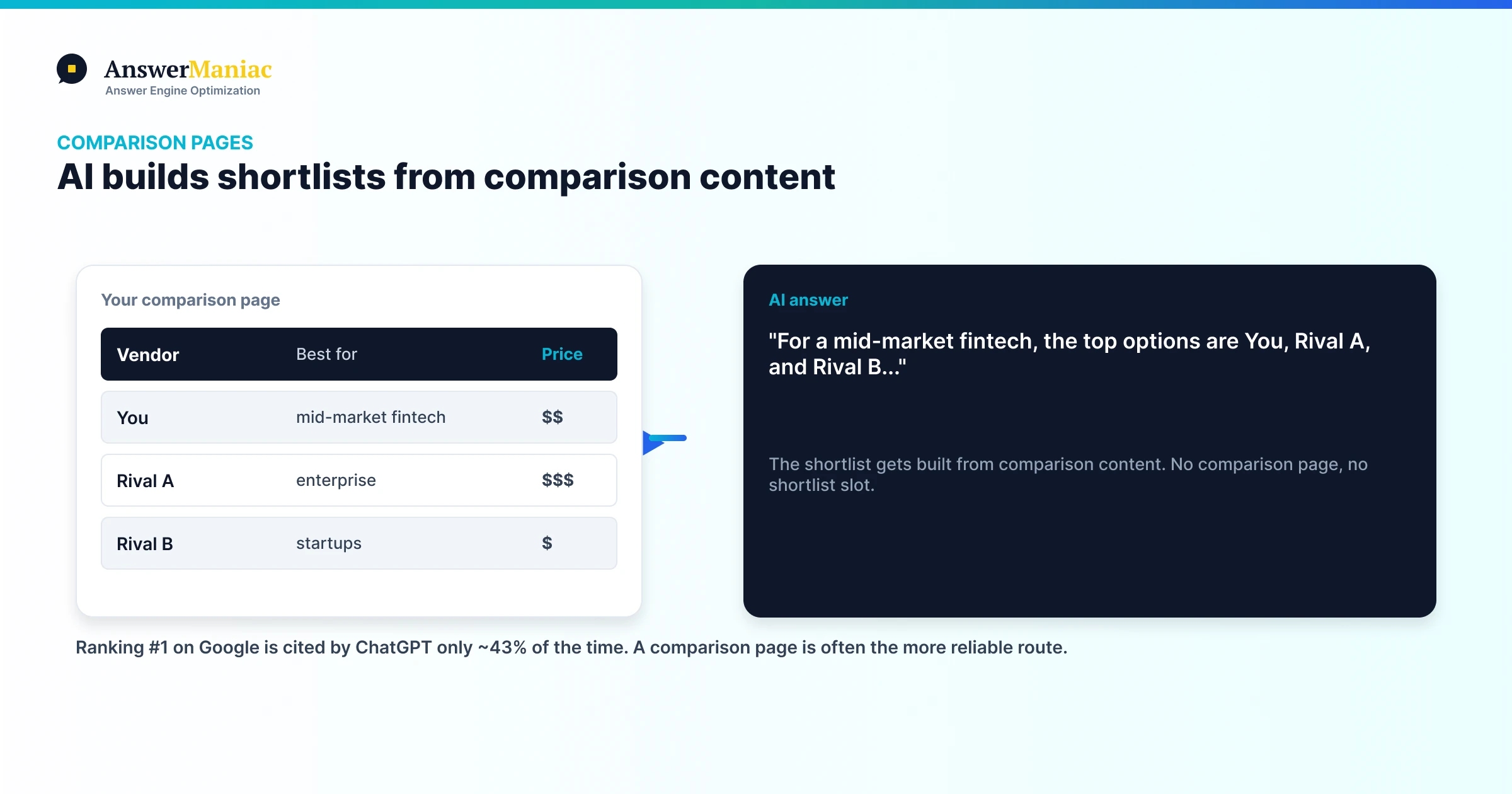
CRM queries are comparison-driven. Over 70% of CRM-related AI queries involve direct comparisons: "Salesforce vs. HubSpot," "best CRM for small business," "CRM pricing comparison." AI assistants respond with structured tables, feature-by-feature breakdowns, and pricing tiers. If your content does not provide this structure, you will not be cited -- regardless of how authoritative your domain is.
Cybersecurity queries are trust-driven. Security buyers ask about certifications, compliance frameworks, threat detection rates, and independent test results. AI models heavily weight content from recognized testing bodies (AV-TEST, MITRE ATT&CK evaluations, Gartner peer reviews). Marketing content without third-party validation is almost never cited in this category.
Project management queries are use-case-driven. Buyers in this space ask "best project management tool for remote teams" or "project management for agencies." AI responses segment by use case rather than feature. Content that is organized around user scenarios outperforms feature-list content by a wide margin.
Understanding these patterns is the difference between an AEO strategy that produces results and one that produces content no AI ever references.
| SaaS Category | Dominant Query Type | Primary AI Source | Content Format That Wins |
|---|---|---|---|
| CRM | Comparison & pricing | G2, Capterra, vendor pages | Feature matrices, pricing tables |
| Project Management | Use-case segmentation | Review sites, blog roundups | Scenario-based guides, workflow templates |
| Marketing Automation | Integration & workflow | Martech blogs, vendor docs | Integration maps, workflow diagrams |
| Cybersecurity | Risk & compliance | Analyst reports, test results | Technical whitepapers, certification pages |
| HR/People Management | Compliance & ease-of-use | HR industry publications | Compliance checklists, implementation guides |
| Analytics/BI | Technical capability | Documentation, Stack Overflow | Query examples, benchmark comparisons |
For a deeper framework on building content AI assistants actually cite, see our content strategy for AI visibility guide.
Vertical 1: CRM Software
The Competitive Landscape
The CRM category is dominated by Salesforce, HubSpot, Zoho CRM, Pipedrive, and Freshsales. Salesforce commands the largest share of AI citations due to its massive content footprint, extensive documentation, and ubiquity in analyst reports. HubSpot has emerged as the strongest challenger in AI visibility, largely because its content strategy -- built on comparison pages, pricing transparency, and freemium positioning -- aligns naturally with how AI assistants construct answers.
Top AI Queries Buyers Ask
- "What is the best CRM for [company size/industry]?"
- "Salesforce vs. HubSpot" (and every permutation of top-5 comparisons)
- "How much does [CRM] cost?"
- "Best free CRM software"
- "CRM for [specific use case: real estate, SaaS, nonprofits]"
Current Citation Patterns
AI assistants overwhelmingly cite comparison and review aggregator pages (G2, Capterra, TrustRadius) when answering CRM queries. Vendor-owned content gets cited when it includes transparent pricing, clear feature differentiation, and structured data. Blog posts that discuss "why CRM matters" or "benefits of CRM" are almost never cited because they do not answer the comparative questions buyers actually ask.
Specific Optimization Tactics
- Build comparison pages against every named competitor. Create dedicated pages for "[Your CRM] vs. Salesforce," "[Your CRM] vs. HubSpot," and so on. Structure each with a comparison table at the top, followed by category-by-category breakdowns. AI models extract these tables directly into answers.
- Publish transparent pricing with a structured pricing table. CRM pricing queries are among the highest-volume AI queries in this category. If your pricing is hidden behind a "Contact Sales" wall, AI cannot cite it -- and it will cite a competitor who publishes pricing openly.
- Create industry-specific landing pages. "Best CRM for real estate" and "best CRM for SaaS startups" are distinct queries with distinct citation pools. Build dedicated pages for each industry you serve, with case studies and metrics specific to that vertical.
- Add structured data (schema markup) for software applications. Use SoftwareApplication schema with pricing, rating, and feature properties. Review our schema markup for AI citations guide for implementation details.
Content Types That Work
- Feature comparison matrices with 8+ dimensions
- Pricing calculators and transparent tier breakdowns
- Industry-specific case studies with ROI metrics
- Migration guides ("How to switch from Salesforce to [Your CRM]")
Expected Timeline
CRM is a highly competitive AI citation landscape. Expect 3-4 months to begin appearing in comparison citations, 6-8 months to consistently rank in "best CRM" queries, and 12+ months to displace entrenched leaders in head-to-head comparisons.
Vertical 2: Project Management Software
The Competitive Landscape
Asana, Monday.com, Notion, ClickUp, Trello, and Jira dominate AI citations in this category. Notably, Notion punches above its traditional market weight in AI visibility because its community-generated content -- templates, workflows, and use-case guides -- creates a dense citation network that AI models trust. Monday.com's aggressive comparison advertising has also translated into strong AI citation presence.
Top AI Queries Buyers Ask
- "Best project management tool for [use case: remote teams, agencies, software development]"
- "Asana vs. Monday.com vs. [competitor]"
- "Free project management software"
- "Best project management tool for small teams"
- "How to manage projects in [tool name]"
Current Citation Patterns
This category is unique in that AI assistants heavily segment answers by use case rather than listing a single "best" tool. A query like "best project management tool" typically returns a categorized response: "For remote teams, consider X. For software development, Y is preferred. For creative agencies, Z offers..." This means there are more citation slots available, and niche players can capture specific segments without competing head-to-head with Asana or Monday.com.
Specific Optimization Tactics
- Own your use-case niche with dedicated landing pages. If you serve agencies, build the definitive "Project Management for Agencies" page with agency-specific workflows, billing integration details, and client collaboration features. AI will cite the most specific, relevant source for each use-case query.
- Create template libraries and make them publicly indexable. Notion's template gallery is one of the most-cited project management resources in AI answers. Build a public template library with detailed descriptions, use-case tags, and preview screenshots. Each template page becomes a citation candidate.
- Publish workflow comparison content. Rather than feature-by-feature comparisons, this category rewards workflow comparisons: "How Asana handles sprint planning vs. how [Your Tool] handles sprint planning." Walk through the actual click-by-click process.
- Target the "free" query cluster aggressively. "Free project management tool" queries drive significant AI citation traffic. If you have a free tier, create a dedicated page that details exactly what is included, with limitations stated clearly and honestly.
Content Types That Work
- Use-case-specific landing pages with workflow walkthroughs
- Template libraries with detailed descriptions
- Team-size-based recommendation guides
- Video walkthroughs embedded in structured content pages
Expected Timeline
The project management category is moderately competitive. Use-case-specific pages can earn citations within 2-3 months. Broad "best project management tool" citations typically require 4-6 months of sustained content investment. Template libraries begin generating citations within 6-8 weeks if properly structured.
Vertical 3: Marketing Automation
The Competitive Landscape
The marketing automation space is dominated by HubSpot Marketing Hub, Marketo (Adobe), Pardot (Salesforce), ActiveCampaign, Mailchimp, and Klaviyo. AI citation patterns in this category skew heavily toward integration capabilities and workflow complexity. HubSpot dominates AI citations here not just because of brand strength, but because its documentation on integrations, workflows, and implementation is exceptionally well-structured for AI extraction.
Top AI Queries Buyers Ask
- "Best marketing automation platform for [company size/type]"
- "HubSpot vs. Marketo" (and permutations)
- "Marketing automation for [specific channel: email, SMS, social]"
- "How to set up [specific workflow: lead scoring, drip campaigns, attribution]"
- "Marketing automation pricing comparison"
Current Citation Patterns
Marketing automation citations are heavily influenced by workflow documentation. When a buyer asks "how to set up lead scoring," AI assistants cite sources that provide step-by-step implementation details, not marketing pages that describe lead scoring conceptually. This creates an opportunity for platforms that invest in detailed, publicly accessible workflow documentation -- essentially turning help docs into citation assets.
Specific Optimization Tactics
- Turn your knowledge base into a public citation engine. Many marketing automation platforms keep their best workflow documentation behind login walls. Make implementation guides, workflow templates, and integration documentation publicly accessible and indexable. Every gated help article is a citation you are handing to a competitor.
- Build integration ecosystem pages. Marketing automation buyers care deeply about what tools integrate with your platform. Create a dedicated integrations directory where each integration has its own page detailing setup steps, data sync capabilities, and use cases. AI frequently cites these pages when users ask about specific integration pairs.
- Create workflow blueprint content. Publish detailed "how to build [specific automation]" guides with visual workflow diagrams, trigger/action breakdowns, and expected results. These are among the most-cited content types in the marketing automation category.
- Publish channel-specific guides. "Best email marketing automation" and "best SMS marketing automation" are different queries with different citation pools. Create dedicated content for each channel you support, with channel-specific metrics and best practices.
Content Types That Work
- Integration directory pages with setup documentation
- Workflow blueprint guides with visual diagrams
- Channel-specific automation playbooks
- ROI calculators with industry benchmarks
- Migration guides from competitor platforms
Expected Timeline
Marketing automation is a crowded but structured category. Integration pages can earn citations within 4-6 weeks. Workflow documentation typically takes 2-3 months to gain citation traction. Competitive displacement against entrenched leaders like HubSpot requires 6-12 months of consistent content investment. See our guide on competitor displacement strategies for detailed tactics.
Vertical 4: Cybersecurity Software
The Competitive Landscape
CrowdStrike, Palo Alto Networks, SentinelOne, Fortinet, and Zscaler dominate AI citations in cybersecurity. This category is fundamentally different from other SaaS verticals because AI citation trust is overwhelmingly driven by third-party validation rather than vendor-produced content. Independent test results, analyst evaluations, and compliance certifications carry 5-10x more citation weight than marketing content.
Top AI Queries Buyers Ask
- "Best endpoint detection and response (EDR) platform"
- "CrowdStrike vs. SentinelOne" (and permutations)
- "Best cybersecurity solution for [compliance framework: SOC 2, HIPAA, FedRAMP]"
- "How to protect against [specific threat type]"
- "SIEM vs. XDR vs. EDR -- what's the difference?"
Current Citation Patterns
AI assistants in the cybersecurity space rely heavily on three source types: independent testing organizations (MITRE ATT&CK evaluations, AV-TEST, SE Labs), analyst firms (Gartner Magic Quadrant, Forrester Wave), and technical documentation with specific detection metrics. Vendor blog posts about "the importance of cybersecurity" are almost never cited. What gets cited is content that includes specific detection rates, response times, false positive rates, and compliance certifications.
Specific Optimization Tactics
- Publish your independent test results prominently. If you participate in MITRE ATT&CK evaluations, AV-TEST, or other recognized testing frameworks, create dedicated results pages with structured data. Include detection percentages, response times, and year-over-year improvement metrics. AI models extract these specific numbers into answers.
- Build compliance framework mapping pages. Create dedicated pages for each compliance framework you support (SOC 2, HIPAA, PCI DSS, FedRAMP, GDPR). Map your specific capabilities to each framework requirement with a structured table. These pages earn citations when buyers ask compliance-specific questions.
- Create threat intelligence content with original data. Publish threat reports, attack trend analyses, and vulnerability assessments using your own telemetry data. Original research with specific statistics is among the highest-cited content types in cybersecurity AI queries.
- Develop technical comparison content with quantified metrics. Generic "us vs. them" pages do not work in cybersecurity. Comparisons must include specific, verifiable metrics: detection rates, mean time to detect (MTTD), mean time to respond (MTTR), false positive rates, and deployment complexity scores.
Content Types That Work
- Independent test result summaries with structured data
- Compliance framework mapping tables
- Threat intelligence reports with original data
- Technical architecture documentation
- Integration guides for SIEM/SOAR/XDR ecosystems
Expected Timeline
Cybersecurity is the most trust-dependent SaaS vertical for AI citations. Without independent test results or analyst recognition, earning citations is extremely difficult. Companies with third-party validation can begin appearing in AI answers within 2-3 months. Companies without it should budget 6-12 months to build the credibility infrastructure (participating in evaluations, earning certifications, publishing original research) before expecting meaningful AI citation presence.
Vertical 5: HR/People Management Software
The Competitive Landscape
BambooHR, Gusto, Rippling, Workday, ADP, and Namely lead AI citations in HR software. This vertical has a distinctive citation dynamic: compliance and regulatory content drives a disproportionate share of citations because HR buyers frequently ask AI about labor law requirements, benefits administration rules, and payroll tax obligations -- and AI cites the platforms that provide authoritative answers to these regulatory questions.
Top AI Queries Buyers Ask
- "Best HR software for small business"
- "BambooHR vs. Gusto vs. Rippling"
- "How to handle [specific HR process: onboarding, performance reviews, offboarding]"
- "Payroll software with [specific feature: multi-state, contractor payments, benefits]"
- "[State/country] employment law requirements for [specific topic]"
Current Citation Patterns
HR software AI citations split into two distinct pools: product comparison citations (which function similarly to CRM citations) and regulatory/compliance citations (which are unique to this vertical). The second pool is larger and less competitive. Companies like Gusto have built enormous AI citation footprints not through product pages but through their employer compliance guides, tax calculators, and state-by-state employment law resources. This content gets cited even when the user is not asking about Gusto specifically.
Specific Optimization Tactics
- Build a comprehensive compliance resource center. Create state-by-state employment law guides, benefits administration requirement pages, and payroll tax obligation summaries. Update these quarterly. This content functions as a citation magnet that introduces your brand to buyers who may not have been searching for HR software directly.
- Create process-specific workflow guides. HR buyers frequently ask "how to" questions: how to run payroll for the first time, how to set up benefits enrollment, how to handle employee termination. Build step-by-step process guides that reference your platform's specific workflow while providing universally applicable guidance.
- Publish company-size-specific recommendation pages. "Best HR software for 50 employees" and "best HR software for 500 employees" return different AI answers. Create dedicated pages for each company size segment with tailored feature recommendations and pricing.
- Develop ROI and cost-of-manual-process calculators. HR buyers are often justifying the cost of new software to leadership. Interactive calculators that estimate time saved, error reduction, and compliance risk reduction get cited frequently because AI can reference the methodology and typical results.
Content Types That Work
- State-by-state compliance guides updated quarterly
- Employee lifecycle process guides (hire-to-retire)
- Company-size recommendation matrices
- Payroll and benefits calculators with structured output
- Implementation timelines and onboarding checklists
Expected Timeline
HR software is a moderately competitive category with significant opportunity in compliance content. Compliance resource pages can begin earning citations within 4-6 weeks -- faster than almost any other content type in any SaaS vertical. Product comparison citations take 3-5 months. Displacing established citation leaders in "best HR software" queries requires 6-9 months of sustained content investment.
Vertical 6: Analytics & Business Intelligence
The Competitive Landscape
Tableau, Looker (Google), Power BI (Microsoft), Metabase, Domo, and Sisense dominate AI citations in BI. This vertical has the most technically oriented citation landscape of any SaaS category. AI models heavily weight documentation quality, community content (Stack Overflow, GitHub discussions), and technical tutorial depth when constructing answers about analytics tools.
Top AI Queries Buyers Ask
- "Best business intelligence tool for [company size/technical level]"
- "Tableau vs. Power BI vs. Looker"
- "How to [specific analysis task] in [tool name]"
- "Best BI tool for [data source: Snowflake, BigQuery, Postgres]"
- "Self-service analytics platform comparison"
Current Citation Patterns
Analytics and BI citations are the most technically driven of any SaaS category. When a buyer asks "how to create a dashboard in Tableau," AI cites documentation pages, community forum answers, and technical tutorials -- not marketing pages. This means that documentation quality is the primary competitive lever for AI visibility. Power BI benefits enormously from Microsoft's documentation infrastructure. Looker benefits from Google Cloud's technical content ecosystem. Independent BI tools must build their own documentation-as-citation-asset strategy.
Specific Optimization Tactics
- Treat documentation as your primary marketing channel. Every documentation page should be publicly accessible, well-structured, and rich with examples. Include code snippets, SQL examples, and visual outputs. AI models cite documentation pages 4x more often than marketing pages in the BI category.
- Build data-source-specific connection guides. "How to connect [Your Tool] to Snowflake" and every permutation for major data sources. Each guide should include setup steps, query examples, performance optimization tips, and common troubleshooting steps. These are high-citation pages because they answer specific, actionable questions.
- Publish benchmark comparisons with real query performance data. BI buyers care about speed. If your platform can demonstrate query performance advantages, publish benchmarks with specific datasets, query types, and response times. AI cites performance data when buyers ask about speed and scalability.
- Create "how-to" tutorial content for common analysis tasks. Build tutorials for tasks like cohort analysis, funnel visualization, churn prediction dashboards, and executive reporting. Structure each tutorial with the query/formula, expected output, and use-case context.
- Develop integration content for the modern data stack. Map your integrations with dbt, Fivetran, Airbyte, Snowflake, BigQuery, and other data infrastructure tools. AI frequently cites integration-specific content when buyers ask about building data pipelines.
Content Types That Work
- Comprehensive API and product documentation
- Data source connection guides with code examples
- Performance benchmark reports with real metrics
- Step-by-step analysis tutorials
- Modern data stack integration architecture pages
Expected Timeline
BI and analytics is a technically demanding category. Documentation-driven citation strategies can begin showing results in 6-8 weeks if your documentation is well-structured. Tutorial content earns citations within 2-3 months. Competitive displacement in "best BI tool" queries is a long-term play requiring 8-12 months, primarily because Tableau, Power BI, and Looker have massive documentation footprints that are difficult to outpace.
Cross-Category Patterns: What Works Across All SaaS Verticals
After analyzing citation behavior across these six verticals, several patterns emerge that apply regardless of category.
1. Structured Comparison Content Outperforms Everything Else
In every vertical, structured comparison pages -- those with tables, feature matrices, and side-by-side breakdowns -- earn more AI citations than any other content type. This is not surprising. AI assistants are frequently asked to compare tools, and they need structured source material to construct comparison answers. If you build one type of content first, make it comparison content.
2. Pricing Transparency Correlates With Citation Frequency
Across all six categories, companies that publish transparent pricing receive more AI citations than those that gate pricing behind sales conversations. AI models cannot cite what they cannot access. More importantly, pricing queries represent some of the highest-intent queries in every category, and AI assistants actively seek out sources that provide specific pricing data.
3. Third-Party Validation Amplifies Vendor Content
In every category, AI citations reference a mix of vendor-produced content and third-party sources. Companies that appear prominently in third-party sources (G2, Gartner, industry publications) see their own vendor content cited more frequently -- as if the third-party validation increases the trust weight of the vendor's own pages.
4. Freshness Signals Matter More Than Domain Authority
A recently published, well-structured page from a smaller vendor consistently outperforms an older, poorly structured page from a market leader. AI models weight publication dates and update frequencies heavily. Quarterly content refreshes with visible "last updated" timestamps are a simple but powerful tactic across all categories.
5. Public Documentation Is an Underutilized Citation Asset
In categories where documentation is public (analytics, cybersecurity, marketing automation), documentation pages earn more citations than marketing pages. Most SaaS companies treat documentation as a support tool. The companies winning at AI visibility treat it as a marketing channel.
For a comprehensive overview of these principles, see our AI visibility guide.
The SaaS AEO Priority Matrix
Not every SaaS company should execute the same tactics in the same order. Your company stage determines your AEO priority sequence.
Early-Stage SaaS (Pre-Product-Market Fit to Series A)
Priority 1: Category Definition Content You are likely competing in a category where buyers do not yet know your name. Your goal is to appear in AI answers for category-level queries ("best [category] software") rather than branded queries. Focus on:
- One comprehensive comparison page positioning you against the top 3 incumbents
- One "best [category] for [your target segment]" page
- Transparent pricing page with structured data
Priority 2: Use-Case-Specific Pages Build 3-5 pages targeting the specific use cases where you have the strongest product-market fit. These niche queries are less competitive and faster to win.
Priority 3: Integration Content Document your integration ecosystem early. AI frequently cites integration-specific content, and this is content that larger competitors often neglect for emerging integration partners.
Growth-Stage SaaS (Series A to Series C)
Priority 1: Competitive Displacement You have some brand recognition. Now you need to displace competitors in head-to-head comparisons. Build comparison pages against every named competitor, invest in competitor displacement strategies, and ensure your G2 and Capterra profiles are optimized.
Priority 2: Content Authority Building Publish original research, industry benchmarks, and data-driven reports. This is the stage where investing in thought leadership content pays off in AI citation authority.
Priority 3: Documentation as Marketing Transform your knowledge base from a support tool into a citation engine. Make all documentation public, add structured data, and ensure every help article is a potential AI citation source.
Enterprise SaaS (Series C+ / Public)
Priority 1: Citation Consolidation You likely already appear in many AI answers. The goal is to increase citation share and ensure accuracy. Monitor AI outputs weekly, correct inaccuracies through content updates, and expand coverage across adjacent queries.
Priority 2: Analyst and Third-Party Strategy Invest in analyst briefings, independent testing participation, and industry publication partnerships. At this stage, third-party citations are often more impactful than additional vendor content.
Priority 3: International and Localized Content Expand your AI visibility into non-English markets by creating localized comparison pages, pricing pages, and documentation in key languages.
| Company Stage | First 30 Days | 30-90 Days | 90-180 Days |
|---|---|---|---|
| Early-Stage | Top competitor comparison page + pricing page | 3-5 use-case pages + integration docs | Category-level authority content |
| Growth-Stage | Competitor displacement pages (all named competitors) | Original research + benchmarks | Public documentation overhaul |
| Enterprise | Citation monitoring + accuracy corrections | Analyst and third-party strategy | International content expansion |
Explore our AEO and GEO services to see how we build these strategies for SaaS companies at every stage, or check our pricing plans to find the right fit for your team.
Frequently Asked Questions
How long does it take for a SaaS company to start appearing in AI citations?
The timeline depends on your vertical and current content foundation. SaaS companies with existing structured content (comparison pages, documentation, pricing pages) can begin earning AI citations within 4-8 weeks of implementing AEO optimizations. Companies starting from scratch should expect 3-6 months before consistent citation presence. The fastest path is always structured comparison content -- in every SaaS vertical we studied, comparison pages earned citations faster than any other content type.
Should SaaS companies optimize for ChatGPT, Perplexity, or Gemini first?
Prioritize based on where your buyers are searching. For B2B SaaS, ChatGPT and Perplexity currently drive the most qualified referral traffic. Perplexity provides source attribution, making it easier to track citation performance. Gemini matters most for SaaS companies in Google-adjacent categories (analytics, cloud infrastructure, productivity). Our recommendation: optimize your content structure once (using the category-specific tactics above), and you will earn citations across all three platforms because the underlying content qualities AI models reward are consistent. For more details on auditing your presence across all platforms, see our AI visibility audit guide.
Can smaller SaaS companies compete with incumbents like Salesforce or HubSpot in AI visibility?
Yes, but not by competing on the same terms. Smaller SaaS companies win AI citations by targeting niche queries that incumbents do not optimize for. "Best CRM" is a query you will not win against Salesforce in the short term, but "best CRM for commercial real estate brokerages" is a query that Salesforce has not built a dedicated page for. Every SaaS vertical has dozens of these niche query opportunities. The companies that map their unique strengths to underserved query segments build citation presence faster than those trying to compete head-on for category-level queries.
How do I measure AI citation ROI for my SaaS product?
Measure AI citation performance across three tiers. First, track citation presence: how often does your brand appear when AI answers queries in your category? Use our audit tool to baseline this. Second, track referral traffic: monitor traffic from ai.chatgpt.com, perplexity.ai, and gemini.google.com in your analytics platform. Third, track pipeline impact: tag AI-referred leads in your CRM and measure conversion rate, deal velocity, and average contract value against other channels. SaaS companies we work with typically see AI-referred traffic convert at 3-5x the rate of organic search traffic because AI-referred buyers arrive with higher intent and more pre-purchase education.
Start With Your Category
Generic AEO advice will not move the needle for your SaaS company. Your buyers ask specific questions. Your competitors have specific citation advantages. Your content needs a specific strategy built for the dynamics of your vertical.
Pick your category from the six above. Identify the 4-5 anchor queries your buyers are asking AI. Audit your current citation presence for those queries. Then build the content assets -- comparison pages, documentation, compliance guides, benchmark reports -- that your specific vertical rewards.
Or let us do it for you. Our SaaS AEO programs are built around the category-specific frameworks in this guide, customized to your competitive landscape and buyer journey.
See pricing and get started with your SaaS AI visibility strategy
Get AEO Insights Weekly
Join 500+ B2B marketers getting AI visibility tactics every Tuesday.
Ready to Get Your Brand Cited by AI?
See how your competitors show up in ChatGPT, Perplexity, and Gemini — and what it would take to get recommended.