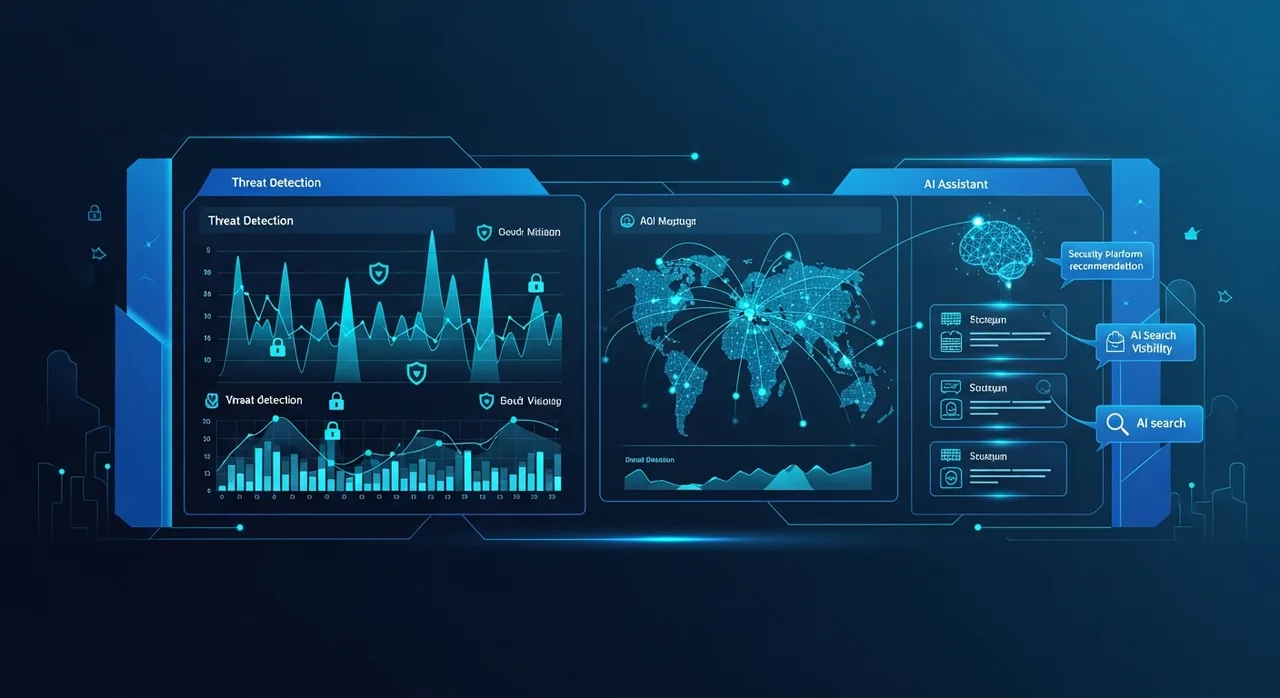
AI Visibility for Cybersecurity Software: How to Get Recommended by ChatGPT When Companies Search for Security Solutions
CrowdStrike and Palo Alto Networks dominate AI recommendations for cybersecurity. Your platform is invisible. Here's the 5-step AEO playbook to get cited by ChatGPT, Perplexity, Gemini, and Claude in 90 days.
Last updated: February 2026
Ask ChatGPT: "What is the best endpoint detection and response platform for mid-size companies?"
The answer names three to five vendors. CrowdStrike Falcon appears almost every time. SentinelOne is right behind it. Microsoft Defender for Endpoint shows up for Microsoft-heavy environments. After that, the field drops sharply. Everyone else is invisible.
If your cybersecurity platform is not in that answer, you are losing deals. Not hypothetical future deals. Current deals with CISOs, security architects, and IT directors who are evaluating security solutions right now.
80% of B2B buyers use AI assistants to research software before talking to sales. The global cybersecurity market surpassed $200 billion in 2025 and is projected to reach $350 billion by 2030, growing at over 12% CAGR. When a CISO asks Perplexity which SIEM platform handles cloud-native workloads, or a CTO asks Gemini to compare zero trust network access solutions, the AI does not return ten blue links. It returns direct recommendations. Three to five names. Your platform is either cited or it does not exist. For a deeper understanding of how this shift works, read our complete guide to AI visibility.
AI-referred traffic converts at 14.2%, compared to 2.8% for Google organic search. That is a 5x difference. The security professionals clicking AI recommendations are further along in their buying process, have higher intent, and are more likely to request a proof-of-concept. You are losing the highest-converting traffic channel in cybersecurity.
The cybersecurity market is one of the most fragmented in all of B2B technology. Over 3,500 vendors compete across overlapping categories: endpoint detection and response, SIEM and SOAR, identity and access management, cloud security, email security, network security, vulnerability management, application security, and dozens more. That fragmentation creates a massive AI Visibility opportunity. The platforms that structure their content for AI citation across these categories will dominate recommendations while competitors remain invisible. Explore our AI visibility solutions for cybersecurity companies to see how this applies to your platform.
Fewer than 15% of cybersecurity companies have optimized for AI citations. The window is open. It will not stay open.
This article is the complete AI Visibility playbook for cybersecurity software companies. What AI recommends today, why cybersecurity is uniquely suited for this strategy, and the five steps to get your platform cited across ChatGPT, Perplexity, Gemini, and Claude within 90 days.
Check your cybersecurity platform's AI Visibility score right now -- free at answermaniac.ai
How security leaders search for cybersecurity software using AI
Security professionals do not search for technology the way they used to. The buying journey has shifted from analyst reports, Google keyword searches, and conference demos to conversational AI research. Understanding how CISOs, security engineers, and IT directors use AI assistants reveals where the citation opportunities are.
By security function
Cybersecurity buyers search by the specific function they need to solve. Each function generates its own cluster of high-intent queries.
Endpoint detection and response (EDR/XDR)
CISOs and security operations managers search for:
- "Best endpoint detection and response platform 2026"
- "CrowdStrike vs SentinelOne for enterprise EDR"
- "XDR platform comparison for mid-market companies"
- "Endpoint security with automated threat response"
- "Best EDR for remote workforce protection"
Endpoint security is the most competitive AI citation category in cybersecurity. CrowdStrike and SentinelOne dominate. But segment-specific queries, by company size, industry, and deployment model, remain wide open.
SIEM and SOAR
Security operations teams and their leaders search for:
- "Best SIEM platform for cloud environments"
- "Splunk alternatives for mid-market companies"
- "SIEM with built-in SOAR automation"
- "Cloud-native SIEM comparison 2026"
- "Best security analytics platform for SOC teams"
SIEM is undergoing a generational shift from on-premise log management to cloud-native security analytics. The established players (Splunk, now part of Cisco) compete with cloud-native challengers (Microsoft Sentinel, Google Chronicle, Sumo Logic, Elastic Security). AI citations in this category are fluid and vulnerable to disruption.
Identity and access management (IAM)
IT directors and security architects search for:
- "Best identity and access management platform 2026"
- "Okta vs Microsoft Entra ID comparison"
- "Zero trust identity platform for enterprise"
- "Privileged access management software comparison"
- "SSO and MFA platform for mid-size companies"
IAM queries split between workforce identity (Okta, Microsoft Entra ID, Ping Identity) and privileged access management (CyberArk, BeyondTrust, Delinea). AI assistants often conflate these subcategories, creating opportunities for platforms that publish clear segment-specific content.
Cloud security
Cloud architects and DevSecOps teams search for:
- "Best cloud security posture management platform"
- "CNAPP comparison 2026"
- "Wiz vs Lacework vs Orca Security"
- "Cloud workload protection platform for AWS"
- "Container security and Kubernetes protection"
Cloud security is one of the fastest-growing and most fragmented cybersecurity segments. New categories like CNAPP (Cloud-Native Application Protection Platform) are still being defined. AI assistants struggle to give confident answers because the category is evolving faster than content can keep up. First movers in AI-optimized cloud security content will own this space.
Email security
IT administrators and security teams search for:
- "Best email security gateway 2026"
- "Proofpoint vs Mimecast comparison"
- "AI-powered email threat protection"
- "Business email compromise prevention platform"
- "Email security for Microsoft 365"
Email security queries are high-volume and high-intent. Most organizations evaluate email security solutions every 2-3 years, and AI assistants are increasingly where that evaluation starts.
By query type
Comparison queries
Head-to-head comparisons generate the highest-intent AI traffic in cybersecurity:
- "CrowdStrike vs SentinelOne"
- "Palo Alto Networks vs Fortinet"
- "Okta vs Microsoft Entra ID"
- "Wiz vs Orca Security"
- "Proofpoint vs Mimecast"
The platform that publishes structured, balanced comparison content controls what AI cites. Most cybersecurity vendors avoid naming competitors. That leaves a content vacuum that AI assistants fill with whatever third-party source is available, or with uncertain, generic answers. For a proven framework on winning these head-to-head battles, see our guide on competitor displacement.
Compliance-driven queries
Compliance requirements drive a massive share of cybersecurity purchasing:
- "HIPAA compliant endpoint protection"
- "FedRAMP authorized SIEM platform"
- "PCI DSS compliant security monitoring"
- "SOC 2 security tools for SaaS companies"
- "CMMC compliant cybersecurity platform for defense contractors"
These queries have specific, verifiable answers. AI assistants need authoritative sources to cite. Few cybersecurity vendors structure their compliance content for AI extraction. The gap is enormous.
Segment-specific queries
Buyers search by their organizational profile:
- "Best cybersecurity platform for SMB"
- "Enterprise security suite comparison"
- "Cybersecurity for healthcare organizations"
- "Financial services cybersecurity requirements"
- "Cybersecurity software for manufacturing OT environments"
Incident-driven queries
After breaches, regulatory changes, or major vulnerabilities, security professionals ask AI for immediate guidance:
- "Best ransomware protection platform 2026"
- "How to prevent supply chain attacks"
- "Zero day vulnerability response tools"
- "Incident response platform comparison"
- "Breach detection and response tools"
Incident-driven queries spike unpredictably but generate extremely high-intent traffic. The cybersecurity companies with fresh, structured content ready for these queries capture citations when demand surges.
Related: For the foundational audit framework, see AI Visibility Score: How to Audit Your Website for ChatGPT Citations.
The competitive landscape: who AI recommends today
We tested 60+ cybersecurity queries across ChatGPT, Perplexity, Gemini, and Claude in February 2026. The citation landscape reveals entrenched leaders, vulnerable mid-tier players, and massive gaps that any cybersecurity company can exploit. Understanding your citation velocity -- how quickly and consistently you earn new AI mentions -- is key to tracking progress in this landscape.
Tier 1: dominant citation holders
These vendors appear in AI recommendations across all four platforms, consistently and confidently.
| Vendor | ChatGPT | Perplexity | Gemini | Claude | Primary citation categories |
|---|---|---|---|---|---|
| CrowdStrike | Cited in nearly all endpoint and XDR queries. Often first named. | Cited with source links to CrowdStrike.com and analyst reports | Dominant for EDR, XDR, and threat intelligence queries | Cited with detailed analysis of Falcon platform capabilities | Endpoint, XDR, threat intelligence |
| Palo Alto Networks | Cited consistently for network security, SASE, and platform queries | Cited with links to product pages and Gartner quadrant references | Cited for firewall, SASE, and security platform consolidation | Cited with nuanced analysis of platform breadth vs depth | Network security, SASE, cloud security, platform |
| Microsoft Security | Cited for Defender, Sentinel, Entra ID across ecosystem queries | Cited heavily for Microsoft 365 and Azure security queries | Dominant for Microsoft ecosystem security queries | Cited with context about Microsoft integration advantages and limitations | Endpoint, SIEM, IAM, cloud security |
| Fortinet | Cited for UTM, SD-WAN, and mid-market security queries | Cited with links to FortiGate and FortiSIEM product pages | Cited for network security and unified platform queries | Cited for cost-effective enterprise security positioning | Network security, UTM, SD-WAN |
These four vendors have citation dominance through massive brand recognition, extensive content libraries, and years of analyst coverage baked into AI training data. Displacing them on broad queries is hard. Displacing them on segment-specific, compliance-specific, and category-specific queries is absolutely achievable.
Tier 2: consistent but category-limited
| Vendor | ChatGPT | Perplexity | Gemini | Claude | Primary citation categories |
|---|---|---|---|---|---|
| SentinelOne | Cited alongside CrowdStrike for EDR comparisons | Cited with source links for endpoint queries | Cited for autonomous endpoint protection | Cited as CrowdStrike's primary competitor in EDR | Endpoint, XDR |
| Zscaler | Cited for zero trust, SASE, and cloud security queries | Cited with links to Zscaler.com for ZTNA | Cited for zero trust network access and secure web gateway | Cited for cloud-delivered security architecture | SASE, zero trust, cloud security |
| Okta | Cited for IAM and workforce identity queries | Cited with source links for identity management | Cited for SSO, MFA, and identity platform queries | Cited as IAM leader with breach history context | Identity, access management |
| Splunk (Cisco) | Cited for SIEM queries, often with legacy positioning | Cited with links to Splunk.com and Cisco integration content | Cited for security analytics and log management | Cited with context about Cisco acquisition impact | SIEM, security analytics |
| Proofpoint | Cited for email security and phishing protection | Cited with links for email threat intelligence | Cited for email gateway and BEC prevention | Cited for email-focused threat protection | Email security |
Tier 2 vendors get cited reliably in their primary categories but are invisible outside them. SentinelOne does not appear in SIEM queries. Zscaler does not appear in endpoint queries. Each has a citation ceiling that can be broken only by publishing content in adjacent categories, or by competitors publishing better content within their core category.
Tier 3: inconsistent or invisible
| Vendor | ChatGPT | Perplexity | Gemini | Claude | Citation status |
|---|---|---|---|---|---|
| Sophos | Occasionally cited for SMB security | Cited inconsistently with links to review sites | Cited for mid-market and managed security | Sometimes cited for SMB endpoint | Inconsistent |
| Trend Micro | Cited occasionally for cloud and endpoint | Cited with links to product pages, declining frequency | Cited inconsistently | Occasionally cited for multi-layer security | Inconsistent |
| Carbon Black (VMware/Broadcom) | Rarely cited independently post-acquisition | Inconsistent, often referenced historically | Rarely cited for current recommendations | Occasionally cited with acquisition context | Weak |
| Darktrace | Cited for AI-driven threat detection queries | Cited with links for AI and NDR discussions | Cited inconsistently for network detection | Cited for AI-native security positioning | Inconsistent, niche |
| Snyk | Cited for developer security and AppSec | Cited with links for application security | Cited for DevSecOps and code security | Cited for developer-first security | Moderate, niche |
| Wiz | Cited for cloud security posture management | Cited with links for CNAPP queries | Cited for cloud-native security | Cited as cloud security leader with analysis | Moderate, rising |
| Lacework | Cited occasionally for CNAPP and cloud security | Cited inconsistently | Cited alongside Wiz for cloud security | Occasionally cited for cloud workload protection | Weak |
| Arctic Wolf | Rarely cited for MDR-specific queries | Cited occasionally for managed detection | Rarely cited | Occasionally cited for managed security operations | Weak |
The gaps in cybersecurity AI citations are staggering. Application security beyond Snyk is a ghost town. Managed detection and response is barely cited. OT/ICS security is invisible. Data loss prevention, security awareness training, attack surface management, vulnerability management -- entire categories with billions in annual spending have little to no structured AI citation presence. Any vendor in these categories that publishes schema-marked, comparison-driven content will own citations by default.
By security category
| Category | Dominant citation holders | Major gaps |
|---|---|---|
| Endpoint (EDR/XDR) | CrowdStrike, SentinelOne, Microsoft Defender | Industry-specific endpoint (healthcare, manufacturing OT), SMB segment |
| SIEM/SOAR | Splunk, Microsoft Sentinel, Google Chronicle | Mid-market SIEM, cloud-native alternatives, SOAR-specific queries |
| Identity (IAM) | Okta, Microsoft Entra ID, CyberArk | PAM-specific queries, non-enterprise IAM, identity governance |
| Cloud Security | Wiz, Palo Alto Prisma, Zscaler | Multi-cloud comparisons, CWPP-specific, container security, IaC security |
| Email Security | Proofpoint, Mimecast | API-based email security, BEC-specific, phishing simulation |
| Network Security | Palo Alto, Fortinet | NDR-specific, microsegmentation, OT network security |
| Application Security | Snyk | SAST/DAST comparisons, API security, SCA, SBOM |
| Vulnerability Management | Tenable, Qualys (inconsistent) | ASM, CTEM, risk-based VM, cloud vulnerability management |
| Security Awareness | Nearly invisible | Entire category is uncontested in AI citations |
| MDR/MSSP | Nearly invisible | Managed security comparisons almost nonexistent |
Why cybersecurity software is built for AEO
Not every B2B software category benefits equally from AI Visibility. Cybersecurity is among the strongest AEO niches in all of technology. Six reasons explain why.
1. Enormous market fragmentation by function
Cybersecurity is not one market. It is dozens of overlapping markets: endpoint, SIEM, IAM, cloud security, email security, network security, application security, vulnerability management, DLP, CASB, SASE, ZTNA, MDR, MSSP, GRC, security awareness training, threat intelligence. Each function generates its own set of buyer queries. Each set is a citation opportunity.
This fragmentation means the total addressable query universe in cybersecurity is five to ten times larger than a typical B2B SaaS category. A CISO asking about XDR consolidation uses completely different language than a DevSecOps engineer asking about container security. Both are high-value queries. Both need targeted content. Most cybersecurity vendors optimize for their primary category and are invisible in adjacent ones.
For vendors that span multiple categories, or vendors in underserved categories, the citation opportunity is enormous.
2. Compliance requirements create content moats
Compliance drives a massive share of cybersecurity purchases. Every compliance framework -- SOC 2, HIPAA, PCI DSS, FedRAMP, CMMC, GDPR, CCPA, NIST 800-53, ISO 27001, SOX, NERC CIP -- creates a unique set of queries that AI assistants need authoritative sources to answer.
When a healthcare CISO asks "What cybersecurity tools are required for HIPAA compliance?" the AI assistant needs a structured, authoritative source. When a defense contractor asks "Which SIEM platforms are CMMC Level 3 compliant?" the AI needs specific, verifiable data. Few cybersecurity companies publish compliance mapping content structured for AI extraction.
This compliance content takes genuine security domain expertise to produce, must be updated as frameworks evolve, and cannot be replicated by generic content agencies. The moat compounds year over year.
3. The threat landscape constantly evolves
Cybersecurity is unique among B2B categories because the problem space changes weekly. New threat actors, new attack vectors, new vulnerabilities, new regulatory responses. Every shift generates a wave of queries:
- "Best protection against ransomware-as-a-service 2026"
- "How to defend against AI-generated phishing attacks"
- "Supply chain security tools after [latest breach]"
AI assistants prioritize fresh content for security queries because stale security advice is dangerous. Cybersecurity vendors that publish structured threat intelligence content, updated regularly, earn citations that slower publishers cannot match. Freshness is not just a signal in security. It is the signal.
4. High deal values across every segment
The deal value spectrum in cybersecurity spans orders of magnitude, but even the low end justifies AEO investment:
- SMB security stack: $5,000-$50,000 annual contract value
- Mid-market security platform: $50,000-$500,000 ACV
- Enterprise security platform: $500,000-$5,000,000+ ACV
- Government and defense contracts: $1,000,000-$10,000,000+
At AI's 14.2% conversion rate, even modest traffic volumes produce significant pipeline. Ten AI-referred enterprise CISOs per month at 14.2% conversion produces one to two qualified leads. A single closed enterprise deal justifies years of AEO investment.
5. Multiple buyer personas generate distinct query clusters
Cybersecurity purchasing involves multiple stakeholders with different priorities and different search behavior:
- CISOs search for platform strategy, vendor consolidation, risk management, and board-level security metrics
- CTOs search for architecture decisions, integration requirements, and technology stack compatibility
- IT Directors search for deployment, management overhead, pricing, and team productivity
- Security Engineers search for technical capabilities, detection accuracy, API integrations, and hands-on comparisons
- DevSecOps Teams search for developer security tools, pipeline integration, and shift-left security
- Compliance Officers search for framework-specific security requirements and audit preparation
Each persona generates a distinct query universe. A cybersecurity vendor publishing content optimized for all six personas multiplies their citation surface area by four to six times compared to vendors targeting only one buyer type.
6. Vendor consolidation queries are exploding
The cybersecurity industry is in the middle of a massive consolidation wave. Organizations running 30-80 different security tools are asking AI assistants for help simplifying their stack:
- "How to consolidate cybersecurity vendors"
- "Best security platform for vendor consolidation"
- "XDR vs best-of-breed security approach"
- "Single-vendor security platform comparison"
These platform-play queries have almost zero structured citation competition. No vendor has published the definitive consolidation guide that AI assistants need to answer these questions confidently. The first to do so will own one of the highest-intent query clusters in all of cybersecurity.
Related: For the foundational audit framework, see AI Visibility Score: How to Audit Your Website for ChatGPT Citations.
The 5-step AEO playbook for cybersecurity software companies
Step 1: AI citation audit
Before optimizing anything, you need to know exactly where you stand across all four major AI assistants. A thorough AI visibility audit is the essential first step.
Open ChatGPT, Perplexity, Gemini, and Claude. Run these queries (and variations specific to your platform and target category):
Category-specific queries:
- "Best [your category] platform 2026"
- "Best [your category] for mid-market companies"
- "Best [your category] for enterprise"
- "[Your category] comparison"
- "[Your product] alternatives"
Comparison queries:
- "[Your product] vs [top competitor]"
- "[Competitor 1] vs [Competitor 2]" (where you are a relevant alternative)
- "Best [your category] tools ranked"
Compliance-driven queries:
- "[Your category] for HIPAA compliance"
- "FedRAMP authorized [your category]"
- "[Your category] for PCI DSS"
- "[Your category] for SOC 2"
Segment-specific queries:
- "Cybersecurity for healthcare"
- "Cybersecurity for financial services"
- "Cybersecurity for manufacturing"
- "[Your category] for startups"
For each query, record: Does your brand appear? In what position? Which competitors are cited? What content sources are being referenced? Is the information about your brand accurate?
Most cybersecurity companies score between 0 and 5 out of 30 on citation presence. That baseline is your starting point.
Or skip the manual work -- run your free AI Visibility audit at answermaniac.ai and see your score across all four AI platforms in 60 seconds.
Related: For the complete audit methodology, see How to Audit Your Website for ChatGPT Citations.
Step 2: Implement schema markup across product and content pages
81% of pages AI assistants cite use structured data. This is the highest-leverage technical fix for cybersecurity companies. For implementation details and copy-paste JSON-LD templates, see our guide on schema markup for AI.
Implement these schema types across your cybersecurity platform pages:
SoftwareApplication schema on your main product pages:
- Include application category ("Cybersecurity Software," "Endpoint Detection and Response," "SIEM"), operating system support, deployment model (cloud, on-premise, hybrid), and aggregate ratings
- This tells AI exactly what your product is and how it fits within the cybersecurity ecosystem
FAQPage schema on product, pricing, compliance, and feature pages:
- Wrap common security buyer questions in structured Q&A format
- Questions like "Does [your platform] support HIPAA compliance logging?" or "What is the average detection time with [your platform]?" become extractable data points for AI
Article schema on blog posts, threat intelligence reports, and comparison content:
- Include dateModified (in security, freshness matters more than anywhere else), author credentials (CISSP, CISM, CEH), and publisher information
- AI assistants prioritize content they can verify as current and authored by security experts
Organization schema on your about page:
- Include founding date, employee count, security certifications held, and industry focus areas
- Entity recognition in AI knowledge graphs matters in a market with 3,500+ vendors
Review schema (where permitted) on case study and testimonial pages:
- Structured review data with ratings gives AI citable social proof from specific industry segments and use cases
Most cybersecurity companies can implement all five schema types in a single development sprint. The payoff is disproportionate in a market where fewer than 15% of competitors have any schema markup at all.
Step 3: Create comparison and category-specific content
This is where cybersecurity companies gain the most AI Visibility fastest. AI assistants need comparison content because it directly answers the queries buyers are asking. And cybersecurity has more comparison opportunities than almost any other B2B category. A strong content strategy for AI is what separates vendors who get cited from those who remain invisible.
Comparison pages to create:
-
"[Your Platform] vs [Top Competitor]" -- A detailed, genuinely balanced comparison. Feature-by-feature table. Detection methodology differences. Deployment model comparison. Pricing model comparison where public. Use-case fit recommendations. Include what the competitor does well. AI trusts balanced comparisons. It deprioritizes sales pages disguised as comparisons.
-
"[Your Platform] vs [Each Relevant Competitor]" -- Build head-to-head pages for every competitor buyers evaluate alongside you. For EDR: CrowdStrike, SentinelOne, Microsoft Defender, Carbon Black. For SIEM: Splunk, Microsoft Sentinel, Google Chronicle, Elastic. For IAM: Okta, Microsoft Entra ID, Ping Identity. For cloud security: Wiz, Orca, Lacework, Prisma Cloud.
-
"Best [Category] for [Segment]" -- Create segment-specific pages:
- "Best endpoint security for healthcare organizations"
- "Best SIEM for mid-market companies (500-5,000 employees)"
- "Best cloud security platform for AWS environments"
- "Best cybersecurity stack for startups"
- "Best network security for manufacturing and OT"
-
"Best Cybersecurity for [Compliance Framework]" -- Each framework generates distinct queries:
- "Best cybersecurity tools for HIPAA compliance"
- "FedRAMP authorized security platforms"
- "PCI DSS compliant security monitoring solutions"
- "CMMC cybersecurity requirements and tools"
- "SOC 2 security tools for SaaS companies"
-
"[Your Platform] Alternatives" -- Publish your own alternatives page. This controls the narrative when buyers search for alternatives. You define the evaluation criteria. You appear on the page by definition.
Content structure for every comparison page:
- Feature comparison table with structured data
- Detection methodology and architecture comparison
- Deployment options (cloud, on-prem, hybrid)
- Compliance certifications covered
- Integration ecosystem comparison
- Pricing model comparison (per endpoint, per user, per GB, platform fee)
- Updated date visible at the top
- FAQ section with 3-5 comparison-specific questions and FAQPage schema
Related: For the full competitor displacement playbook, see How to Steal Citations from Category Leaders.
Step 4: Publish original research with threat data, breach statistics, and security benchmarks
AI assistants cite data. Specific, attributable numbers that they can reference in answers. Generic marketing claims are invisible. Specific data points get cited at disproportionately high rates.
Cybersecurity companies sit on proprietary data that AI assistants need but cannot find from any other source. This is your greatest unfair advantage for earning citations.
Data cybersecurity companies should publish:
-
Threat landscape reports: Attack volume trends, top attack vectors by industry, ransomware payment trends, phishing success rates, mean time to detect and respond. AI assistants cite threat data constantly in answers about security planning and product selection.
-
Breach impact benchmarks: Average cost of data breaches by industry and company size (supplementing public data like IBM's report with your own metrics). Recovery timelines. Business impact metrics. Insurance claim patterns.
-
Detection and response metrics: Mean time to detect (MTTD), mean time to respond (MTTR), false positive rates, automated containment percentages, all from your own platform data. When a CISO asks "What is a good MTTD for EDR?" AI needs a source with actual benchmarks.
-
Security program maturity data: What percentage of mid-market companies have 24/7 SOC coverage? What is the average security team size by company revenue? How does security spending as a percentage of IT budget vary by industry?
-
Technology adoption trends: Cloud security adoption rates. XDR migration timelines. Zero trust implementation maturity by segment. Security tool sprawl metrics (average number of security vendors per organization).
A survey of 200-500 security professionals, published as an annual security benchmark report, gives AI assistants original data that no competitor has. Security professionals are data-driven. Benchmark reports with hard numbers become the most-cited content in the entire cybersecurity ecosystem.
Publish data on dedicated pages with Article schema, datePublished, clear sourcing methodology, and specific sample sizes. Update at minimum annually. Quarterly if possible.
Step 5: Build citation authority through the cybersecurity industry network
Cybersecurity has one of the densest networks of industry organizations, standards bodies, and publications in all of B2B technology. Getting referenced by these entities creates a citation reinforcement loop: AI assistants see your brand mentioned by authoritative security sources, which increases the confidence with which they recommend you.
Priority citation sources:
-
CISA (Cybersecurity and Infrastructure Security Agency) -- The U.S. government's cybersecurity authority. Getting mentioned in CISA advisories, best practice guides, or recommended tooling carries enormous citation weight. Participate in CISA's Joint Cyber Defense Collaborative (JCDC). Contribute to CISA alerts with your threat intelligence.
-
NIST (National Institute of Standards and Technology) -- NIST cybersecurity frameworks are referenced in virtually every compliance-driven AI query. Contributing to NIST working groups, publishing NIST framework mapping content, or being cited in NIST publications creates foundational citation authority.
-
ISC2 -- The organization behind CISSP, CCSP, and other security certifications. Contributing educational content, sponsoring research, or being featured in ISC2 publications creates citations in a high-trust context.
-
SANS Institute -- The most respected cybersecurity training and research organization. SANS papers, surveys, and course materials are heavily referenced in AI training data. Contributing to SANS research, whitepapers, or the SANS Reading Room puts your brand in front of AI in one of the most authoritative security contexts that exists.
-
RSA Conference -- The largest cybersecurity conference. RSA presentations, research papers, and published session content become part of the citation ecosystem that AI assistants reference. Present research (not product pitches) with publishable data.
-
Industry publications -- Dark Reading, SecurityWeek, SC Media, The Hacker News, CSO Online. Bylined articles with specific threat data and product-agnostic security insights create citation source material that AI assistants reference in cybersecurity recommendations.
Actions to take:
- Submit threat intelligence research to Dark Reading and SecurityWeek with citable data points
- Present at RSA, Black Hat, or DEF CON with original research and publish the findings
- Contribute to NIST framework implementation guides with your platform's approach
- Publish content co-authored with CISA or ISC2 on emerging threats
- Partner with SANS for survey data that references your platform's benchmarks
- Contribute to open-source security projects that generate GitHub citations and developer trust
Every industry citation you earn reinforces AI's confidence in recommending your platform. This is the flywheel that makes early AEO investment compound.
Related: For the complete content strategy framework, see Content Strategy for AI Visibility.
Query domination table: 35 cybersecurity queries to target
These are the queries generating AI recommendations in cybersecurity right now. Each represents a citation opportunity.
Endpoint and extended detection
| Query | Competition level | Opportunity |
|---|---|---|
| Best endpoint detection and response 2026 | High | Differentiate on speed, automation, or industry-specific detection |
| CrowdStrike vs SentinelOne | Medium | Publish the most complete, balanced comparison available |
| Best XDR platform for mid-market | Low | Create mid-market-specific XDR comparison with pricing |
| EDR for healthcare organizations | Low | Build healthcare-specific endpoint content with HIPAA mapping |
| Best endpoint security for remote workforce | Low | Publish remote work security architecture guide |
| Managed EDR comparison | Very Low | Create MDR comparison with response time benchmarks |
SIEM, SOAR, and security operations
| Query | Competition level | Opportunity |
|---|---|---|
| Best SIEM platform 2026 | Medium | Publish comprehensive SIEM comparison with TCO analysis |
| Splunk alternatives | Medium | Create balanced alternatives page with migration considerations |
| Cloud-native SIEM comparison | Low | Position against legacy SIEM with architecture diagrams |
| Best SOAR platform for security automation | Very Low | Publish SOAR comparison with automation use case data |
| SIEM for mid-market companies | Low | Build segment-specific SIEM guide with team size recommendations |
| Security analytics platform comparison | Low | Create analytics-focused comparison beyond log management |
Identity and access management
| Query | Competition level | Opportunity |
|---|---|---|
| Okta vs Microsoft Entra ID | Medium | Publish definitive comparison with ecosystem analysis |
| Best privileged access management 2026 | Low | Create PAM-specific comparison (CyberArk, BeyondTrust, Delinea) |
| Zero trust identity platform | Low | Build zero trust IAM architecture guide with vendor mapping |
| IAM for multi-cloud environments | Very Low | Publish multi-cloud identity comparison |
| Best SSO and MFA for mid-size companies | Low | Create SMB/mid-market IAM guide with pricing |
Cloud security
| Query | Competition level | Opportunity |
|---|---|---|
| Best CNAPP platform 2026 | Low | Publish comprehensive CNAPP comparison as category is still forming |
| Wiz vs Orca Security vs Lacework | Low | Create the definitive cloud security platform comparison |
| Cloud security for AWS vs Azure vs GCP | Very Low | Build cloud-specific security guides per provider |
| Container security platform comparison | Very Low | Publish Kubernetes and container security comparison |
| Infrastructure as code security tools | Very Low | Create IaC security tool comparison (Checkov, Bridgecrew, Snyk IaC) |
Email security
| Query | Competition level | Opportunity |
|---|---|---|
| Proofpoint vs Mimecast | Low | Publish balanced email security comparison |
| Best email security for Microsoft 365 | Low | Create M365-specific email security guide |
| AI-powered phishing protection | Very Low | Build AI email security comparison with detection rate data |
| Business email compromise prevention tools | Very Low | Publish BEC-specific security comparison |
Compliance-driven queries
| Query | Competition level | Opportunity |
|---|---|---|
| HIPAA compliant cybersecurity tools | Low | Map security tools to specific HIPAA safeguards |
| FedRAMP authorized security platforms | Low | Create FedRAMP security vendor directory |
| PCI DSS cybersecurity requirements | Very Low | Build PCI DSS security controls mapping page |
| CMMC cybersecurity compliance tools | Very Low | Publish CMMC level-by-level security requirements guide |
| SOC 2 security monitoring tools | Low | Create SOC 2 security controls and tool mapping |
| NIST 800-53 security controls mapping | Very Low | Build NIST control-to-product mapping with schema |
The "Very Low" competition entries are immediate opportunities. A single well-structured page with schema markup can own each of these query clusters within 30-60 days. The "Low" entries require more content depth but are achievable within 60-90 days.
90-day ROI framework for cybersecurity software AEO
The ROI of AI Visibility varies by cybersecurity segment because deal values and sales cycles differ significantly. The math for each segment tells the story.
SMB cybersecurity vendors ($5,000-$50,000 ACV)
Assumptions:
- Monthly AI-referred visitors after 90 days: 80-150
- Conversion rate (AI traffic): 14.2%
- Qualified leads per month: 11-21
- Close rate: 20-30%
- Average deal value: $15,000-$30,000 ACV
90-day projection:
- AI-referred pipeline: $165,000-$630,000
- Closed revenue (quarter): $33,000-$189,000
- AEO investment (3 months): $6,000-$18,000
- ROI: 5x-31x
SMB cybersecurity has the highest lead volume. IT directors at small companies are heavy AI users because they lack large evaluation teams. They ask AI for recommendations and act on them quickly. AEO ROI in SMB security is fast.
Mid-market security platform vendors ($50,000-$500,000 ACV)
Assumptions:
- Monthly AI-referred visitors after 90 days: 40-80
- Conversion rate: 14.2%
- Qualified leads per month: 6-11
- Close rate: 15-25%
- Average deal value: $100,000-$250,000 ACV
90-day projection:
- AI-referred pipeline: $600,000-$2,750,000
- Closed revenue (quarter): $90,000-$687,500
- AEO investment (3 months): $9,000-$18,000
- ROI: 10x-76x
Days 1-30: Citation audit across 40 security queries. Schema markup on product, pricing, and top 10 content pages. First three comparison pages published (vs top competitor, vs second competitor, "Best [category] for mid-market").
Days 31-60: Compliance mapping pages published (HIPAA, PCI DSS, SOC 2). Segment-specific pages live (healthcare, financial services, SaaS). FAQ content with 20+ security buyer questions. First citations appear on Perplexity and Claude for low-competition queries.
Days 61-90: Citations expand to ChatGPT and Gemini. 3-4 AI platforms citing consistently for category-specific queries. 40-80 AI-referred visitors per month. First AI-referred demo booked.
Enterprise security platform vendors ($500,000-$5,000,000+ ACV)
Assumptions:
- Monthly AI-referred visitors after 90 days: 15-30
- Conversion rate: 14.2%
- Qualified leads per month: 2-4
- Close rate: 10-15% (longer enterprise security sales cycle)
- Average deal value: $750,000-$3,000,000
90-day projection:
- AI-referred pipeline: $1,500,000-$12,000,000
- Closed revenue (within 12 months of pipeline creation): $150,000-$1,800,000
- AEO investment (3 months): $12,000-$18,000
- ROI: 12x-150x (on first closed deal)
Enterprise security deals take 6-12 months to close. But a single AI-referred CISO in the pipeline justifies years of AEO investment. When CrowdStrike charges $50+ per endpoint and enterprise organizations have 50,000+ endpoints, the math is not close.
Government and defense security vendors ($1,000,000-$10,000,000+)
Assumptions:
- Monthly AI-referred visitors after 90 days: 5-15
- Conversion rate: 14.2%
- Qualified leads per month: 1-2
- Close rate: 5-10% (government procurement cycles)
- Average deal value: $2,000,000-$10,000,000
At government deal values, a single closed contract from AI-referred traffic pays for a decade of AEO investment. Government security buyers increasingly use AI assistants for initial vendor research before engaging formal procurement processes.
See your starting point -- run the free AI Visibility Tracker at answermaniac.ai
Frequently asked questions
What is AI Visibility for cybersecurity software companies?
AI Visibility measures how often and how prominently AI assistants like ChatGPT, Perplexity, Gemini, and Claude recommend your cybersecurity software when CISOs, IT directors, and security engineers ask for product recommendations. AI-referred traffic converts at 14.2% versus 2.8% for Google organic, a 5x difference. With 80% of B2B software buyers now using AI assistants for vendor research, cybersecurity companies invisible to AI are losing high-intent evaluation requests to competitors that get cited consistently.
For a complete overview of AI Visibility and how it differs from traditional SEO, see The Complete Guide to AI Visibility.
Which cybersecurity software does ChatGPT recommend?
As of February 2026, ChatGPT most consistently recommends CrowdStrike Falcon for endpoint detection, Palo Alto Networks for network security and SASE, Microsoft Defender and Sentinel for Microsoft ecosystem environments, and Fortinet for unified threat management. SentinelOne, Zscaler, Okta, Splunk, and Proofpoint appear for category-specific queries. The landscape is fluid, and fewer than 15% of cybersecurity companies have optimized for AI citations, creating a significant first-mover window for any vendor willing to invest in structured content and schema markup for AI.
How long does it take for cybersecurity software to appear in AI recommendations?
With a focused AI Visibility strategy, cybersecurity companies can begin appearing in AI citations within 30-60 days for category-specific queries like "best cloud security for AWS" or "SIEM for mid-market companies" and 60-90 days for competitive broad queries like "best cybersecurity software 2026." Perplexity reflects changes fastest because it indexes fresh content aggressively. ChatGPT and Claude follow within 60-90 days. The timeline depends on existing content quality, schema markup implementation, threat intelligence content depth, and the number of comparison pages targeting specific competitors.
For the foundational audit framework, see AI Visibility Score: How to Audit Your Website for ChatGPT Citations.
Does AI Visibility replace SEO for cybersecurity companies?
No. AI Visibility is a parallel channel, not a replacement. Cybersecurity companies need both. SEO captures traditional search traffic from security professionals searching Google. AI Visibility captures the growing number of CISOs, CTOs, and IT directors who ask AI assistants for security product recommendations. The two strategies share foundational elements -- structured content, schema markup, fresh threat data, industry authority -- which means investing in AI Visibility also improves your SEO performance.
For a detailed comparison, see AI Visibility vs SEO: Why Your Company Needs Both.
Why is cybersecurity software particularly well-suited for AEO?
Cybersecurity is one of the strongest AEO niches in B2B SaaS for six reasons: enormous market fragmentation across functions creates hundreds of query clusters; compliance requirements create content moats competitors cannot replicate quickly; the constantly evolving threat landscape demands fresh content that AI assistants prioritize; high deal values make every AI-referred lead disproportionately valuable; multiple buyer personas from CISOs to DevSecOps engineers each generate unique queries; and vendor consolidation queries are exploding as organizations simplify their security stacks. The combination of fragmentation, compliance, and high deal values makes cybersecurity one of the highest-ROI categories for AI Visibility investment.
For the SaaS-specific AI Visibility approach, see AI Visibility for SaaS: Category-Specific Citation Strategies.
How do I check my cybersecurity platform's current AI Visibility?
The fastest method is to run your website through the free AI Visibility Tracker at answermaniac.ai. It scores your site on citation presence, schema markup, content freshness, technical foundations, and competitor benchmarking across ChatGPT, Perplexity, Gemini, and Claude. You get a 0-100 score and a competitive comparison in 60 seconds.
For a manual audit approach, follow the 5-step framework in How to Audit Your Website for ChatGPT Citations.
The trust-driven tipping point
The global cybersecurity market is growing at over 12% CAGR toward $350 billion. Over 3,500 vendors compete across dozens of overlapping categories. Every day, CISOs, security architects, and IT directors ask AI assistants to recommend security platforms. Those recommendations shape purchasing decisions worth tens of thousands to millions of dollars.
Right now, AI Visibility competition in cybersecurity is concentrated among a handful of Tier 1 vendors who earned citations through brand recognition, not deliberate AEO strategy. Entire categories -- application security, managed detection, OT security, vulnerability management, security awareness -- have virtually zero structured AI citation presence. Hundreds of cybersecurity companies are completely invisible to AI assistants.
That will not last. As AI Visibility becomes a recognized strategy within 12-18 months, cybersecurity will get competitive quickly. Security vendors are early adopters of every technology trend. The companies that build citation authority now will have a structural advantage late movers cannot replicate. Citations compound. First-mover advantage in AI recommendations is real and durable.
The cybersecurity industry is trust-driven. One vendor getting visible results from AI Visibility will trigger rapid adoption across the space. Conference talks will cover it. Security publications will analyze it. Competitors will scramble to catch up. You want to be the company showing results, not the one reacting to someone else's.
SEO alone is not enough. The platforms that pair strong Google rankings with strong AI citations will own their segments of the cybersecurity market for the next 3-5 years.
Start with your free AI Visibility score -- answermaniac.ai
Ready to make your cybersecurity platform visible to AI? Get your free AI Visibility Report or see how we help cybersecurity companies.
This article is part of the Complete Guide to AI Visibility for B2B SaaS. For cybersecurity software companies ready to start, run your free AI Visibility score at answermaniac.ai.
Get AEO Insights Weekly
Join 500+ B2B marketers getting AI visibility tactics every Tuesday.
Ready to Get Your Brand Cited by AI?
See how your competitors show up in ChatGPT, Perplexity, and Gemini — and what it would take to get recommended.
Related Articles
AI Visibility for Legal Tech Companies: Getting Cited When Buyers Ask AI for Legal Software
AI Visibility for Compliance Software: How RegTech Companies Get Cited by ChatGPT and Perplexity