ChatGPT CTR Optimization: How to Improve Click-Through Rates
How to improve ChatGPT click-through rates using GEO tactics, structured content, prompt optimization, and CTR measurement frameworks.
ChatGPT CTR optimization is the process of increasing the percentage of users who click through to your website after seeing your brand cited in a ChatGPT response. It's related to traditional CTR optimization but operates on completely different mechanics.
In Google, CTR is about title tags and meta descriptions in a list of 10 blue links. In ChatGPT, CTR is about how your citation appears within a conversational answer, whether the user trusts the recommendation enough to click, and whether your landing page delivers on the AI's implicit promise.
We've tracked ChatGPT citation click patterns across 40+ domains. The brands that earn the highest CTR from AI citations share specific structural and strategic patterns.
Key Takeaways
- GEO (Generative Engine Optimization) requires fundamentally different CTR tactics than traditional SEO.
- Structured content designed for passage extraction drives higher citation quality.
- Prompt-based optimization for titles and meta descriptions improves AI citation CTR.
- Optimizing only for AI without maintaining traditional SEO foundations is a common mistake.
- Measuring ChatGPT CTR requires new tools and attribution methods.
GEO vs. Traditional SEO: Why CTR Works Differently
Generative Engine Optimization (GEO) is the practice of optimizing your content to be cited by AI systems. Traditional SEO optimizes for search engine rankings. The CTR mechanics are fundamentally different.
Traditional SEO CTR factors:
- Title tag attractiveness
- Meta description relevance
- Rich snippets and schema features
- SERP position (position 1 gets ~31% CTR, position 10 gets ~2%)
- URL appearance and brand recognition
GEO CTR factors:
- Citation context (what the AI says about your brand before the link)
- Position within the AI response (first citation vs. last)
- User trust in the AI's recommendation
- Brand recognition before the citation
- Landing page alignment with the cited claim
| Factor | SEO CTR Impact | GEO CTR Impact |
|---|---|---|
| Title tag optimization | High | Low (AI rewrites titles) |
| Meta description | High | Moderate (sometimes shown) |
| Schema markup | Moderate | High (improves citation quality) |
| Brand recognition | Moderate | Very high |
| Content structure | Low | Very high |
| Page load speed | Moderate | High (users compare to instant AI) |
| Citation context | N/A | Critical |
The key insight: In traditional SEO, you control your SERP appearance through title tags and meta descriptions. In GEO, the AI controls how your brand appears. Your job is to influence the AI's representation by structuring your content for optimal extraction.
How to Structure Content for AI CTR
The content structure that earns high ChatGPT CTR follows specific patterns. This isn't about word count or keyword density. It's about making your content easy for AI to cite accurately and compellingly.
Pattern 1: The Definitive Statement
ChatGPT cites content that makes clear, authoritative statements. Hedged language ("it might be possible that...") gets passed over in favor of direct claims backed by evidence.
Structure:
[Direct claim]. [Supporting evidence with specific data]. [Practical implication].
Example:
"B2B companies that implement FAQ schema see citation rates increase by an average of 35% within 60 days. This effect is strongest for pages targeting comparison and how-to prompts, where structured Q&A pairs give ChatGPT pre-formatted answers to extract."
Pattern 2: The Comparison Framework
Comparison content gets cited at higher rates than any other content type in ChatGPT. Users frequently ask ChatGPT to compare options, and the AI needs structured comparison data to generate useful responses.
Structure:
- Use tables for feature comparisons.
- Include clear "best for" recommendations per option.
- Provide specific pricing data points (not ranges when possible).
- Name the criteria you're using to evaluate.
Pattern 3: The Step-by-Step Process
How-to content earns high CTR because users click through to implement the steps. ChatGPT cites the overview, and users want the full detail.
Structure:
- Number every step.
- Start each step with an action verb.
- Include expected outcomes for each step.
- Add tool/resource links within steps.
- Keep the overview citeable (3-4 sentences) but link to detailed implementation.
Pattern 4: The Data-First Insight
Original data gets cited more than summarized data. If you have proprietary benchmarks, industry surveys, or client performance data, structure it for extraction.
Structure:
[Specific metric] + [time frame] + [sample size/source] + [implication]
Example:
"Across 127 B2B landing pages tracked over Q4 2025, pages with answer-first introductions earned 2.3x more ChatGPT citations than pages with traditional introductions. The effect was most pronounced for pages targeting evaluative prompts."
Prompt-Based Optimization for Titles and Meta
Traditional title tag optimization targets what users see in search results. Prompt-based optimization targets what ChatGPT extracts when formulating citations.
Title Optimization for AI Citations
ChatGPT doesn't always show your exact title tag. But it uses your title to understand what your page covers. A title optimized for AI citation targeting performs double duty: it ranks in Google AND helps ChatGPT classify your content correctly.
AI-optimized title formula:
[Primary topic] + [Specific angle/number] + [Year or qualifier]
Examples:
- "ChatGPT CTR Optimization: 7 Tactics That Actually Work (2026)"
- "B2B AI Visibility: Benchmark Data from 200+ Companies"
- "Perplexity Click Optimization: The PERPLEX Framework"
What to avoid in titles:
- Clickbait formulas ("You Won't Believe...") -- AI systems deprioritize these.
- Vague titles ("Everything You Need to Know") -- gives AI no specific angle to cite.
- Keyword-stuffed titles -- ChatGPT interprets meaning, not keyword presence.
Meta Description Optimization for AI
Your meta description influences how ChatGPT describes your page when citing it. Think of it as your pitch to the AI, not just to the user.
AI-optimized meta description formula:
[What the page covers] + [Unique data/framework/angle] + [Who it's for]
Example:
"How to improve ChatGPT citation click-through rates using the GEO framework. Includes benchmark data from 40+ B2B domains and a practical implementation checklist for marketing teams."
This gives ChatGPT everything it needs to accurately represent your page in a citation.
AI-Only Optimization Mistakes to Avoid
Some marketers are abandoning traditional SEO entirely in favor of AI optimization. This is a strategic error. Here are the most common mistakes.
Mistake 1: Ignoring Google Rankings
Google rankings still influence AI citations. ChatGPT's browsing feature checks Google results. Perplexity uses multiple search indices. If your page doesn't rank at all in traditional search, your AI citation potential is limited.
The fix: Maintain traditional SEO foundations (technical health, content quality, backlinks) while layering AI-specific optimizations on top.
Mistake 2: Over-Optimizing for One AI Platform
ChatGPT, Perplexity, Gemini, Claude, and Copilot all have different retrieval systems. Optimizing exclusively for ChatGPT means potentially missing citations from the others.
The fix: Focus on universal AI visibility factors -- structured content, entity authority, and passage-level clarity -- that work across all platforms.
Mistake 3: Writing Content Only for AI Extraction
Content designed purely for AI extraction reads poorly to humans. If users click through and find robotic, snippet-optimized text, they bounce. High bounce rates eventually hurt your domain's AI citation authority too.
The fix: Write for humans first, structure for AI second. The best AI-cited content is also the best human-readable content.
Mistake 4: Neglecting Brand Building
AI systems increasingly weight brand authority in citation decisions. A well-known brand with mediocre content often gets cited over an unknown brand with excellent content. That's frustrating, but it's reality.
The fix: Invest in brand building through PR, social media, industry events, and community participation alongside content optimization.
Mistake 5: Not Measuring AI-Specific Metrics
Using traditional SEO metrics (keyword rankings, organic sessions) to evaluate AI visibility is like using a thermometer to measure wind speed. You need AI-specific measurement.
The fix: Track citation frequency, brand mention sentiment, prompt coverage, and AI referral conversion rates.
Measuring and Improving ChatGPT CTR Over Time
Measuring ChatGPT CTR is harder than measuring Google CTR because there's no equivalent of Google Search Console for AI platforms. But it's not impossible.
Setting Up AI CTR Tracking
Step 1: Identify AI referral traffic in analytics.
Create custom channel definitions in GA4:
| Source | Channel Name | Regex Pattern |
|---|---|---|
| chat.openai.com | ChatGPT | chat\.openai\.com |
| perplexity.ai | Perplexity | perplexity\.ai |
| gemini.google.com | Gemini | gemini\.google\.com |
Step 2: Estimate citation impressions.
Since you can't see how many times ChatGPT cited your domain, use proxy metrics:
- Run your target prompts weekly and track citation frequency.
- Use AI visibility tracking tools that automate this process.
- Monitor citation trends over time rather than absolute numbers.
Step 3: Calculate approximate CTR.
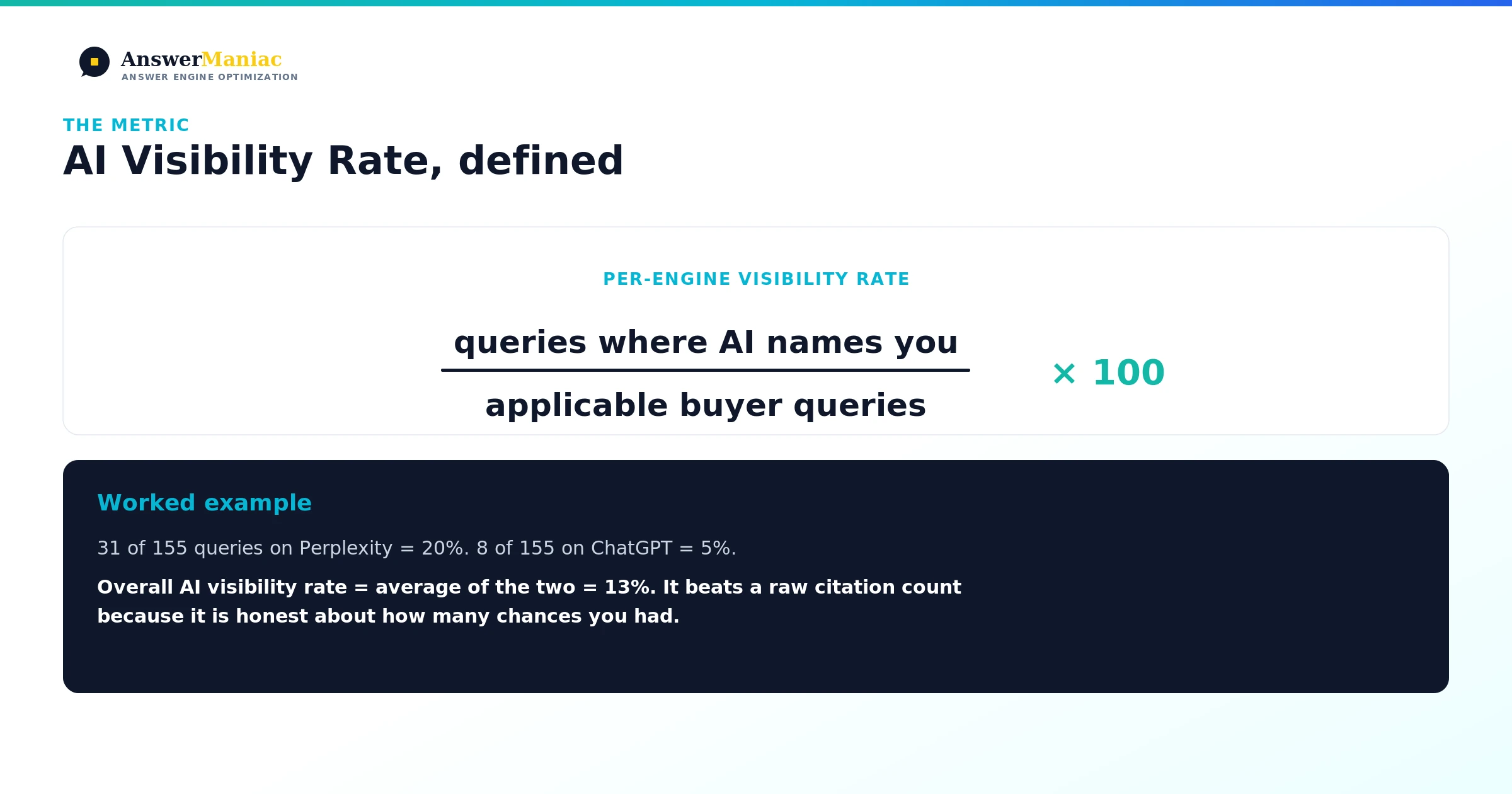
Estimated AI CTR = AI referral sessions / Estimated citation impressions
This won't be precise, but directional trends are what matter for optimization.
CTR Improvement Framework
Once you have baseline measurements, use this framework to improve CTR over time:
Week 1-2: Audit Phase
- Run top 50 target prompts across ChatGPT and Perplexity.
- Document which prompts cite your domain, which cite competitors.
- Identify the gap: prompts where competitors get cited but you don't.
Week 3-4: Structural Optimization
- Rewrite introductions on top pages using answer-first format.
- Add FAQ schema to pages that match high-volume prompts.
- Create or update comparison tables and structured data.
Week 5-8: Content Expansion
- Publish new content targeting uncovered prompt clusters.
- Build content hubs around your primary topic areas.
- Launch Reddit/Quora participation for community-validated citations.
Week 9-12: Measurement and Iteration
- Re-run the same 50 target prompts. Compare citation frequency to baseline.
- Analyze which structural changes had the biggest citation impact.
- Double down on what's working. Cut what isn't.
Ongoing: Monthly Reviews
- Track AI referral traffic trends month over month.
- Monitor competitor citation changes.
- Update content with fresh data and examples quarterly.
The Connection Between AI CTR and Revenue
AI CTR optimization isn't an academic exercise. It directly impacts revenue for B2B companies.
The math:
- If ChatGPT cites your domain 1,000 times per month (estimated).
- And your AI CTR is 5% (50 clicks per month).
- And your AI traffic conversion rate is 4.4x your organic rate.
- And your organic conversion rate is 2%.
Then: 50 clicks x 8.8% conversion rate = 4.4 conversions per month from ChatGPT alone.
For B2B companies with high contract values, those 4-5 conversions could be worth tens of thousands in monthly revenue.
Now imagine improving your citation rate from 1,000 to 3,000 (achievable with content hubs and entity optimization) and your CTR from 5% to 8% (achievable with better content structure and brand recognition).
That's 240 clicks x 8.8% = 21 conversions per month. From one AI platform.
Forbes reports that AI-driven marketing strategies are delivering measurable ROI improvements across B2B sectors. The companies measuring and optimizing AI CTR now are building compounding advantages.
FAQ
What is ChatGPT CTR optimization?
ChatGPT CTR optimization is the process of increasing the percentage of users who click through to your website after seeing your brand cited in a ChatGPT response. It involves structuring content for better citation quality, building brand recognition, and aligning landing pages with AI-generated expectations.
How is GEO different from SEO for CTR?
In SEO, you control your SERP appearance through title tags and meta descriptions. In GEO, the AI controls how your brand appears in its response. CTR optimization focuses on influencing the AI's citation quality, building brand trust, and ensuring landing page alignment rather than title tag optimization.
What's a good ChatGPT CTR benchmark?
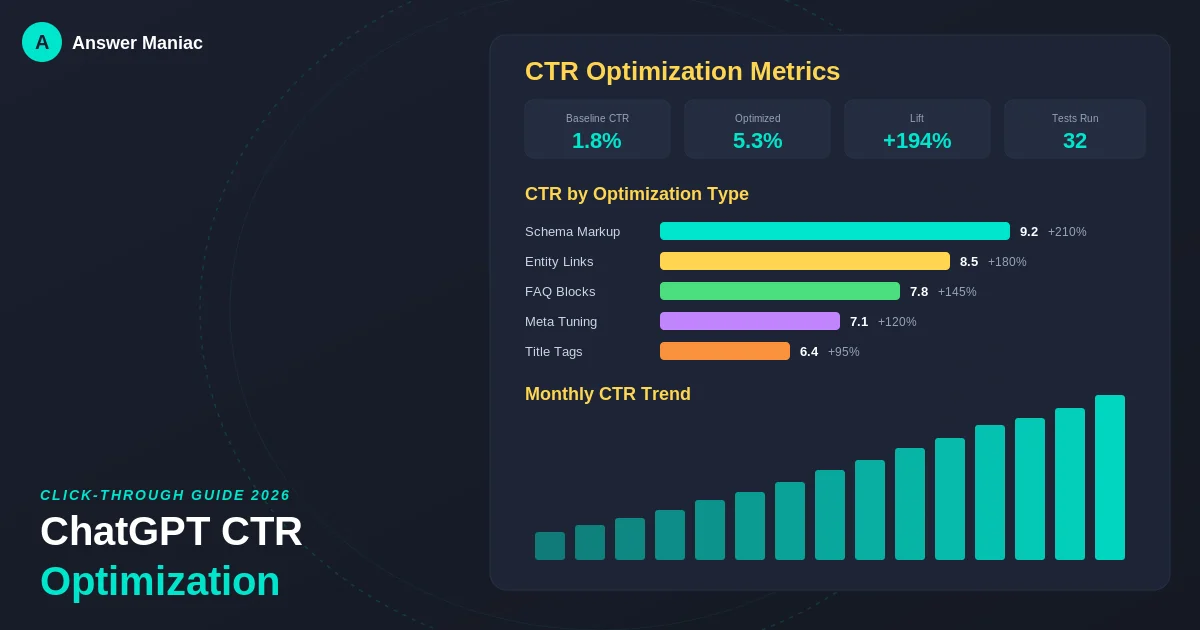
Based on our client data, AI citation CTR typically ranges from 3-8% for B2B brands with moderate brand recognition. Top-performing brands with strong recognition and well-structured content can see 10-15% CTR from AI citations.
Can I improve ChatGPT CTR without changing my content?
Partially. Brand building, landing page optimization, and technical fixes (robots.txt, schema markup) can improve CTR without content changes. But the biggest CTR improvements come from restructuring content for better passage extraction and citation quality.
How long does it take to see CTR improvements?
Structural changes (FAQ schema, answer-first formatting) typically show results within 30-60 days. Brand building efforts take 90-180 days to meaningfully impact AI citation CTR. Consistent measurement and iteration are required for sustained improvement.
Should I optimize for ChatGPT CTR or Perplexity CTR first?
Start with the platform that currently sends you more referral traffic. For most B2B brands, that's Perplexity (higher base CTR). But ChatGPT has larger total query volume, so the opportunity ceiling is higher. Ideally, optimize for both using universal GEO tactics.
What to Do Next
ChatGPT CTR optimization compounds over time. Every structural improvement, brand mention, and content update builds on the previous one. The brands starting now will have an insurmountable lead by 2027.
Here's the priority order:
- Set up AI referral traffic tracking in GA4 (this week).
- Audit your top 20 pages for passage-level citation readiness (this month).
- Add FAQ schema and restructure introductions (this month).
- Build prompt cluster maps and fill content gaps (this quarter).
- Launch brand building initiatives across Reddit, LinkedIn, and industry publications (ongoing).
Want the full analysis? AnswerManiac's AI Visibility Audit tracks your citation performance and CTR across ChatGPT, Perplexity, Gemini, Claude, and Copilot. We use the ANSWER Framework to identify exactly where you're losing clicks and build a strategy to capture them.
IBM research on AI-driven marketing analytics confirms that structured, measurement-driven approaches to AI optimization consistently outperform ad hoc tactics. Start measuring first. Optimize second.
References
- Forbes. "AI-Driven Marketing ROI in B2B." forbes.com
- IBM. "AI Marketing Analytics." ibm.com
Related Reading
Get AEO Insights Weekly
Join 500+ B2B marketers getting AI visibility tactics every Tuesday.
Ready to Get Your Brand Cited by AI?
See how your competitors show up in ChatGPT, Perplexity, and Gemini — and what it would take to get recommended.