How We Increased a B2B SaaS Company's AI Citations 3x in 90 Days
The exact 30/60/90 methodology we use to triple AI citations for B2B SaaS. Real tactics, published benchmarks, illustrative numbers clearly labeled as such.
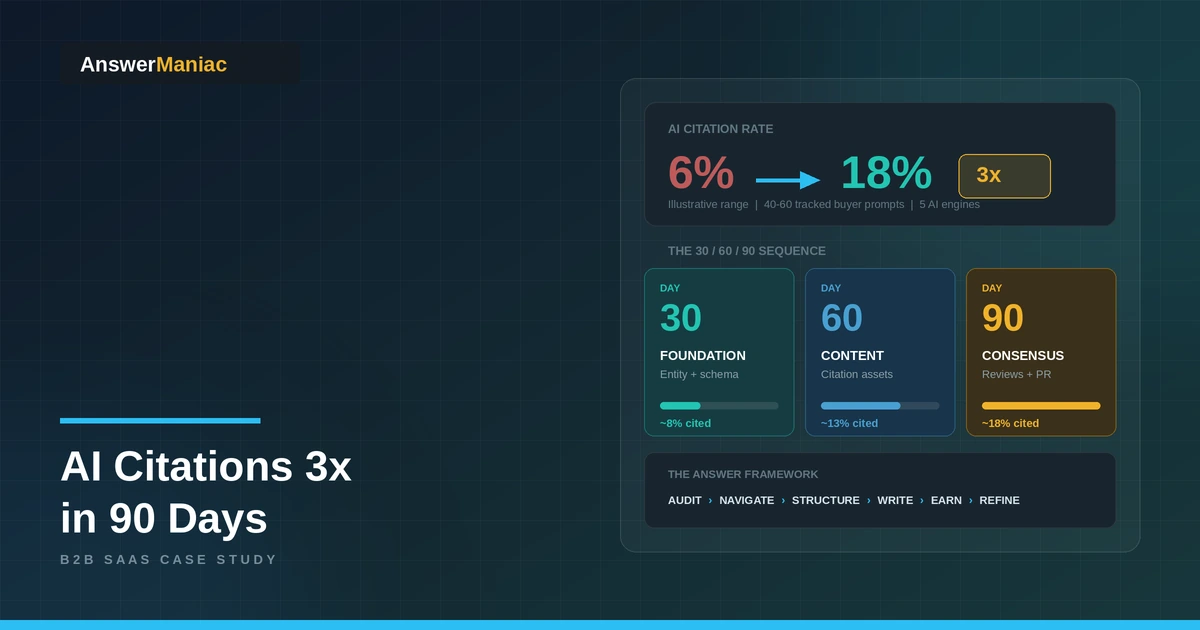
Direct Answer: Tripling AI citations in 90 days comes from a specific sequence, not volume. We run The ANSWER Framework in three phases: days 1-30 fix the entity and technical foundation so AI models can identify you confidently; days 31-60 ship citation assets built around the exact prompts buyers type, with the machine-extractable elements the Princeton GEO study found most effective (statistics, quotations, cited sources); days 61-90 build third-party consensus through review platforms, listicle placements, and digital PR. A 3x citation increase means going from a low single-digit baseline to a low double-digit one. That is a real and achievable move. It is not a guarantee, and anyone who promises you one is selling something else.
Run a free AI Visibility Score and see your actual citation baseline
Let's be upfront about what this post is and is not.
It is a complete walkthrough of the 90-day methodology we run for B2B SaaS clients, with named sources for every industry benchmark. It is not a client case study with a logo at the top and a hockey stick chart. We do not publish client citation data without permission, and the specific numbers below are clearly labeled as illustrative ranges drawn from what we typically see.
Being precise about that distinction is the point. Half the AEO case studies circulating right now cite "8,337% growth" without defining the denominator. If your baseline was one referral, going to 84 is an 8,300% increase and also basically nothing.
Here is what actually happens in 90 days.
Key Facts
Published benchmarks worth knowing before you start:
- The Princeton GEO study (Aggarwal et al., KDD 2024) tested roughly 10,000 queries and found the three strongest optimization methods produced a 30-40% relative improvement in visibility. The top three were adding statistics, adding quotations, and citing sources.
- Semrush found that roughly 90% of ChatGPT citations come from pages ranking position 21 or lower for related queries. Traditional top-10 rankings are not the gate.
- Semrush's ghost citations study found 62% of AI citations do not produce a brand mention in the answer text. Being linked and being recommended are different outcomes.
- Perplexity averages around 21.9 citations per response versus ChatGPT's 10.4. Perplexity is the easier surface to win first.
- Cross-platform overlap is low. In one 2026 audit, only about 11% of domains cited by ChatGPT were also cited by Perplexity. You are optimizing for five engines, not one.
The Challenge: What "Invisible" Actually Looks Like
The typical company we start with is a B2B SaaS platform doing $8M to $30M ARR in a vertical most people cannot name. Franchise development software. Fleet compliance. RegTech for mid-market lenders. They rank fine in Google. They have a competent content team. Their sales cycle runs 60 to 120 days with a buying committee of four to seven people.
And when a prospect opens ChatGPT and types "best franchise development software for multi-unit operators," they are not in the answer.
Their three competitors are. Usually the same three, in the same order, across every engine.
This is the pattern in nearly every audit we run. The company is not absent from the internet. It is absent from the specific sources AI models pull from when synthesizing a recommendation. Those are different problems with different fixes, and treating the second like the first is why most in-house AEO efforts stall.
The baseline for a company in this position is typically a citation rate somewhere in the 3% to 9% range across a tracked prompt set of 40 to 60 buyer-intent queries. That is our illustrative starting range, consistent with what published 2026 benchmarks describe as a below-average competitive share of citation for B2B SaaS.
Tripling that means landing somewhere between 12% and 25%. Meaningful. Not magic.
Days 0-14: The Audit (The "A" in ANSWER)
Everything downstream depends on measuring the right thing first, so we spend two weeks before touching a single page.
We build the prompt set. Not keywords. Prompts. We interview the sales team and mine closed-won call transcripts to find the actual questions buyers ask. "What software do multi-unit franchisees use to track development pipelines" is a prompt. "Franchise development software" is a keyword. The prompt set runs 40 to 60 queries covering category discovery, comparison, objection handling, and integration questions.
We baseline across all five engines. ChatGPT, Perplexity, Gemini, Claude, and Copilot, each prompt run multiple times to account for output variance. We log presence, position, sentiment, and which domains got cited instead. That last column is the most useful artifact in the entire audit, because it tells you exactly which properties own the category consensus. More on how we structure this in our guide to AI visibility tracking.
We run entity reconciliation. This is where most of the damage lives. We pull the company's representation on LinkedIn, Crunchbase, G2, Capterra, Wikidata, and their own site and check whether they tell the same story. In our experience they almost never do. Different founding years. Different employee counts. A category description on G2 that contradicts the homepage. Every inconsistency is a reason for a model to hedge instead of recommend. Our entity SEO guide covers the reconciliation process in detail.
We audit technical extractability. Schema coverage, heading structure, whether the key claims live in prose that a model can lift cleanly or inside a carousel that never renders for a crawler.
The output is an AI Visibility Score and a prioritized fix list. If you want to see what this looks like on a real site, we published our own self-audit including the parts that did not work.
Days 1-30: Foundation
The first month produces almost no citation movement. We tell clients this on day one, because the alternative is a panicked call in week three.
Entity reconciliation ships first. Every profile aligned. Same founding year, same category language, same executive names spelled the same way, same one-sentence description of what the product does and who it is for. Organization schema with sameAs pointing at every reconciled property. This is boring, unglamorous work and it moves the needle further than anything else in the entire 90 days.
Schema goes in as infrastructure, not strategy. Organization, Product, FAQPage, and Article markup across the priority page set. We are direct with clients about this: schema is table stakes, not a differentiator. It helps models parse you correctly. It does not make them prefer you. Our schema markup guide for AI citations explains where the real value sits.
We restructure the top 15 existing pages. Every one gets a direct answer block in the first 100 words: a self-contained, quotable paragraph that answers the page's core question without requiring surrounding context. Then specific numbers with sources attached, and a real FAQ section using the phrasing buyers actually use.
That structural change is where the Princeton research earns its keep. Statistics addition, quotation addition, and source citation were the three highest-performing methods in the GEO-bench evaluation, at 30-40% relative visibility improvement. We are not guessing at that. We are implementing the finding.
Typical day-30 outcome: citation rate moves from the 3-9% baseline into the 5-12% range, driven almost entirely by Perplexity. Perplexity searches live, so it reflects changes in days rather than weeks. Treat it as your smoke test. If Perplexity has not picked up a new citation asset within a week, the asset has a problem and you should fix it before publishing forty more like it.
Days 31-60: Citation Assets
Month two is production. This is the "Structure" and "Write" stages of the framework, and it is where the volume happens.
We ship 12 to 20 citation assets. Not blog posts. Citation assets, which is a different format with a different job.
A blog post is written to rank for a keyword and hold a reader for four minutes. A citation asset is written so a language model can extract a defensible, attributable claim from it in one pass. In practice that means:
- A direct answer block up top that stands alone if lifted out of context
- Original data or a proprietary benchmark the model cannot find anywhere else
- Named sources for every statistic, inline, with the organization named in the sentence
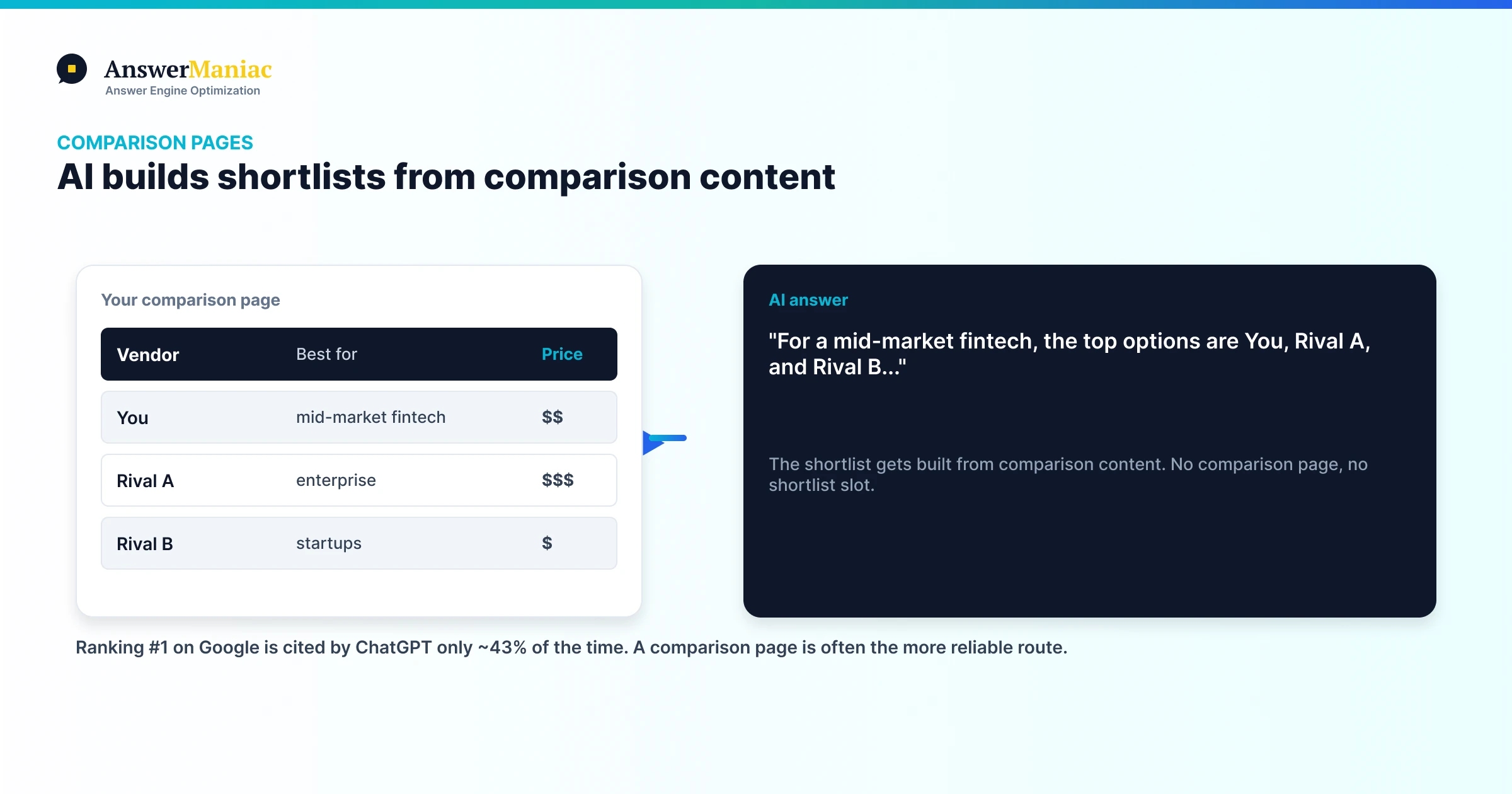
- Comparison tables, because models extract structured rows more reliably than prose
- FAQ sections using verbatim buyer phrasing from the prompt set
The mix we run is roughly 40% comparison and alternatives content, 30% original data and benchmarks, 20% definitional and category-education pieces, 10% objection handling.
The comparison content matters more than most teams expect. Semrush's finding that roughly 90% of ChatGPT citations come from pages ranking position 21 or lower reframes the whole exercise. You are not competing for a top-10 slot. You are competing to be the clearest, most extractable answer to a specific question, and that is a fight a smaller company can win. Our content strategy guide for AI visibility breaks down the formats.
One honest caveat: this phase is expensive in editorial hours and it is where in-house programs usually collapse. Twelve to twenty genuinely original assets in thirty days is a real production load. If your content team is already at capacity, you will get eight mediocre ones instead, and eight mediocre assets move nothing.
Typical day-60 outcome: the 8-18% range, with Gemini starting to respond as Google reprocesses the structured data and Google Business Profile signals.
Days 61-90: Consensus
Month three is "Earn," and it is the stage that separates a citation bump from a durable position.
Models do not recommend you because your site says you are good. They recommend you because multiple independent sources agree you are good. That agreement is what we are manufacturing, legitimately, in the final thirty days.
Review platform density. Structured campaigns to get genuine G2 and Capterra reviews from existing happy customers. Perplexity explicitly sources G2 in its citations, and you can watch the links appear. A company with 200 real reviews outperforms a competitor with 2,000 backlinks and none.
Third-party listicle placement. We identify every "best [category] software" listicle that AI models actually cite for the prompt set, then pursue inclusion through the publisher's real process. This is outreach, not link buying, and it works because most vertical listicles are maintained by people who genuinely want the list to be accurate.
Digital PR built for citation, not for links. Original research, survey data, and industry commentary pitched to publications the models already trust in that vertical. The measurement target is a cited mention in an AI answer, not a domain rating point. Our digital PR for AI search guide covers the difference.
Community presence. Reddit and Quora appear consistently among the most-cited domains in Google AI Overviews per Semrush's analysis. Genuine participation in the subreddits and forums where your buyers already are is a citation channel. Astroturfing is not, and it gets caught.
Typical day-90 outcome: the 12-25% range across the tracked prompt set. ChatGPT and Copilot are the laggards, which is expected given their training and index refresh cadence.
The Results Framework
Here is how we structure reporting. The percentages are illustrative ranges based on typical engagements, not a specific client's data.
| Metric | Baseline | Day 30 | Day 60 | Day 90 |
|---|---|---|---|---|
| Citation rate (all engines, 40-60 prompts) | 3-9% | 5-12% | 8-18% | 12-25% |
| Perplexity citation rate | 4-11% | 9-20% | 15-30% | 20-40% |
| ChatGPT citation rate | 2-7% | 2-8% | 5-13% | 9-20% |
| Gemini citation rate | 3-8% | 4-10% | 8-16% | 12-22% |
| Share of voice vs top 3 competitors | 4-10% | 6-13% | 10-19% | 14-26% |
| Citation assets live | 0 | 15 | 32 | 45 |
| Reconciled entity properties | 2-4 | 9-12 | 12-15 | 15-18 |
| Third-party listicle placements | 0-2 | 0-2 | 2-5 | 5-11 |
The 3x in the title refers to the citation rate row: the midpoint of the baseline range roughly triples by day 90.
Two things to watch that most reports leave out:
Citation without mention. Semrush found 62% of AI citations do not result in a brand mention in the answer text. Your URL is in the source list, your name is not in the sentence. Track these separately, because the fix is different: mention rate is an entity and consensus problem, citation rate is a content extractability problem. We cover the instrumentation in AI citation analytics.
Engine-level variance. With roughly 11% domain overlap between ChatGPT and Perplexity in published audits, a blended average hides more than it reveals. Report per engine or you will optimize the wrong thing.
For connecting any of this to revenue, our guide to measuring AI search ROI walks through attribution, and the tooling landscape is covered in the best GEO tools for 2026.
Key Takeaways
Sequence beats volume. The same 45 assets published in the wrong order produce a fraction of the result. Foundation, then content, then consensus. Publishing citation assets before entity reconciliation is like running ads to a broken checkout.
Perplexity first, ChatGPT last. Perplexity's live retrieval makes it your fastest feedback loop. ChatGPT's slower refresh cadence means it will look like nothing is working until roughly day 60. Set that expectation on day one.
Extractability is the actual work. The Princeton finding is not subtle: statistics, quotations, and cited sources drove 30-40% relative visibility gains. Most B2B content fails on all three because it was written to sound authoritative rather than to be quotable.
Third-party consensus is the moat. Anyone can restructure their own pages in a month. Review density, listicle inclusion, and earned media take longer to build and are correspondingly harder to displace. That is why "Earn" is a full stage in The ANSWER Framework rather than a bullet in a content brief.
90 days is a starting position, not a finish line. Citation rates decay if you stop. Models re-index, competitors respond, and category consensus shifts. The "Refine" stage exists because this is maintenance work, permanently.
We will say the obvious thing one more time: we cannot guarantee a 3x. We can guarantee the execution, the deliverables, and the measurement. Anyone quoting you a citation number in a sales call is describing something they do not control.
Get your free AI Visibility Score or book a strategy call if you want to see what this sequence looks like applied to your specific category.
FAQ
Are the numbers in this post from a real client?
No, and we are saying so directly. The percentage ranges are illustrative, drawn from patterns across engagements and calibrated against published 2026 benchmarks. We do not publish identifiable client citation data without written permission, and we are not going to invent a logo and a chart to make a point. Every named statistic in this post traces to a source you can check yourself: the Princeton GEO study, Semrush's citation research, or published industry benchmarks.
Is a 3x citation increase realistic for most B2B SaaS companies?
For a company starting from a genuinely low baseline in a vertical without an entrenched category leader, yes. Tripling a 4% citation rate to 12% is a much smaller lift than tripling 20% to 60%, and most of the companies we work with are in the first situation. If you are already the most-cited brand in your category, expect single-digit percentage-point gains instead of multiples.
Why does ChatGPT take longer to respond than Perplexity?
Different architectures. Perplexity runs live web retrieval on nearly every query, so new content can surface within days of publication. ChatGPT relies more heavily on its index and training data, with a slower refresh cycle. Practically, this means you should validate every new citation asset against Perplexity within a week and treat ChatGPT movement as a lagging indicator that shows up around day 60.
What happens if we stop after 90 days?
Citation rates decay. Not immediately, but the direction is consistent. Models re-index, competitors publish, review counts shift, and listicles get updated. The foundation work from days 1-30 holds up well because entity consistency is durable. The content and consensus advantages erode within a few months without maintenance. Budget for ongoing work or plan to give the position back.
How many prompts should we track?
40 to 60 buyer-intent prompts is the range we use for a single-category B2B SaaS company. Fewer than 30 and normal output variance will swamp your signal. More than 80 and you are tracking queries nobody actually asks. Run each prompt multiple times per measurement cycle, because the same question asked twice can produce different sources.
Does this replace our SEO program?
No. It runs alongside it. The overlap is smaller than people assume, given Semrush's finding that roughly 90% of ChatGPT citations come from pages ranking position 21 or lower. Traditional SEO optimizes for a click. AEO optimizes for being the source a model synthesizes from, whether or not anyone clicks. Both matter, and the content structures that serve them are genuinely different.
Get AEO Insights Weekly
Join 500+ B2B marketers getting AI visibility tactics every Tuesday.
Ready to Get Your Brand Cited by AI?
See how your competitors show up in ChatGPT, Perplexity, and Gemini — and what it would take to get recommended.