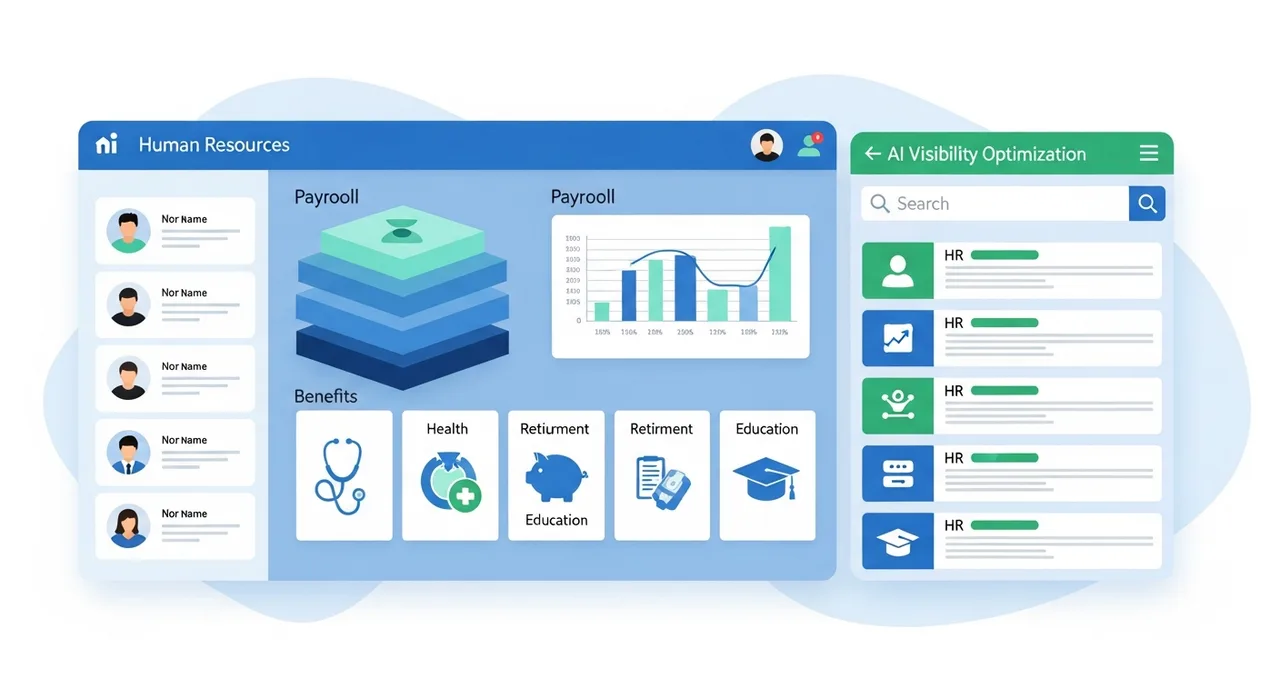
AI Visibility for HR & Payroll Software: Get Recommended by ChatGPT, Perplexity & Gemini
HR buyers ask ChatGPT and Perplexity for HRIS and payroll recommendations before contacting sales. Here is the 5-step AEO playbook to get your HR software cited across every AI assistant.
Last updated: February 2026
"What is the best HRIS for a 200-person company?"
"Compare BambooHR vs Rippling vs Gusto for a growing startup."
"Which payroll software handles multi-state compliance and benefits administration?"
"Best HCM platform for mid-market companies with remote employees across 15 states."
These questions are not being typed into Google. They are being asked inside ChatGPT, Perplexity, Gemini, and Claude, the AI assistants that 80% of B2B buyers now use to research software before they ever speak to a sales representative.
The global human capital management (HCM) market is projected to exceed $30 billion by 2027, growing at roughly 12% annually. Within that, the payroll software segment alone accounts for more than $10 billion. Every company on earth -- from a 10-person startup to a 50,000-employee enterprise -- needs HR and payroll software. That makes this one of the most competitive B2B SaaS categories in existence. Google Ads for "payroll software" runs $30-$60 per click. SEO competition for core HRIS terms has been saturated for years.
But a parallel channel has opened. AI-referred traffic converts at 14.2% versus 2.8% for Google organic, a 5x difference outlined in our complete guide to AI visibility. Fewer than 15% of HR software companies are optimizing for it. The companies that get recommended by ChatGPT, Perplexity, and Gemini when an HR director asks "What payroll software should I use?" will capture a disproportionate share of high-intent pipeline. The companies that ignore this channel will watch their competitors get the first call, and often the only call.
If you are an HR tech company looking to understand where you stand, explore our AI visibility solutions for HR tech companies or run your free AI Visibility audit to see exactly where your HR platform ranks across ChatGPT, Perplexity, Gemini, and Claude in 60 seconds.
How HR leaders search for HR and payroll software using AI
HR buyers do not search the way they did three years ago. The linear Google journey -- type keyword, scan ten blue links, visit three websites, fill out demo forms -- is being replaced by conversational AI research that delivers direct vendor recommendations with reasoning.
Understanding how HR buyers query AI assistants is the starting point for any AI Visibility strategy. The queries fall into five categories, each requiring a different content strategy for AI.
Comparison queries
These are the highest-intent queries in the HR software space. A buyer asking "BambooHR vs Rippling" has already narrowed their shortlist and is making a final decision.
- "BambooHR vs Gusto for growing startups"
- "Rippling vs Deel for international payroll"
- "ADP vs Paychex vs Gusto for small business payroll"
- "Workday vs UKG for enterprise HCM"
- "Paylocity vs Paycom for mid-market companies"
AI assistants answer comparison queries by synthesizing feature tables, pricing data, and use-case recommendations from whatever structured content they can find. If you have not published comparison pages, someone else's content -- or the AI's training data, which may be outdated -- shapes the answer.
Segment-specific queries
HR software needs vary enormously by company size, industry, workforce type, and growth stage. Buyers know this, and they ask AI accordingly.
- "Best HRIS for startups with 20-50 employees"
- "Payroll software for restaurants with tipped employees"
- "HR platform for healthcare organizations with shift workers"
- "Best HCM for remote-first companies across multiple states"
- "Payroll software for construction companies with union labor"
These segment-specific queries represent the largest citation gap in HR software. Most platforms publish generic "best HR software" content. Very few create dedicated pages addressing the specific needs of restaurants, healthcare, construction, manufacturing, or other industries with unique HR requirements. AI assistants struggle to answer these queries well, which means the first company to publish authoritative segment-specific content will own those citations.
Feature-specific queries
Buyers with specific requirements search for them directly.
- "Payroll software with built-in benefits administration"
- "HRIS with applicant tracking and onboarding"
- "HR software with time tracking and scheduling"
- "Payroll platform that handles 1099 contractors and W-2 employees"
- "HCM with performance management and compensation planning"
Compliance queries
Payroll and HR compliance is one of the most complex areas in business. Regulations vary by state, industry, and company size. Buyers lean heavily on AI assistants to navigate this complexity.
- "HR software for multi-state payroll compliance"
- "Which payroll platforms handle California meal and rest break rules?"
- "HRIS that supports ACA reporting and compliance"
- "Payroll software for states with income tax vs no income tax"
- "HR platform that handles FMLA, COBRA, and ADA compliance tracking"
Compliance queries are citation gold. They require authoritative, up-to-date, detailed answers. AI assistants cannot fabricate compliance information without risking giving dangerous advice. They need reliable sources to cite. If your platform publishes the most comprehensive, current compliance content in HR, you will earn those citations.
Pricing and ROI queries
Budget holders want straight answers.
- "How much does BambooHR cost per employee?"
- "Gusto pricing for a company with 75 employees"
- "Average cost of payroll software for small business"
- "ROI of switching from manual payroll to automated platform"
- "Hidden costs of enterprise HCM implementation"
How AI handles these differently than Google
On Google, the buyer gets a page of ads, a few listicle results from G2 or SelectSoftware, and organic results that take 15 minutes to parse. The buyer does the synthesis work.
With AI assistants, the synthesis is done for them. ChatGPT will say: "Based on your requirements for a 200-person company with employees in 8 states, here are three strong options..." and provide a reasoned recommendation. Perplexity cites its sources inline so the buyer can verify. Gemini cross-references Google's knowledge graph. Claude tends toward nuanced analysis with trade-off reasoning.
The difference that matters: AI assistants recommend. Google lists. Being recommended by an AI assistant carries implicit endorsement. That is why AI-referred traffic converts at 5x the rate of Google organic. The buyer arrives with a recommendation already attached to your brand.
Related: For a detailed breakdown of how each platform discovers and cites content, see The Complete Guide to AI Visibility for B2B SaaS.
Who AI recommends today: the HR and payroll citation landscape
We tested 50+ HR and payroll buyer queries across all four major AI assistants. The citation landscape reveals a clear hierarchy and even clearer gaps.
The citation map
| AI Assistant | Top-Cited for HR/Payroll | Notable Gaps |
|---|---|---|
| ChatGPT | ADP, Gusto, BambooHR, Rippling, Workday. Paychex and Paylocity mentioned for mid-market. | Industry-specific queries return generic answers. International payroll recommendations are thin. Newer platforms like Deel, Remote, and Oyster inconsistently cited for global payroll. |
| Perplexity | Similar hierarchy but cites source pages inline. G2, SelectSoftware, and Forbes Advisor pages dominate sourcing. Vendor sites rarely cited directly. | Vendor-published content almost never appears as a source. Third-party review sites control the narrative. |
| Gemini | ADP and Workday for enterprise. Gusto and BambooHR for SMB. Rippling for "all-in-one" queries. | Segment-specific queries (restaurants, construction, healthcare HR) return generic lists. Compliance-specific queries lack vendor-level detail. |
| Claude | More nuanced trade-off analysis. BambooHR for ease of use. Rippling for breadth. Gusto for small business. ADP for enterprise scale. Paycom and Paylocity for mid-market. | Industry-specific and compliance-specific queries produce cautious, general answers with few firm recommendations. |
Tier analysis
Tier 1: Citation dominant (ADP, Workday, BambooHR, Gusto, Paychex)
These five platforms are cited across nearly every broad HR and payroll query. Their citation dominance comes from three sources: massive brand presence in AI training data, extensive third-party review coverage on G2 and Capterra, and years of content marketing investment. Displacing them on broad category terms is difficult -- but not the goal. The goal is to own the segments and queries where they are weak or absent. For tactics on how to approach this, see our guide on competitor displacement.
Tier 2: Frequently cited (Rippling, Paylocity, Paycom, UKG, TriNet)
These platforms appear for specific query types but lack consistent citation across all four AI assistants. Rippling dominates "all-in-one" and "IT + HR" queries. Paylocity and Paycom appear on mid-market queries but rarely on SMB or enterprise ones. UKG shows up for enterprise workforce management but less for core HR. TriNet (formerly Zenefits) appears on PEO-related queries.
Tier 3: Inconsistently cited or absent (HiBob, Justworks, OnPay, Namely, Paycor, isolved, Bambee, Deel, Remote, Oyster)
These platforms represent the largest opportunity and the largest risk. Many have strong products with specific segment advantages: HiBob for mid-market culture and engagement, Justworks for PEO simplicity, Deel and Remote for international payroll and EOR. But they appear in AI citations sporadically or not at all. The AI assistants know they exist but do not have enough structured, authoritative content to confidently recommend them.
This is where AI Visibility strategy changes outcomes. A Tier 3 platform that implements a focused AEO playbook can reach Tier 2 citation frequency within 90-120 days for its target segments. A Tier 2 platform can crack Tier 1 on segment-specific queries. The platforms that wait will find their competitors embedded in AI recommendations, a position that compounds over time and gets harder to displace.
Check where your HR platform stands -- free AI Visibility audit
Why HR and payroll software is perfect for AEO
Not every B2B SaaS category benefits equally from AI Visibility. HR and payroll software benefits more than most.
1. Every company is a buyer
HR and payroll is not a niche. Every company with employees needs HR software and payroll processing. The total addressable market is effectively unlimited. This means the query volume for HR and payroll software is enormous -- and growing as more buyers adopt AI assistants for research. There are more AI queries about HR and payroll software than about almost any other B2B SaaS category. More queries mean more citation opportunities.
2. Extreme market fragmentation
There are hundreds of HR and payroll software platforms. The market is fragmented by company size (1-50, 50-500, 500-5000, 5000+), by industry (healthcare, restaurants, construction, tech, manufacturing), by geography (US-only, multi-country, specific countries), by workforce type (salaried, hourly, tipped, union, contractor, remote), and by functional scope (payroll-only, HRIS, HCM, PEO). This fragmentation is an AEO advantage. It creates hundreds of segment-specific queries where niche platforms can dominate citations without competing against ADP and Workday head-on.
3. Regulatory complexity creates content moats
Payroll compliance is staggeringly complex. Federal tax withholding. State income taxes across 50 states with different rules. Local taxes in cities like New York, Philadelphia, and San Francisco. Overtime regulations that vary by state. Meal and rest break requirements. Paid leave mandates that differ by jurisdiction. ACA reporting. Workers compensation. Unemployment insurance. COBRA. FMLA.
Every regulation, every state, every compliance intersection creates a content opportunity. AI assistants need authoritative sources to answer compliance questions accurately. The HR software company that publishes the most comprehensive, current, structured compliance content builds a citation moat that competitors cannot replicate quickly. This content requires genuine payroll expertise to create, it demands regular updates as regulations change, and it compounds over time as AI assistants learn to trust the source.
4. High deal values justify the investment
HR and payroll software annual contract values range from $5,000 for small business solutions to $200,000+ for enterprise HCM. The mid-market sweet spot -- companies with 100-1,000 employees -- typically runs $20,000-$80,000 per year. A single AI-referred deal at these price points covers an entire year of AEO investment. The unit economics are compelling: even a modest increase in AI-referred pipeline generates significant revenue relative to the cost of optimizing for citations.
5. Multi-stakeholder buying creates multiple query paths
HR software purchases involve multiple decision-makers, each with different questions. The HR director asks about features and employee experience. The CFO asks about cost, ROI, and payroll accuracy. The IT leader asks about integrations, security, and implementation. The CEO asks about scalability and vendor reputation.
Each stakeholder generates different AI queries. Each query is a citation opportunity. A single HR software deal might involve 15-25 distinct AI queries across 3-5 decision-makers over a 2-4 month evaluation cycle. Companies that earn citations across all these query types build cumulative trust that influences the entire buying committee.
6. Constant regulatory change demands fresh content
Payroll regulations change constantly. New state paid leave laws. Minimum wage increases. Tax bracket adjustments. Overtime threshold changes. ACA reporting requirement updates. Each change creates a content opportunity -- a reason to publish updated, authoritative analysis that AI assistants need and will cite. Companies that publish regulatory updates quickly build a freshness signal that AI assistants reward with higher citation velocity.
Related: For the foundational audit framework, see AI Visibility Score: How to Audit Your Website for ChatGPT Citations.
The 5-step AEO playbook for HR and payroll software
Step 1: AI citation audit -- map where you stand
Before building any content, you need to know exactly where your platform appears in AI recommendations -- and where it does not. An AI visibility audit is the essential first step.
Run these 25 test queries across ChatGPT, Perplexity, Gemini, and Claude:
- "Best payroll software for [your target company size]"
- "Best HRIS for [your primary industry vertical]"
- "[Your brand] vs [top 3 competitors]" -- one query per competitor
- "Best HR software for multi-state payroll"
- "Payroll platform with benefits administration"
- "HR software for [your primary segment -- startups, mid-market, enterprise]"
- "Best HCM platform for remote teams"
- "Cheapest payroll software for small business"
- "HR software with built-in time tracking"
- "Best payroll software for restaurants" (or your industry)
- "What is [your brand]?"
- "[Your brand] pricing"
- "[Your brand] reviews"
Document for each query:
- Were you mentioned? In what position?
- Which competitors were cited?
- What source content was referenced (if Perplexity or cited sources visible)?
- What was the recommendation reasoning?
- How confident was the AI's answer?
This audit reveals three things: your current citation baseline, the specific queries where competitors dominate, and the gaps where no platform has strong citations. The gaps are your opportunity.
Run the automated version at answermaniac.ai. Our tracker tests your domain across all four AI assistants and scores your visibility on a 0-100 scale.
Step 2: Schema markup -- make your content machine-readable
81% of pages that AI assistants cite use structured data markup. In HR and payroll content, where accuracy, feature comparisons, and compliance information drive buying decisions, schema markup for AI is not optional. It is the foundation of citation authority.
Implement these schema types across your HR content:
Article schema on every educational page: compliance guides, industry analyses, market reports, implementation guides. Include author credentials (PHR, SPHR, SHRM-CP certifications for HR content; CPA credentials for payroll content). AI assistants evaluate author authority as a citation signal.
FAQPage schema on FAQ pages and any content structured in question-answer format. This maps directly to how buyers query AI assistants: "What is the best HRIS for..." is a question, and AI assistants look for FAQ-structured content to answer it.
HowTo schema on implementation guides, onboarding playbooks, compliance checklists, and setup documentation. Queries like "How to set up multi-state payroll" and "How to migrate from ADP to [your platform]" earn citations from HowTo-marked content.
Product schema on your product and pricing pages with features, pricing tiers, and supported integrations structured as machine-readable data.
Comparison/Table schema on your comparison and feature matrix pages. Structure your feature tables so AI assistants can extract and present comparison data.
Related: For step-by-step implementation, see Schema Markup for AI: The 5 Types ChatGPT Crawls.
Step 3: Comparison and segment content -- answer the queries buyers actually ask
This is where most HR software companies fail. They publish product pages and blog posts about their own features. They do not publish the content that AI assistants need to answer buyer questions. A strong content strategy for AI focuses on what buyers ask, not what you want to say.
Comparison pages you must publish:
- "[Your Platform] vs [Competitor]" for every major competitor in your segment. If you compete with BambooHR, publish "[Your Platform] vs BambooHR." Include feature comparisons, pricing (where public), ideal customer profiles, and honest trade-off analysis. AI assistants detect and deprioritize biased content. Be genuinely balanced. It builds trust with both AI and buyers.
- "Best payroll software for [segment]" -- Create dedicated pages for each segment you serve: small business, mid-market, enterprise. For each industry you target: restaurants, healthcare, construction, technology, professional services, nonprofits, manufacturing.
- "Best HR software for [use case]" -- Multi-state payroll. Remote teams. Hourly workers. International employees. Companies with contractors. Each use case is a distinct query that AI assistants need content to answer.
Segment landing pages you must publish:
- Company size segments: "HR Software for 10-50 Employees," "HRIS for 50-200 Employees," "HCM for 500+ Employees"
- Industry pages: "Payroll for Restaurants," "HR Software for Healthcare," "HRIS for Construction Companies"
- Workforce type pages: "Payroll for Tipped Employees," "HR for Union Workforces," "Payroll for 1099 Contractors"
- Geography pages: "Multi-State Payroll Compliance Guide," "Payroll for California Employers," "HR Software for Companies in States Without Income Tax"
Each page should be comprehensive, structured with headers that match AI query patterns, and marked with appropriate schema. AI assistants cite the best available answer to each query. Make sure that answer is yours.
Related: For competitive displacement tactics, see Competitor Displacement in AI Answers: The Citation Takeover Playbook.
Step 4: Original research -- publish data that AI assistants cannot find elsewhere
AI assistants prioritize content that contains specific, citeable data points. In HR and payroll, this means benchmark data and research that buyers cannot find elsewhere.
Data to publish:
- Payroll benchmarks: Average payroll processing time by company size. Error rates for manual vs automated payroll. Cost per payroll run by method. Time to first payroll for new implementations.
- HR metrics benchmarks: Time-to-hire by industry and company size. Employee turnover rates. Benefits enrollment participation rates. Onboarding completion rates and time-to-productivity.
- Compliance data: Number of payroll tax jurisdictions by state. Common payroll compliance penalties and their costs. Regulatory change frequency by category (tax, leave, overtime, benefits).
- Implementation data: Average HRIS implementation timeline by company size. Migration success rates from specific platforms. ROI timelines: when do companies break even after switching HR software?
- Salary and compensation data: If your platform processes payroll, you may have anonymized, aggregated compensation data worth publishing. Salary benchmarks by role, industry, and geography are among the most-cited data types in AI responses.
Package this data into structured content with data tables, clear methodology notes, and update dates. AI assistants cite benchmark data at disproportionately high rates because these pages answer "how much," "how long," and "what is average" questions that HR buyers ask constantly.
If you conduct customer surveys or aggregate anonymized platform data, publish the findings as quarterly or annual benchmark reports. These become citation magnets.
Step 5: Build the citation network -- earn authority from the sources AI trusts
AI assistants do not exist in a vacuum. They evaluate source authority based on how widely a source is referenced, linked, and cited across the web. In HR and payroll, specific publications and organizations carry outsize authority influence. Building citation velocity across these sources accelerates your path to AI recommendations.
Priority citation network targets:
- SHRM (Society for Human Resource Management) -- The most authoritative HR industry source. Getting cited, linked, or referenced by SHRM content increases your AI citation authority significantly. Contribute expert commentary, research data, or guest content.
- WorldatWork -- Authority on compensation, benefits, and total rewards. If your platform handles compensation or benefits, WorldatWork references carry significant citation weight.
- HRCI and SHRM-CP/SCP -- Professional certification bodies. Content associated with these credentials signals expertise to AI assistants.
- HR publications -- HR Brew, HR Dive, TLNT, HR Executive, Human Resource Executive. These publications are in the AI training data. Being covered by them (product reviews, expert quotes, contributed content) builds citation authority.
- Payroll industry sources -- American Payroll Association (PayrollOrg), National Payroll Week, state payroll associations. Domain-specific authority signals.
- Business publications -- Inc, Forbes, Business Insider, TechCrunch (for funding and product launches). Broad authority signals that AI assistants recognize.
- Review platforms -- G2, Capterra, TrustRadius, SelectSoftware Reviews. AI assistants heavily reference these platforms. Maintaining a strong review presence with detailed, current profiles feeds AI citation algorithms.
The goal is not just backlinks for SEO. The goal is building a web of authoritative references that AI assistants encounter repeatedly when evaluating whether your platform is reliable enough to recommend. Every mention on a trusted source increases the probability of citation.
Related: For the full strategy on citation velocity, see Citation Velocity: How Fast You Need to Build AI Authority.
30+ queries HR and payroll software companies must target
These are the queries generating AI recommendations in the HR and payroll space right now. Each one is a citation opportunity with a specific content strategy.
Comparison queries (highest intent)
| Query | Competition Level | Citation Strategy |
|---|---|---|
| "BambooHR vs Gusto" | High | Publish balanced head-to-head with use-case recommendations |
| "Rippling vs Deel for international payroll" | Medium | Detailed comparison focused on global payroll capabilities |
| "ADP vs Paychex for small business" | High | Feature table with pricing transparency and segment fit |
| "Paylocity vs Paycom" | Medium | Mid-market focused comparison with implementation data |
| "Workday vs UKG for enterprise" | Medium-High | Enterprise HCM comparison with total cost analysis |
| "Gusto vs OnPay vs Patriot Payroll" | Medium | Small business budget-focused comparison |
| "[Your brand] vs [top competitor]" | Low-Medium | You control this narrative -- publish first |
Segment-specific queries
| Query | Competition Level | Citation Strategy |
|---|---|---|
| "Best HRIS for startups" | Medium | Stage-specific recommendations (seed, Series A, growth) |
| "Best payroll software for small business under 50 employees" | High | Focus on simplicity, price, and setup speed |
| "HR software for mid-market companies 200-1000 employees" | Medium | Emphasize scalability, integrations, and compliance |
| "Enterprise HCM platform for 5000+ employees" | Medium-High | Total cost of ownership and global capabilities |
| "Best HR platform for remote-first companies" | Medium | Multi-state compliance and distributed workforce features |
| "Payroll software for companies with hourly workers" | Low | Time tracking, scheduling, overtime, and tip management |
| "HRIS for nonprofit organizations" | Low | Budget sensitivity, grant reporting, volunteer management |
Industry-specific queries
| Query | Competition Level | Citation Strategy |
|---|---|---|
| "Payroll software for restaurants" | Low | Tip reporting, split shifts, seasonal staff, minimum wage by location |
| "HR software for healthcare organizations" | Low-Medium | Credentialing, shift scheduling, compliance, licensure tracking |
| "Payroll for construction companies" | Low | Certified payroll, prevailing wage, union reporting, job costing |
| "HR software for manufacturing" | Low | Shift differentials, safety compliance, skills tracking |
| "Payroll software for professional services firms" | Low | Project-based billing, partner draws, multi-entity |
| "HR platform for retail chains" | Low-Medium | Multi-location, variable scheduling, high turnover management |
Compliance queries
| Query | Competition Level | Citation Strategy |
|---|---|---|
| "Multi-state payroll compliance software" | Medium | Comprehensive state-by-state compliance guide |
| "HR software for ACA compliance reporting" | Low-Medium | ACA reporting requirements and automation guide |
| "Payroll software that handles California labor laws" | Low | CA-specific: meal breaks, overtime, pay transparency, CCPA |
| "FMLA tracking and compliance software" | Low | Federal and state leave law compliance guide |
| "Payroll tax compliance by state" | Low | State tax guide with withholding rates and deadlines |
| "HR software for wage and hour compliance" | Low-Medium | Overtime, minimum wage, recordkeeping requirements |
Feature and use-case queries
| Query | Competition Level | Citation Strategy |
|---|---|---|
| "Payroll software with benefits administration" | Medium | Feature comparison of platforms offering both |
| "HRIS with built-in ATS and onboarding" | Medium | End-to-end HR platform comparison |
| "Payroll platform with time tracking integration" | Medium | Integration comparison and setup guide |
| "HR software with employee self-service portal" | Low-Medium | Self-service feature comparison with demo data |
| "Best PEO vs HRIS for growing companies" | Medium | Decision framework for PEO vs software at each stage |
| "Global payroll software for international teams" | Medium | EOR, international payroll, and multi-country comparison |
Pricing and evaluation queries
| Query | Competition Level | Citation Strategy |
|---|---|---|
| "How much does BambooHR cost per employee?" | Medium | Transparent pricing analysis (where data is public) |
| "Average cost of payroll software for 100 employees" | Medium | Pricing benchmark by company size and feature set |
| "ROI of switching from spreadsheets to HRIS" | Low | ROI calculator with industry benchmarks |
| "Hidden costs of payroll software implementation" | Low | Implementation cost transparency guide |
The 90-day ROI framework for HR and payroll software
The economics of AI Visibility vary by your platform's segment and average contract value. Here is the math for three typical scenarios.
Scenario 1: SMB payroll platform (ACV $10,000)
Conservative assumptions:
- AI-referred visitors per month after 90 days: 300
- Visitor-to-lead conversion: 10%
- Lead-to-opportunity conversion: 20%
- AI-referred close rate: 14.2%
The math:
- 300 visitors per month
- 30 leads per month
- 6 qualified opportunities per month
- 0.85 closed deals per month
- Annual value: 10.2 deals x $10,000 = $102,000 in new annual revenue
Against an AEO investment of $36,000-$60,000 per year, that is a 1.7x-2.8x return -- and it compounds. Year two volume increases without proportional cost increases.
Scenario 2: Mid-market HRIS/HCM (ACV $50,000)
Conservative assumptions:
- AI-referred visitors per month after 90 days: 200
- Visitor-to-lead conversion: 8%
- Lead-to-opportunity conversion: 25%
- AI-referred close rate: 14.2%
The math:
- 200 visitors per month
- 16 leads per month
- 4 qualified opportunities per month
- 0.57 closed deals per month
- Annual value: 6.8 deals x $50,000 = $340,000 in new annual revenue
Against an AEO investment of $36,000-$72,000 per year, the return is 4.7x-9.4x. A single closed deal in the first quarter covers the entire annual investment.
Scenario 3: Enterprise HCM (ACV $150,000)
Conservative assumptions:
- AI-referred visitors per month after 90 days: 100
- Visitor-to-lead conversion: 5%
- Lead-to-opportunity conversion: 20%
- AI-referred close rate: 14.2%
The math:
- 100 visitors per month
- 5 leads per month
- 1 qualified opportunity per month
- 0.14 closed deals per month
- Annual value: 1.7 deals x $150,000 = $255,000 in new annual revenue
Against an AEO investment of $60,000-$72,000 per year, the return is 3.5x-4.25x. One deal pays for the entire program.
Compare this to Google Ads
Google Ads for HR and payroll terms is expensive and non-compounding. "Payroll software" costs $30-$60 per click. "HRIS software" runs $25-$50. "HR software for small business" is $15-$35. To generate 200 monthly visitors through paid search costs $4,000-$12,000 per month -- $48,000-$144,000 per year -- with zero compounding benefit. The moment you stop paying, the traffic stops.
AI Visibility compounds. Every page you publish, every citation you earn, every trust signal you build makes the next citation easier to get. The cost curve bends down while the value curve bends up.
Related: For vertical-specific citation strategies across other SaaS categories, see AI Visibility for SaaS: Category-Specific Citation Strategies.
FAQ: AI Visibility for HR and payroll software
How long does it take for HR software companies to appear in AI recommendations?
Most HR and payroll software platforms see initial citation improvements within 60-90 days of implementing structured content with schema markup. Full citation authority -- appearing consistently across ChatGPT, Perplexity, Gemini, and Claude for your target HR buyer queries -- typically takes 4-6 months. The timeline can be faster for segment-specific content. Industry-vertical queries (payroll for restaurants, HRIS for construction) and compliance-specific queries (multi-state payroll compliance, ACA reporting) have less competition and faster citation velocity than broad category terms like "best payroll software."
Does AI Visibility replace SEO for HR software companies?
No. AI Visibility and SEO are complementary channels. SEO drives organic search traffic through Google. AI Visibility gets you recommended when HR directors and CFOs ask ChatGPT, Perplexity, or Gemini for payroll and HRIS recommendations. The content that earns AI citations -- structured comparison pages, compliance guides, segment-specific landing pages -- also performs well in traditional search. The critical difference: AI-referred traffic converts at 14.2% compared to 2.8% for Google organic. For HR software with annual contract values of $20,000-$150,000+, that 5x conversion difference translates directly to revenue.
Which HR software segments should we prioritize for AEO content?
Start with the segment where you have the strongest product fit and customer evidence. Broad HRIS and payroll queries are the most competitive -- ADP, Workday, BambooHR, and Gusto dominate citations there. Segment-specific queries have substantially less competition and offer first-mover citation advantages. Multi-state payroll compliance, industry-specific HR (restaurants, healthcare, construction, manufacturing), international payroll and EOR, mid-market HCM, and PEO-vs-software comparison queries all have large citation gaps. Companies that own a segment in AI citations first build advantages that compound over time and become extremely difficult for competitors to reverse.
How does schema markup specifically help HR software companies get cited by AI assistants?
Schema markup tells AI assistants that your content is structured, authoritative, and machine-readable. For HR software, FAQPage schema maps directly to the question-answer queries HR buyers ask AI assistants. Article schema with author credentials (PHR, SPHR, SHRM-CP certifications) signals HR and payroll expertise. HowTo schema on implementation guides, payroll setup documentation, and compliance checklists earns citations on process-oriented queries. 81% of pages cited by AI assistants use structured data markup. In HR and payroll, where regulatory accuracy and feature comparisons drive buying decisions, schema is the foundation of citation authority. For implementation details, see our Schema Markup for AI guide.
What is the biggest mistake HR software companies make with AI Visibility?
Publishing product-focused marketing pages instead of buyer-education content. AI assistants do not cite feature lists and pricing pages that read like sales collateral. They cite pages that answer the actual questions HR buyers ask: compliance guides for multi-state payroll, honest comparison pages between competing platforms, implementation timelines with real data, and segment-specific recommendations with genuine trade-off analysis. The HR software companies earning citations today publish content that an HR director would bookmark and share with their CFO, regardless of whether it explicitly promotes a product.
Can mid-market HR software companies compete with ADP and Workday for AI citations?
Yes, and mid-market platforms often have structural advantages. ADP and Workday dominate broad category queries based on brand recognition in AI training data. But their content is frequently outdated, gated behind sales forms, and poorly structured for AI extraction. A mid-market HR platform that publishes comprehensive, current, schema-marked content can earn citations on segment-specific queries ("best HRIS for 50-500 employees"), industry-specific queries ("payroll software for restaurants with tipped employees"), and compliance-specific queries ("HR software for multi-state payroll compliance") where enterprise platforms provide weak or generic content. The key is not competing for "best HR software" -- it is owning the segment-specific queries where your product genuinely excels and where enterprise platforms have left a content vacuum.
Three steps you can take this week
The HR and payroll software market is one of the largest and most competitive B2B SaaS categories. Hundreds of platforms compete for the same buyers through the same channels: Google Ads, G2 reviews, SEO content, and sales outreach.
AI Visibility is a different channel. The buyer arrives with a recommendation already formed. A single citation can influence a $50,000+ annual contract. The first platform to publish authoritative, structured, segment-specific content builds a compounding advantage that late entrants cannot easily overcome.
Right now, fewer than 15% of HR and payroll software companies are optimizing for AI citations. That window is 18-36 months before major agencies commoditize this channel. The HR software companies that invest in AI Visibility today will define what ChatGPT, Perplexity, Gemini, and Claude recommend to every HR buyer in their target market.
Start this week:
- Audit your current AI visibility. Run the free AI Visibility Tracker and see exactly where you stand across ChatGPT, Perplexity, Gemini, and Claude.
- Test 15 HR buyer queries across all four AI assistants. Document who gets cited, what content format the citations reference, and where the gaps are.
- Publish your first segment-specific page with Article and FAQPage schema. Pick the segment where you have the strongest product fit, whether that is restaurants, mid-market, multi-state compliance, or international payroll, and create the most comprehensive, structured resource available for that segment.
The HR software companies that move now will own the AI-powered recommendation layer for their segment. Most of their competitors have not even discovered it yet.
Ready to make your HR/payroll platform visible to AI? Get your free AI Visibility Report or see how we help HR tech companies.
Get AEO Insights Weekly
Join 500+ B2B marketers getting AI visibility tactics every Tuesday.
Ready to Get Your Brand Cited by AI?
See how your competitors show up in ChatGPT, Perplexity, and Gemini — and what it would take to get recommended.
Related Articles
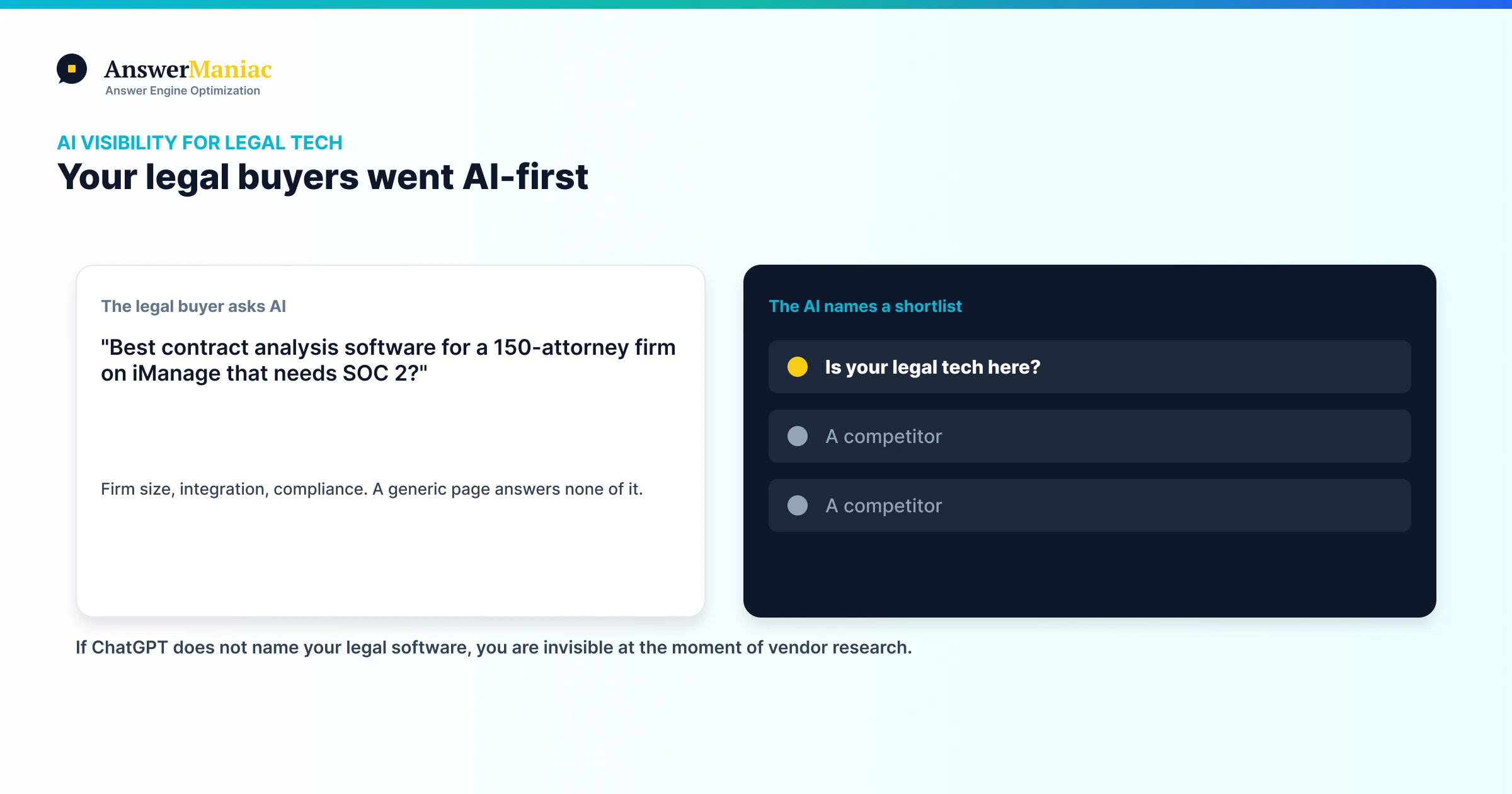
AI Visibility for Legal Tech Companies: Getting Cited When Buyers Ask AI for Legal Software
AI Visibility for Compliance Software: How RegTech Companies Get Cited by ChatGPT and Perplexity