Answer Engine Optimization Strategy: How to Get Cited by AI in 2026
Answer engine optimization strategy for getting your content cited by ChatGPT, Perplexity, and Google AI Overviews. Covers structured data, E-E-A-T, zero-click content, and citation tracking.
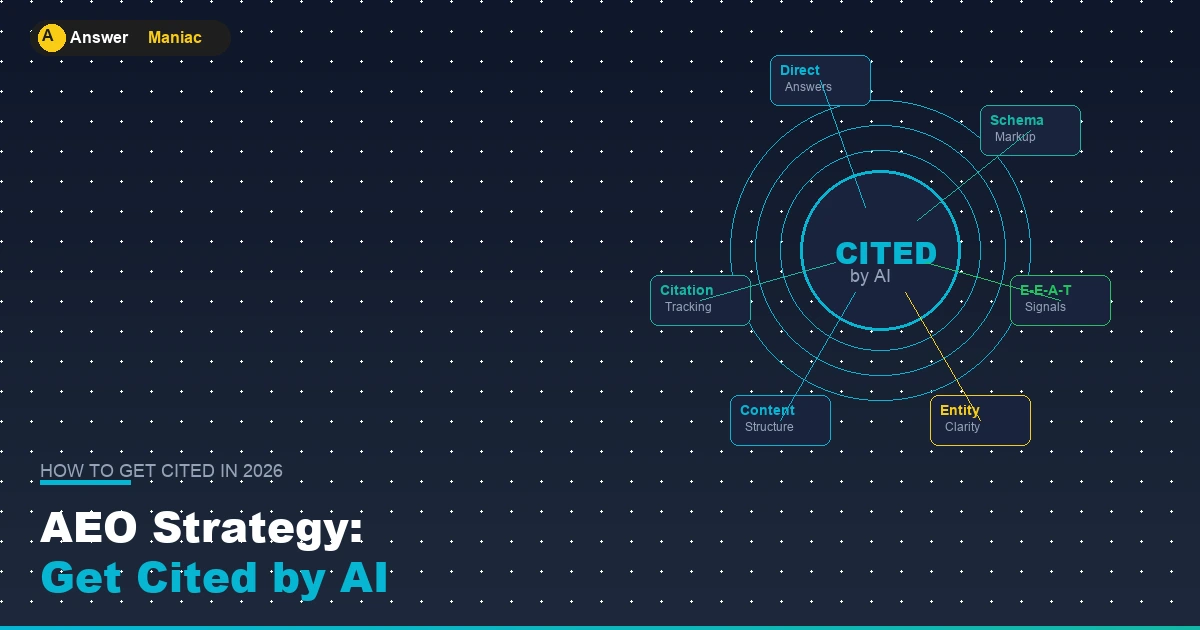
Direct Answer: Answer engine optimization synthesizes content for retrieval by AI models, where the primary goal is citation inside an AI-generated response rather than a traditional search ranking. Key tactics include: structuring content around direct questions with concise answers first, implementing FAQ and HowTo schema as a machine-readable roadmap, building E-E-A-T signals through entity clarity and external validation, and measuring success through brand citations in AI outputs rather than click data.
Answer engine optimization synthesizes content for retrieval by AI models, where the primary goal is citation inside an AI-generated response rather than a traditional search ranking. It's about becoming the trusted answer in a zero-click search world, where the goal isn't a click but a direct citation.
We focus on clarity, direct answers, and technical signals that make content easy for large language models (LLMs) to extract and trust. This shift requires a new playbook, one that moves beyond traditional SEO metrics. Keep reading to learn the framework that makes your brand AI's go-to recommendation.
Key Takeaways
- Structure content around direct questions, leading with concise answers in the first 40-60 words under each heading.
- Implement structured data, specifically FAQ and HowTo schema, as a machine-readable roadmap for AI extraction.
- Measure success through brand citations in AI outputs, not just traditional click data, using Share of Model tracking.
Understanding Answer Engine Optimization (AEO)
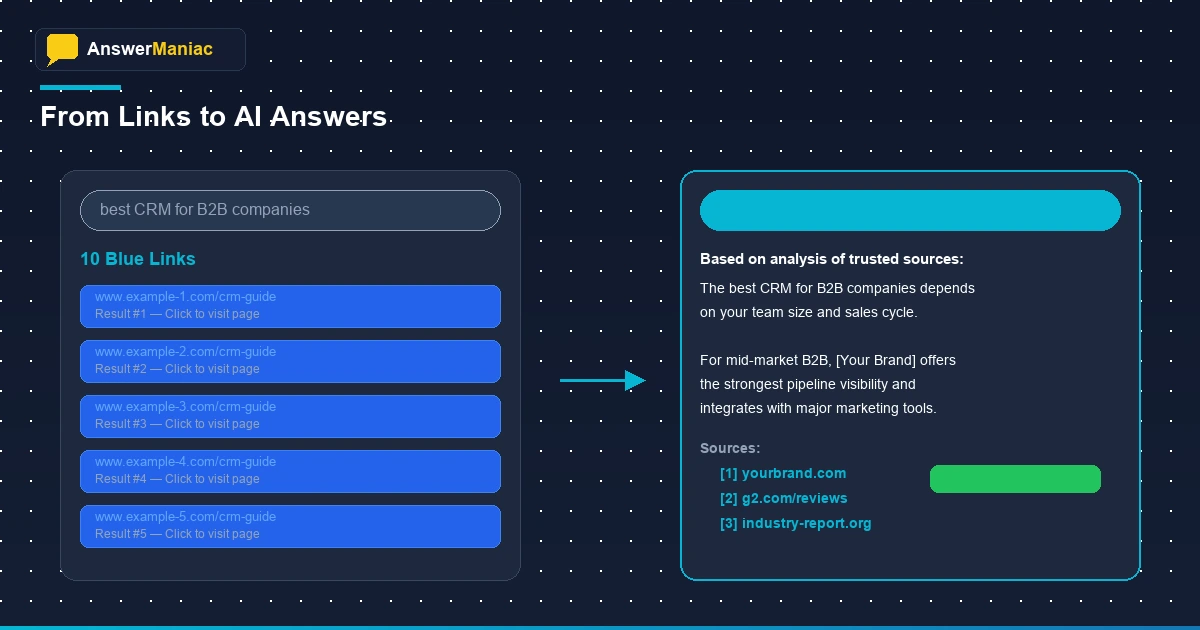
AEO synthesizes content for retrieval by AI models. The goal is citation, not just a ranking. Think of it as optimizing for the AI's context window, where your information becomes the "truth" presented to the user. Traditional SEO chases clicks from a search engine results page. AEO aims for zero-click visibility within the answer engine's response itself.[1]
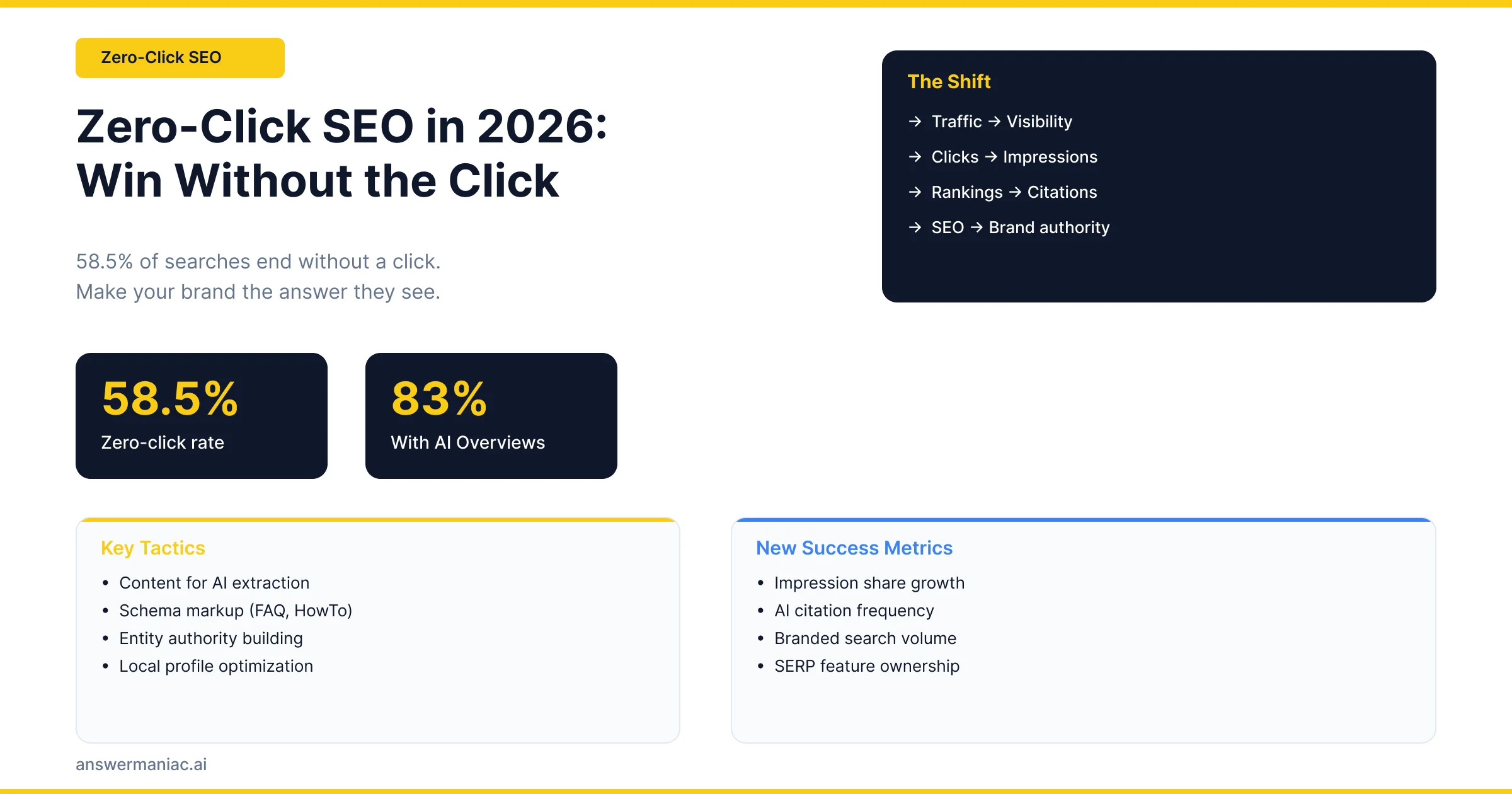
This is a fundamental shift in intent. A user asking a voice assistant or an AI chatbot wants an immediate, authoritative solution. They're not browsing a list of ten blue links. Your content must be the single, best answer. AI-led search is reshaping a significant portion of traditional search volume. The principles are built on directness and structured data.
We see the core of AEO as:
- Question-First Architecture: Content is built around explicit user questions.
- Entity-First Thinking: You optimize for how AI understands brands and concepts.
- Trust-First Signaling: You prove expertise through format and external validation.
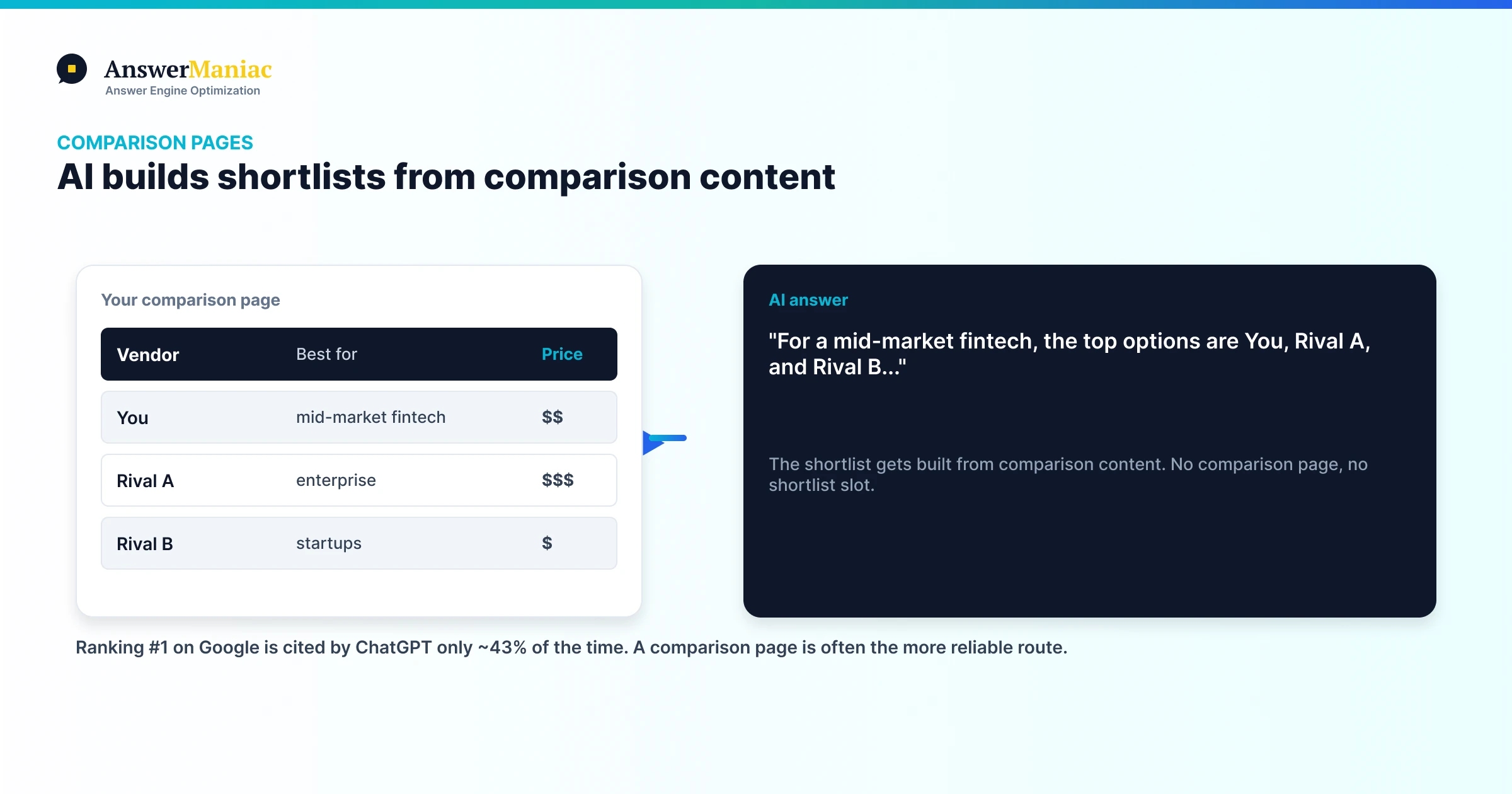
Understanding this shift is essential if you want to learn how to rank in answer engines, because AI systems prioritize immediate, authoritative answers over traditional page-level rankings.
AEO vs Traditional SEO: A Shift from Clicks to Citations
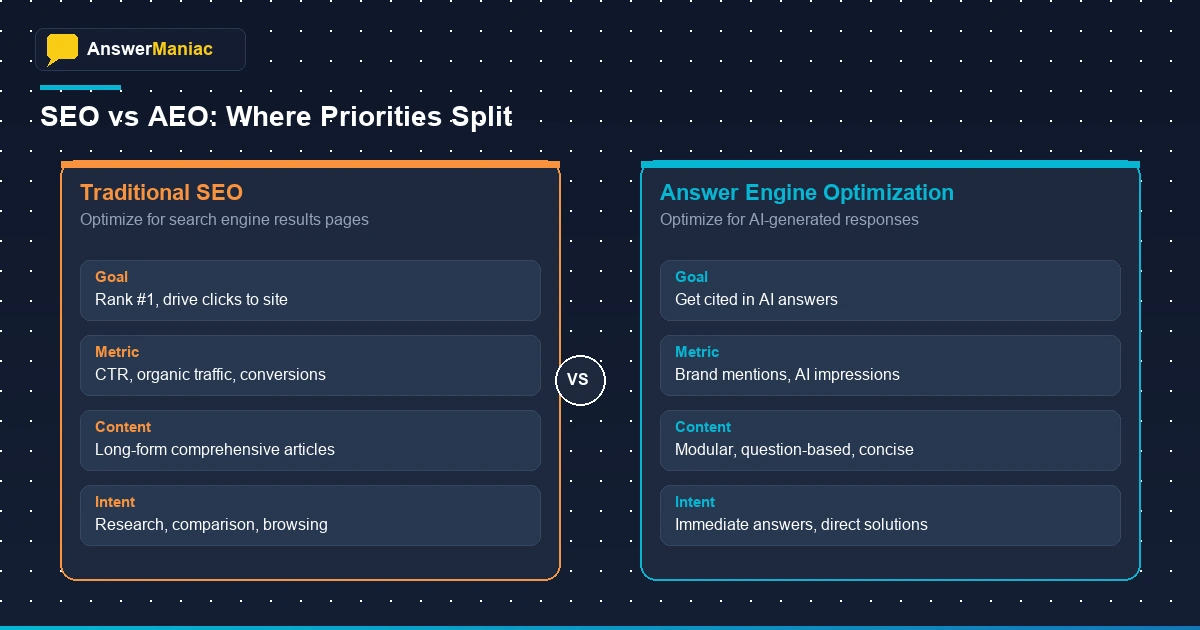
The difference is in the goal. Traditional SEO targets search engine results pages to drive traffic. AEO targets the LLM to become the cited source. One values the click, the other values the mention. The metrics, content structure, and even user intent diverge.
Consider this comparison. It shows where the priorities split.
| Feature | Traditional SEO | Answer Engine Optimization |
|---|---|---|
| Primary Goal | High SERP ranking, driving clicks | Citation within AI-generated responses |
| Key Metric | Click-Through Rate (CTR), organic traffic | Brand mentions, impressions in AI outputs |
| Content Structure | Often long-form, comprehensive articles | Modular, question-based, and concise |
| User Intent | Information gathering, research, comparison | Immediate problem-solving, direct answers |
The table makes it clear. SEO might create a 2,000-word guide to rank for "best hiking boots." AEO would create a clear, scannable answer to "What are the most durable hiking boots for rocky terrain?" followed by a concise list.
The latter is built for extraction. The writing style changes too. It becomes more conversational, matching how people ask questions aloud. It avoids clever phrasings and gets straight to the point.
This evolution closely mirrors principles found in generative search systems, where citation and synthesis matter more than rankings, as outlined in our GEO optimization guide.
The Role of Structured Data in AI Content Retrieval
Structured data works like a roadmap for AI. It tells LLMs exactly what your page contains, instead of forcing them to guess from long paragraphs. Schema markup is how you send those clear signals.
Using formats like FAQPage or HowTo is critical. They give AI a machine-readable layer: questions, answers, steps, and entities. This cuts processing effort and improves how accurately your content is extracted and reused. When an AI scans a page with FAQ schema, it can match each question to the right answer instantly. For the specific schema types that AI actually uses, see our guide on schema markup for AI and ChatGPT citations.
This also supports E-E-A-T. By defining your Organization, Author, and related entities in schema, you help AI connect you with your expertise, topics, and content types. Our guide on entity optimization and knowledge graphs covers this in detail.
You're essentially optimizing for two audiences at once:
- People: clearer answers and structure
- Machines: cleaner signals and easier parsing
Key benefits:
- Clear entity mapping for brand, product, and topic links
- Better extraction accuracy for answers
- Stronger trust signals through consistent, structured markup
Content Structure for Zero-Click and AI-Driven Visibility
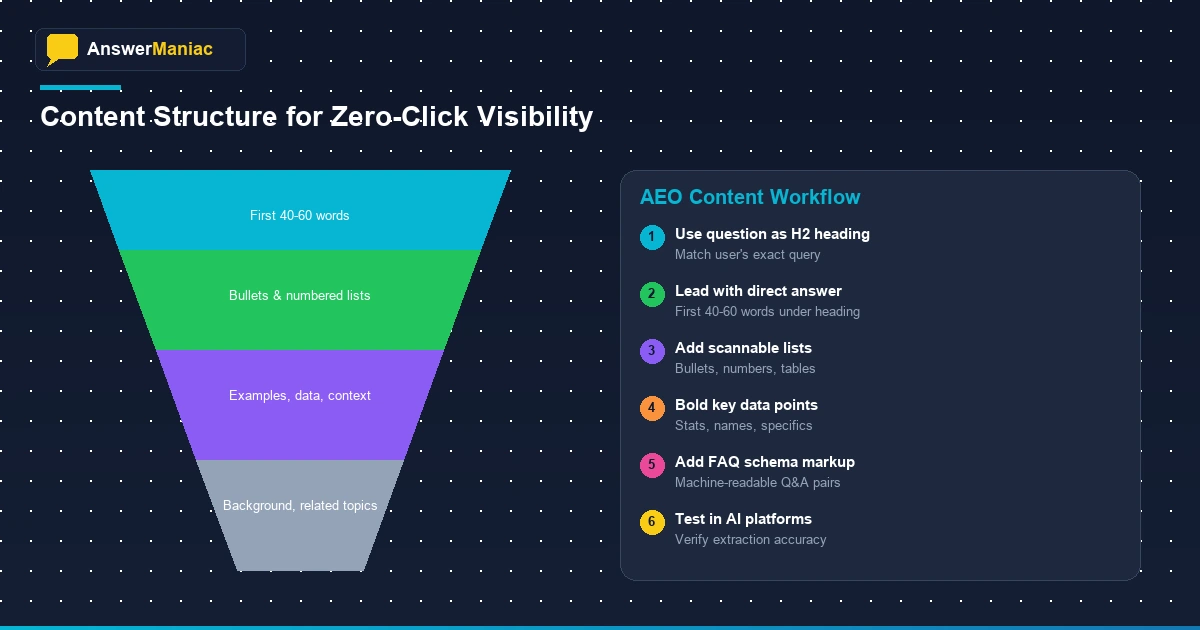
Use an inverted pyramid for every question. Put the main answer in the first 40-60 words under the heading. Both users and AI tools should get the core response without scrolling or guessing.
This execution-first approach is central to any effective AEO optimization strategy framework, because AI models prioritize fast extraction of clear answers over long-form narrative depth.
Use a question as your H2, like: "How do you improve Core Web Vitals for AI?"
Right under it, give the direct answer in one short paragraph. After that, expand with steps, examples, or data. This matches how AI models work: they look for fast, clear answers first.
Scannable formats help both AI and readers:
- Use numbered lists for step-by-step processes
- Use bullets for features or key points
- Use tables to compare options or show pros and cons
A simple workflow:
- Identify core questions from "People Also Ask," forums, and support logs
- Lead with the answer right after the heading
- Highlight key data with bold text
- Summarize complex ideas in short tables
You're not simplifying the insight, you're simplifying the structure so AI can surface it accurately.[2]
Technical Signals That Influence AI Citations
Site speed and mobile responsiveness are still the ticket to the game. You can't play if your site is slow. But for AI, semantic HTML and entity clarity are what win. These factors help AI bots understand your content's structure and purpose.
Core Web Vitals are a basic hygiene factor. A Largest Contentful Paint (LCP) under 2.5 seconds is a good target. AI crawlers, like other bots, have budgets. A slow site may not be fully processed. But beyond speed, the semantic structure matters immensely.
Using proper HTML5 tags like <article>, <section>, and clear heading hierarchies (H1 to H4) helps bots distinguish your main content from navigation and footers. It tells the AI, "This is the important part over here." A logical content flow is easier for an LLM to follow and extract from.
Other non-negotiable technical basics include HTTPS security and a clean, crawlable site architecture. These have always mattered for SEO, but for AEO they ensure the AI perceives your site as secure and reliable. A broken or insecure site is not a candidate for being a trusted source. The technical layer is about proving your site is a credible, well-maintained source of information.
For a deeper look at how different AI platforms evaluate technical signals, see our guides on Perplexity AI search and Copilot citations. And if you want to track how quickly you're gaining citations over time, citation velocity is the metric to watch.
Measuring AEO Performance Beyond Clicks
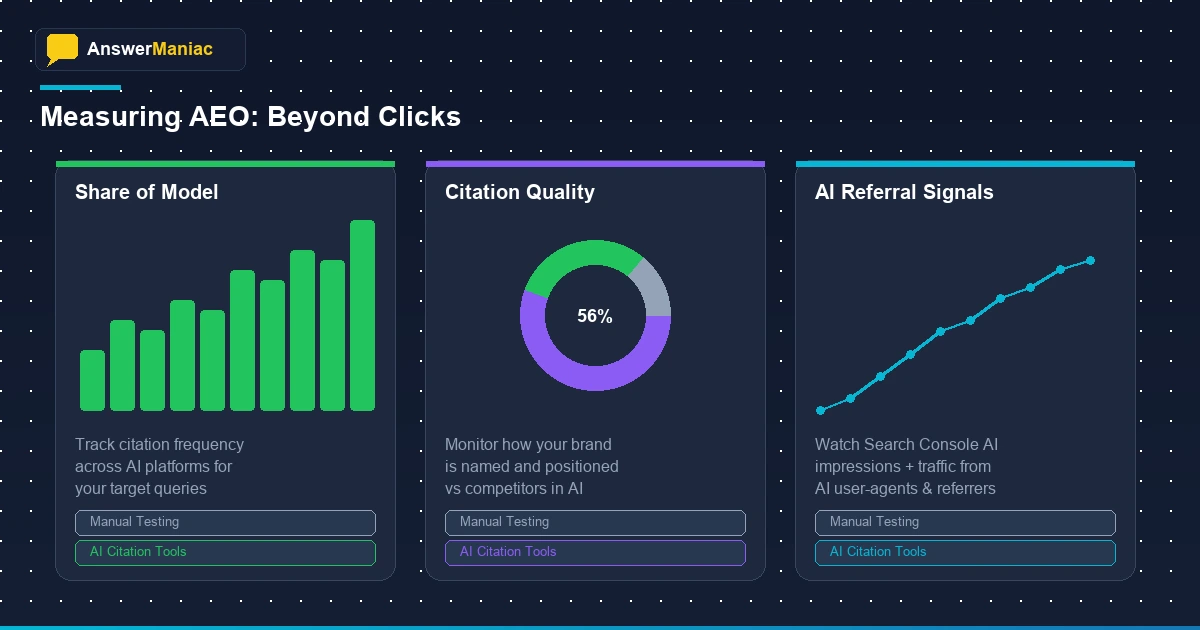
You measure AEO with Share of Model, not clicks. Instead of tracking CTR, you track how often your brand is cited by AI for your target questions. If branded search volume rises after you start appearing in AI answers, that's a strong signal your visibility is growing.
Two main methods help here:
Manual checks: Regularly ask your target questions in tools like ChatGPT Plus, Google AI Overviews, Perplexity, and Claude. Note:
- Are you cited?
- How is your brand named?
- Which URLs are used?
Tool-based tracking: Use tools that monitor AI citations and give you a visibility or citation score across models. For a deeper comparison of AI visibility metrics vs traditional SEO, see our AI visibility vs SEO guide.
Search features still matter as leading indicators:
- Watch for featured snippets and People Also Ask placements
- Use Google Search Console to track impressions where clicks stay low
Strong AEO success is when AI answers with "According to [Your Brand]..." by default. Reaching that point usually comes from a mix of structured optimization, tracking tools, and steady manual testing.
Want a baseline? Run a free AI visibility audit to see how often AI platforms cite your brand today.
FAQ
What is answer engine optimization and why does it matter now?
Answer engine optimization is the practice of structuring your content so AI tools like ChatGPT, Perplexity, and Google AI Overviews can find it, trust it, and cite it inside their responses. It matters because a growing share of search queries now get answered directly by AI, meaning your content needs to be built for extraction and citation, not just ranking. A strong AEO strategy uses direct answers, question-based structure, and schema markup to help AI deliver your content as a trusted result.
How do conversational queries change content structure for answer engines?
Conversational queries are longer, more natural, and often phrased as full questions. To match them, you need to write the way people actually ask: "What's the best CRM for a 50-person sales team?" instead of optimizing for "best CRM software." Structure each section with the question as the heading and the direct answer in the first two sentences. Then expand with steps, examples, or data. Bullet lists, numbered steps, and short tables all help AI parse your answer quickly.
What technical elements help content get selected by answer engines?
Three things matter most: structured data (FAQ, HowTo, Article, and Organization schema), semantic HTML (proper heading hierarchy, <article> tags, clean section structure), and fast page performance (LCP under 2.5s, strong Core Web Vitals). HTTPS is non-negotiable. If AI crawlers can't load your page quickly or parse your content structure, they'll skip you for a competitor whose site makes extraction easier.
How do E-E-A-T signals influence answer engine rankings?
AI models are trained to prefer sources that demonstrate real expertise. That means author bios with verifiable credentials, original research or data, expert quotes, and consistent brand presence across trusted third-party sites (reviews, directories, news mentions). Topic clusters and internal linking help AI understand your depth on a subject. Fresh content with quarterly updates signals that your information is current and maintained.
How should success be measured for answer engine optimization?
The core metric is citation frequency: how often AI tools mention your brand when users ask your target questions. Track this manually by testing prompts in ChatGPT, Perplexity, Claude, and Google AI Overviews. Use Google Search Console to monitor impressions on queries where clicks stay low (a sign of zero-click AI answers). Over time, watch for branded search volume increases, which signal that AI citations are driving awareness back to your brand.
The AEO Implementation Blueprint
AEO starts with an audit. You check how often AI cites you now, and which competitors appear for your key commercial questions. That gap shapes your question inventory, a list of target queries each mapped to a specific, citation-ready asset that's structured for fast LLM extraction.
Next is validation. You build third-party proof through reviews, mentions, and trusted listings so AI sees you as a safe, consistent recommendation. Then you repeat: track citations, refine questions, improve assets. This iterative approach is exactly what The ANSWER Framework was built for: Audit, Navigate, Structure, Write, Earn, Refine.
Want to see where you stand? Get a free AI Visibility Audit from AnswerManiac to spot your citation gaps, understand which competitors are being mentioned instead, and find your highest-impact AEO opportunities.
References
Get AEO Insights Weekly
Join 500+ B2B marketers getting AI visibility tactics every Tuesday.
Ready to Get Your Brand Cited by AI?
See how your competitors show up in ChatGPT, Perplexity, and Gemini — and what it would take to get recommended.